
In a parliamentary democracy, the legitimacy to govern is determined on the floor of the House, not through gubernatorial discretion or political speculation
Published Date – 13 May 2026, 12:00 AM
By Dr Ahmed Raza
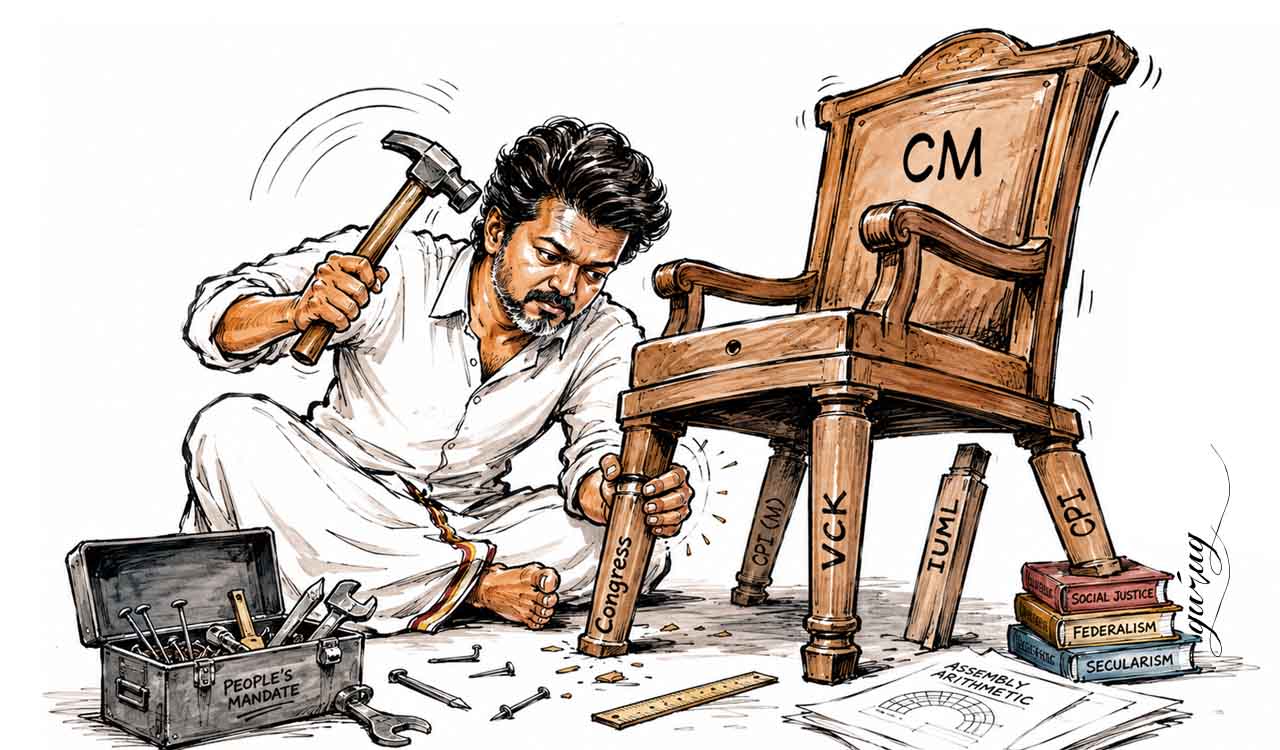
The recent Tamil Nadu Assembly election has triggered an important constitutional debate regarding the powers of the Governor in a hung Assembly. The controversy arose when Tamilaga Vettri Kazhagam (TVK), led by Vijay, became the single largest party with 108 seats in the 234-member Assembly but was not immediately invited to form the government.
The Governor insisted that the party furnish proof of support from at least 118 MLAs, the majority mark, before the swearing-in of the Chief Minister. This development revived the long-standing debate over the Governor’s discretionary powers, democratic mandate, and constitutional morality in India’s parliamentary democracy.
A hung Assembly occurs when no single political party or pre-poll alliance secures an absolute majority in the legislature. In such circumstances, the Constitution entrusts the Governor with the responsibility of ensuring that a stable government is formed. However, the Constitution does not clearly define how the Governor should exercise this discretion, leading to repeated controversies across Indian States.
Constitutional Position of the Governor
The Governor’s powers regarding the appointment of the Chief Minister are derived from Article 164(1) of the Constitution. It states that the Chief Minister shall be appointed by the Governor, and other ministers shall be appointed on the advice of the Chief Minister. Although ministers hold office during the “pleasure of the Governor,” this phrase does not imply personal or arbitrary authority. In a parliamentary democracy, the Governor is expected to function according to constitutional conventions and democratic principles.
Normally, the Governor acts on the advice of the Council of Ministers. However, in situations where no party secures a majority, the Governor exercises discretionary power in deciding whom to invite to form the government. This discretion is expected to be neutral, constitutional, and guided by established conventions rather than political preferences.
The primary aim of the Governor’s role in a hung Assembly is administrative rather than political. The Governor’s duty is to ensure that the State does not remain without an elected executive and that a stable government commanding the confidence of the House is formed at the earliest.
Sarkaria and Punchhi Commissions
To reduce ambiguity in such situations, the Sarkaria Commission (1983) and the Punchhi Commission (2007) laid down guidelines regarding the order of preference the Governor should follow in inviting parties to form a government. The recommended order is: A pre-poll alliance commanding a majority, the single largest party with support of others, a post-election coalition where all partners join the government and a post-poll alliance with outside support.
These commissions also emphasised that majority support should always be tested on the floor of the House and not decided privately by the Governor. The recommendations sought to minimise arbitrariness and preserve democratic legitimacy. In the Tamil Nadu case, many constitutional scholars argued that the TVK, as the single largest party, should have been invited first and allowed to prove its majority through a floor test within a short period.
Importance of Floor Test
The floor test has become the most accepted constitutional mechanism for determining majority support. It ensures transparency, legislative accountability, and democratic legitimacy. Instead of subjective assessments by Governors, the elected Assembly itself determines whether the government enjoys majority confidence. The Supreme Court has repeatedly reinforced the principle that majority should be tested only on the floor of the House.
The recommendations of the Sarkaria Commission and Punchhi Commission on non-partisan appointments and limited discretionary powers must be implemented in letter and spirit
Karnataka Crisis (2018)
One of the most important precedents was the Karnataka political crisis of 2018. In that election, the BJP emerged as the single largest party but lacked a majority. The Congress and the JD(S) formed a post-poll alliance and claimed majority support.
Governor Vajubhai Vala invited BS Yediyurappa to form the government and granted 15 days to prove majority. The Congress–JD(S) alliance approached the Supreme Court, alleging that the long period would encourage horse-trading and defections. The Supreme Court, led by then Chief Justice Dipak Misra, refused to stay the swearing-in but drastically reduced the time for the floor test to 36 hours.
Eventually, the BJP failed to prove majority and resigned, allowing the Congress–JD(S) alliance to form the government. The case established an important constitutional principle: delays in floor tests may encourage political manipulation, and quick floor tests are essential for preserving democratic integrity.
Uttarakhand Crisis (2016)
Another important precedent emerged during the Uttarakhand constitutional crisis of 2016. The Supreme Court declared that the floor test is the “ultimate constitutional mechanism” to determine majority support. The court ordered then Chief Minister Harish Rawat to prove majority on the Assembly floor.
This judgment strengthened the constitutional convention that Governors should avoid subjective determination of majority and instead rely on legislative procedures.
Constitutional Concerns
The controversy also highlights several structural issues in Indian federalism.
- First, the Constitution does not clearly define the precise limits of gubernatorial discretion. This ambiguity often leads to conflicting interpretations.
- Second, Governors are frequently accused of acting in favour of the Union government or particular political parties, thereby weakening federal balance.
- Third, delays in government formation can create political instability, administrative paralysis, and encourage unethical political practices such as defections and inducements.
- Finally, repeated controversies involving Governors weaken the spirit of cooperative federalism and erode public trust in constitutional institutions.
Course Correction
To prevent such controversies, several reforms have been suggested. There should be clearer constitutional conventions or even codified guidelines regarding the order of preference in inviting parties to form governments in hung Assemblies. Mandatory and time-bound floor tests should become standard practice.
Governors must function as politically neutral constitutional heads and avoid any appearance of partisanship. The recommendations of the Sarkaria and Punchhi Commissions regarding non-partisan appointments and limited discretionary powers should be seriously implemented. Judicial oversight must also continue to ensure that constitutional morality prevails over partisan politics.
The Tamil Nadu controversy once again demonstrates the delicate balance between constitutional discretion and democratic legitimacy in India’s parliamentary system. While the Governor possesses certain discretionary powers, these powers are not unlimited and must operate within constitutional morality, democratic conventions, and federal principles.
The consistent position of the Supreme Court has been clear: the true test of majority lies not in Lok Bhavan but on the floor of the legislature. In a democracy, elected representatives assembled in the House, and not constitutional speculation, determine who has the confidence to govern. The Tamil Nadu episode, therefore, serves as an important reminder that constitutional offices must uphold democratic values above political considerations.
(The author is Assistant Professor, Department of Public Administration MANUU, [A Central University], Hyderabad)