
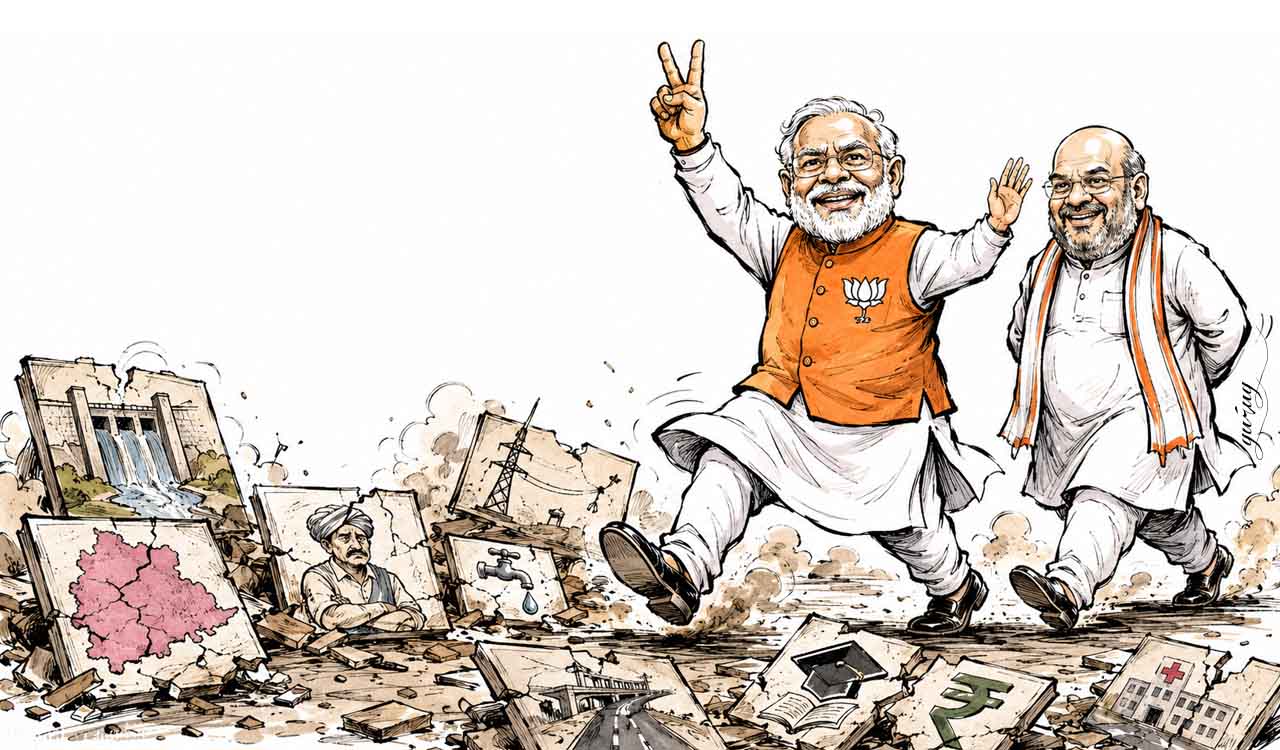
The Centre-led by Narendra Modi has consistently prioritised political loyalty over federal cooperation, denying Telangana its fair share of resources
Published Date – 7 May 2026, 11:00 PM
By Kiran Kumar Jupally
The recurring rhetoric from top BJP leaders, including Prime Minister Narendra Modi’s repeated assertions that the “mother was killed to save the child” and Tejasvi Surya’s recent comparison of bifurcation to the Partition, constitutes a systematic assault on Telangana’s dignity. By labelling the State’s formation as “arbitrary” or “haphazard,” these leaders consistently undermine the constitutional legitimacy of a State born from decades of democratic struggle and immense sacrifice. This narrative is a direct attack on the self-respect of the Telangana people for their hard-won identity for self-governance.
These remarks cannot be viewed as isolated incidents but rather as the ideological justification for a decade of perceived systemic injustice, in which the Union government consistently sidelined the State’s developmental needs and financial rights.
When the Andhra Pradesh Reorganisation Act was signed into law in 2014, the people of Telangana were told that their long wait was finally over. A decade later, the Central government under Prime Minister Narendra Modi has reduced those promises to hollow words, dry ink on unread paper. What was supposed to be a new dawn has become a decade of deliberate neglect.
The Broken Covenant
The AP Reorganisation Act, 2014, was not merely a political document; it was a covenant between the Indian state and the people of Telangana. It listed specific assurances: a Bayyaram Steel Plant, an IIM, a Rail Coach Factory, and dedicated institutions for a newly carved State that deserved its fair share of national resources. Despite AP getting numerous institutions like the IIT, NIT, IIM, IIITDM, IISER, IIPE, Tribal University, Central University, NID, IIFT, ICI, NIOT and NIDM in a decade, Telangana was awarded just one – a Tribal university in 2023 with no permanent buildings yet in more than two years.
The Bayyaram Steel Plant, promised under the 13th Schedule of the Act, remains a distant dream, with no clear timeline or commitment from the Centre, which has stuck to a technical argument citing low-quality iron ore. While many steel plants, such as Vizag Steel Plant, JSW Steel (Dolvi Plant), Durgapur Steel Plant (WB), and Essar Steel (Gujarat), operate on imported raw materials from other States, the central government refuses to treat Bayyaram on similar lines.
Denying a rail coach factory to Telangana, the Prime Minister established one in Gujarat at a cost of Rs 21,000 crore. This was not a policy decision but political favouritism carved in stone. Regional development packages for backward districts like Khammam and Mahabubnagar are gathering dust while the Centre as usual looks the other way.
The Water War
Water is life. In Telangana, it is also politics, history, and survival. The demand for national status for irrigation projects like the Kaleshwaram Lift Irrigation Scheme or the Palamuru-Rangareddy LIS remains unanswered, while Polavaram in AP and the upper Bhadra in Karnataka have got national status.
The bifurcation Act mandated the formation of the Krishna River Management Board (KRMB) and the Godavari River Management Board (GRMB) to ensure equitable sharing of river waters between Telangana and Andhra Pradesh. The boards were constituted in 2014. But their operational jurisdiction was notified only seven years later, in October 2021, which means seven years of inaction, during which Andhra Pradesh undertook unilateral projects, drew water outside its allocated share, and left Telangana scrambling for relief.
After a decade of broken promises and perceived neglect, Narendra Modi and the BJP have lost the moral authority to seek another mandate from Telangana
Five years have passed since 2021, and even today, both boards that were supposed to manage 36 projects in the Krishna basin and 71 in the Godavari basin are stuck to a limited capacity, monitoring reservoir levels and holding meetings with no conclusions. The Centre’s inaction has a human cost. Drought-prone districts of erstwhile Mahabubnagar, Nalgonda, and Khammam, among the most water-stressed in the country, continue to suffer while New Delhi fiddles with procedural delays and political calculations.
The Funds Famine
The BJP’s treatment of Telangana, a net contributor to the national exchequer, is not federalism but a financial extortion dressed as governance. A State is punished for its democratic choice by being denied its constitutional entitlements. In a true federal democracy, central funds follow constitutionally mandated formulas, not political loyalty tests.
Under Modi, that principle has been systematically violated. Over six financial years (2019-25), Finance Ministry data reveals that Telangana contributed roughly 3.87% to India’s total tax collections during this period, but it received only about 2.45% of the total Union transfers. In sharp contrast, Uttar Pradesh and Bihar, which have BJP governments, get 15.82% and 8.66% of the total Union transfers despite contributing to just 4.6% and 0.68%.
Hyderabad Metro Rail
Since 2014, 38 metro rail projects with a total length of 1,051 km at an estimated completion cost of about Rs 3.44 lakh crore have been sanctioned by the Government of India to different States. Hyderabad Metro Rail has received just Rs 1,639 crore as Viability Gap Funding for phase 1. Phase II, a Rs 24,269 crore expansion of 76.4 km across five corridors, has been stuck in “active consideration” and “technical evaluations” for years. Budget after budget has passed without a specific allocation for this critical urban infrastructure project.
Meanwhile, Chennai Metro Phase II was approved as a central sector project in October 2024, with the Centre financing nearly 65% of its estimated cost. Why is the same political will not extended to Hyderabad? Why does a city of over 10 million people, India’s fourth largest, have to watch neighbouring cities receive central approvals while its own expansion sits in ministerial in-trays?
Hyderabad is India’s IT and pharma capital. It drives significant national export revenue. Yet when it comes to funding the infrastructure that keeps this engine running, the Centre looks the other way. The disparity in treatment is not accidental. It is a policy of punishment.
Modi, the modern-day Kaikeyi
To facilitate the Polavaram irrigation project, the central government passed an ordinance in July 2014 transferring seven mandals from Telangana’s Khammam district to Andhra Pradesh. This legal move, later ratified by Parliament, was intended to prevent administrative hurdles since the project’s submergence zones fell within these specific areas. The transfer shifted the mandals of Chintoor, Kunavaram, Vararamachandrapuram, Bhadrachalam (partial), Kukunoor, Velairpadu, and Burgampahad into the residuary State.
While the Bhadrachalam temple structure remained in Telangana after the 2014 reorganisation, the transfer of seven mandals to Andhra Pradesh created a major geographical split.
This shift resulted in a “peculiar situation” where the temple’s historic land assets, including over 1,000 acres, now fall under the territorial jurisdiction of Andhra Pradesh. Key areas like Purushothapatnam, which hold significant endowment lands, were part of the villages moved to facilitate the Polavaram project. This makes Modi the modern-day Kaikeyi who separated Lord Rama from rightfully owning his assets.
Legislative Changes
The promise to increase the number of Assembly seats in Telangana from 119 to 153 as per the AP Reorganisation Act has not been implemented, citing legal and technical reasons.
Uppal Flyover, Downgraded RRR
While the central government boasts of excellent performance in building roads across the country, a 6.2-km six-lane Uppal Elevated Corridor initiated around 2018 is yet to be completed. A 15-minute commute from Jeedimetla to Bowenpally now takes almost an hour, thanks to the snail-paced construction of the Bowenpally–Medchal NH 44 flyover, which has been underway since 2022. With no completion in sight, daily commutes have turned into a nightmare, especially for ambulances from Northern Telangana struggling to reach Hyderabad’s life-saving hospitals.
Adding another feather to its injustice cap, the Central government has decided to scale down the proposed Regional Ring Road (RRR) by changing its nomenclature from an access-controlled expressway to a regular National Highway. This decision also reduces several RRR unique features, including the reduction of the maximum speed limit from 120-130 kmph to 100 kmph and an 8-lane road converted to a 6-lane one.
Initially, service roads were proposed for the RRR on the lines of ORR. However, the approved plan allows a vacant strip of land alongside the road, without the provision of a basic access road. Vehicles may need to travel a distance to take a U-turn.
Breaching the Trust
The Union government’s track record over the last decade is one of broken promises, procedural delays, and political favouritism. By consistently prioritising political loyalty over federal cooperation and denying Telangana its fair share of resources, Narendra Modi and his BJP party have forfeited the moral and political authority to seek further mandates from a State they have systematically marginalised. A vote is a contract of trust, and the Modi government has fundamentally breached that trust.
(The author is a semiconductor professional and IIT Delhi alumnus)