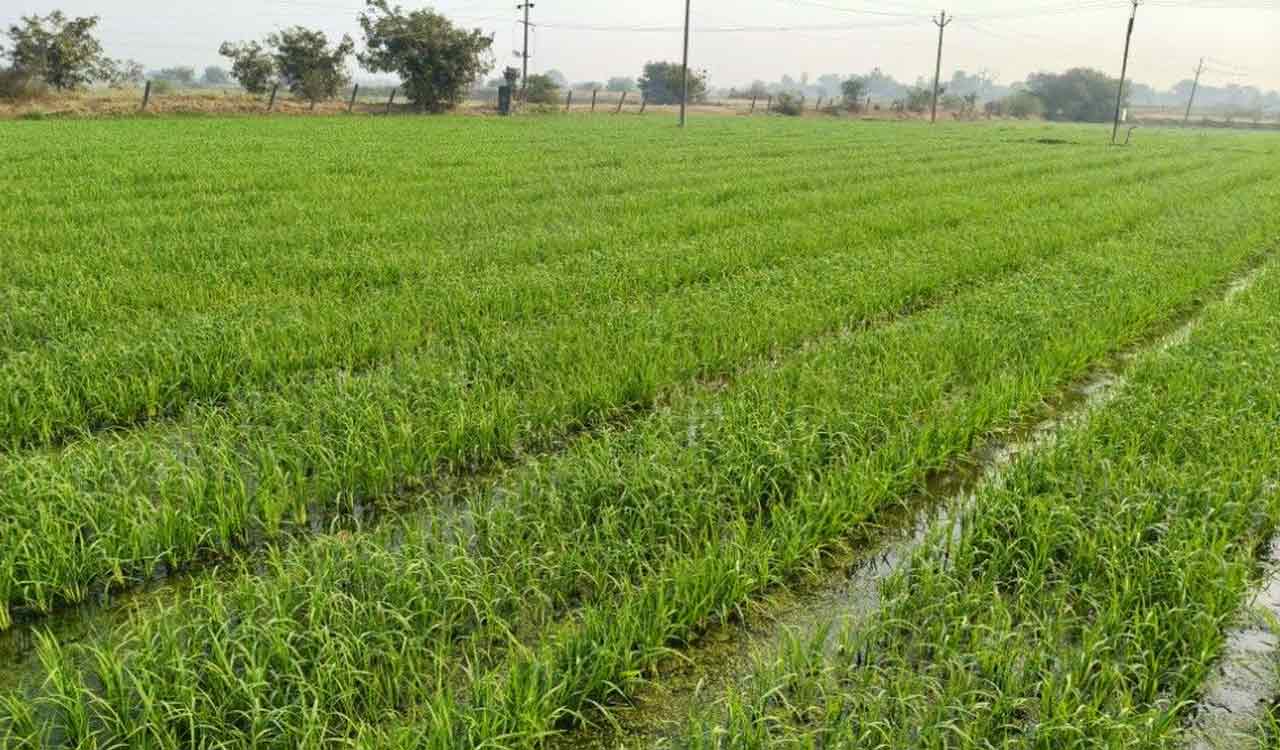
Hybrid paddy cultivation in Kumram Bheem Asifabad has expanded from 20 to 3,000 acres in eight years. Farmers adopting the male-female hybrid crop are achieving higher yields and profits, supported by favourable conditions and guidance from seed companies.
Published Date – 3 May 2026, 12:55 PM
Kumram Bheem Asifabad: What was once started as an experiment has become a trend over a period of time.
Cultivation of a male and female hybrid rice crop was initially grown in just 20 acres on a trial basis in Dahegaon mandal eight years ago. The area of cultivation of this crop has now gone upto 3,000 acres in this region. This manifold increase can be attributed to suitable conditions to raise the crop and the encouragement by seed manufacturers.
Enterprising farmers from remote Dahegaon region, known for raising the staple paddy crop yearly once, are setting an example to others by new crops and earning profits. A section of farmers from Dahegaon, Konchavelli, Pambapur, Odduguda, Laggam, Kalwada, Saligaon and Madavelli villages are increasingly coming forward to cultivate the hybrid rice paddy crop which can withstand pests and manufacturing of fertilizers as well in Yasangi season.
Agriculture officials reasoned that the land in these villages was conducive for such cultivating. They stated that the duration of the crop was 120 days. One can easily register a yield of 10 quintals and see higher returns when compared to that of conventional paddy varieties. They, however, farmers need to be familiar with certain intricacies to excel in growing the crop.
Unlike the traditional crops, this paddy crop is sown in rows—three lines of female plants and one line of male plants in January. The farmers are required to carefully manage two plants. They should carry out crossing of the two plants when it reaches the booting stage. They have to bring the two plants close to each other to spread pollen from the male to female lines.
In Spite of certain unusual tasks, the farmers say they are able to succeed in this farming with the help of private companies that provide guidance and supervision from crop transplantation stage to harvesting. They said that they were selling the produce for Rs 8,000 per quintal. They claimed that they were getting a profit of anywhere between Rs 40,000 and Rs 50,000 per acre.
The innovative farmers of Dahegaon belt have become role models to others by shining in cultivation of this paddy variety .