
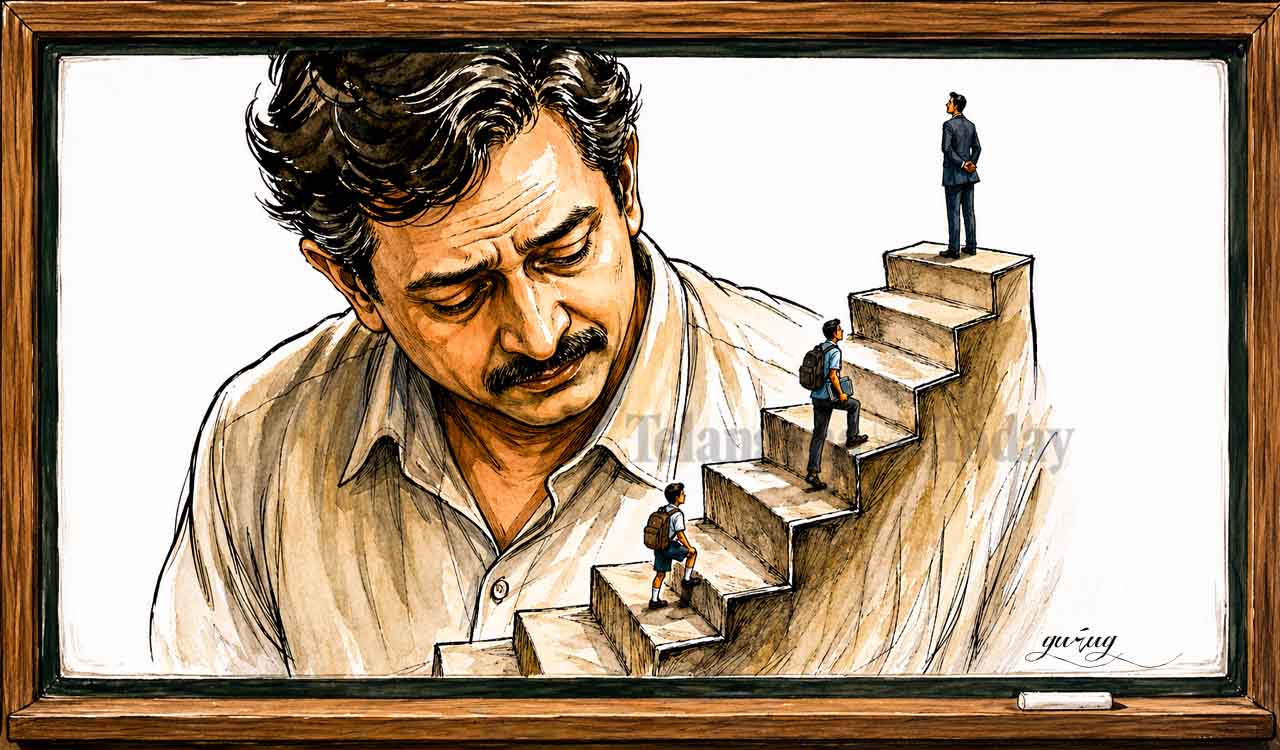
The debate shouldn’t focus on vacation length, but on ensuring teachers return motivated, respected, and fairly paid, with dignity and value
Published Date – 29 April 2026, 10:48 PM
By Dr Sreeramulu Gosikonda
India’s school teaching workforce has crossed 10 million, with government schools employing the majority and private schools steadily expanding, according to UDISE+ (2024–25). AISHE (2024–25) reported about 1.5 million faculty members in higher education, split almost evenly between public and private institutions.
Yet every summer, as schools close, a familiar refrain echoes: “Teachers have it easy—they get so many holidays.” This dismissal trivialises their role. Vacations are not indulgences but part of a system designed for students, while teachers use the time to prepare, update lessons, and recalibrate methods. As Émile Durkheim reminded us, education is how society reproduces itself—teachers are agents of social continuity.
Gurukul to Global Educator
The story of Indian teachers is as old as civilisation itself. In the Gurukul system, teachers were revered as acharyas, custodians of knowledge and morality. The dictum matru devo bhava, pitru devo bhava, acharya devo bhava placed teachers next only to parents and gods. Their role was not merely to impart literacy but to shape character, instil discipline, and transmit traditions.
Over centuries, this role evolved. From the Brahmin monopoly over education to the democratisation of learning through social reform movements, teaching shifted from privilege to right, from being restricted to the dwija castes to embracing Bahujan communities. Payment too transformed — from kind and cash offered by kings and elites to structured salaries under modern governments. Today, teachers straddle two worlds: the idealistic legacy of moral guardianship and the pragmatic demands of democratic equality.
Paulo Freire’s Pedagogy of the Oppressed reminds us that teachers must be both facilitators of critical consciousness and challengers of oppressive structures — a dual role deeply resonant in India’s journey from Gurukul traditions to globalisation.
Teaching is not only an art and a science but also a passion and a profession. As S Radhakrishnan once observed, “The true teachers are those who help us think for ourselves.” This passion for shaping minds has been the enduring thread across centuries.
Debating Salaries and Status in Telangana
The Telangana Education Commission’s 2026 report sparked heated debates by highlighting the “high salaries” of government school teachers. Instead of addressing the chronic underpayment of private school teachers, the report indirectly questioned whether government teachers deserved their pay scales. This narrative is dangerous. It shifts the spotlight away from exploitation in private institutions and creates resentment against government teachers who, in reality, shoulder immense responsibilities.
Market structures often determine private school salaries, with demand and supply dictating pay. But education is not a commodity to be traded like grain or steel. Basil Bernstein, the British sociologist, warned that when education is reduced to market logic, its symbolic and cultural functions are eroded. When private school teachers are denied decent wages, it is not just an economic injustice — it is a social betrayal.
By targeting government teachers rather than supporting private ones, policymakers risk discouraging talented youth from entering the profession altogether. The long-term consequence is clear: a decline in quality education, where nurturing the 21st century skills in the next generation becomes secondary to cost-cutting.
The Missing Merit in Teaching
Empirical studies confirm what anecdotal evidence has long suggested: bright, meritorious students rarely choose teaching as a career. The reasons are manifold — low salaries, lack of social prestige, bureaucratic hurdles, and the perception that teaching is a “soft option.” Yet teaching is anything but easy. It requires patience, empathy, and the ability to balance tradition with modernity. A teacher must be idealistic in values — honesty, integrity, discipline — while pragmatic in practice, ensuring equality, inclusivity, and the dismantling of outdated social hierarchies.
Telangana Education Commission’s 2026 report questions government teachers’ pay, ignores private school underpayment, and risks fuelling resentment against overburdened educators
Pierre Bourdieu’s theory of cultural capital is instructive here. Students from privileged backgrounds often avoid teaching because the profession does not confer the symbolic capital associated with high-status careers. Unless teaching is revalorised socially and economically, it will continue to repel those with the highest academic merit.
The irony is stark: society worships teachers in rhetoric but undermines them in reality. We call them “nation builders” yet deny them financial security. We expect them to embody democratic ideals and still subject them to undemocratic working conditions. As APJ Abdul Kalam reminded us, “Teaching is a very noble profession that shapes the character, calibre, and future of an individual.” If society ignores this nobility, it risks compromising its own future.
Empowering India’s Architects
Whether in a village school or a metropolitan university, teachers are architects of India’s future. They treat every child as their own, nurturing minds with patience and affection. The occasional negative incidents within educational institutions — often amplified by media sensationalism or attributed to “westernisation”—are exceptions, not the rule. The overwhelming majority of teachers remain committed to their vocation, despite systemic neglect.
To safeguard this commitment, India needs rigorous, updated, and holistic tests for teacher recruitment. But equally, it needs to ensure that once recruited, teachers are empowered — financially, psychologically, and socially. Missionary institutions that provide meals to staff after exam results are published exemplify how small gestures of dignity can make a big difference. Teachers are human beings, not machines.
Treating them with respect is not charity; it is a necessity. As Ivan Illich cautioned in Deschooling Society, education is dehumanised when institutions reduce teachers to bureaucratic cogs instead of recognising them as living guides. Krishna Kumar has argued that teachers are central to democratising education in India, bridging the gap between elite knowledge and everyday learners.
A Call to Think Beyond Vacations
The fixation on teachers’ holidays distracts from the urgent question of how society supports them. Beyond the classroom calendar, teachers shoulder invisible work — preparing syllabi, evaluating results, and planning for the year ahead. They take pride in their students’ growth, second only to parents, though society rarely acknowledges this devotion.
What deserves debate is not the length of vacations but whether teachers return to classrooms motivated, respected, and adequately compensated. Without this support, holiday discussions become a diversion from the reforms India’s education system urgently needs.
India stands at a crossroads. Globalisation demands competitive skills, technological literacy, and critical thinking—none of which can flourish without motivated teachers. Yet meritorious students increasingly shun the profession, deterred by poor pay and lack of dignity. The solution lies not in cutting government salaries but in raising private school pay, ensuring parity, and restoring respect.
Policymakers and civil society must shift the narrative: stop framing teachers as holiday takers, start recognising them as nation builders. Teachers’ vacations are not indulgences; they are the monsoon pause before the harvest of learning. If India fails to protect and empower its teachers, the harvest itself will wither. To honour teachers is to honour education.
(The author is Assistant Professor, Department of Sociology, Faculty of Social Sciences, Banaras Hindu University, Varanasi. Views are personal)