
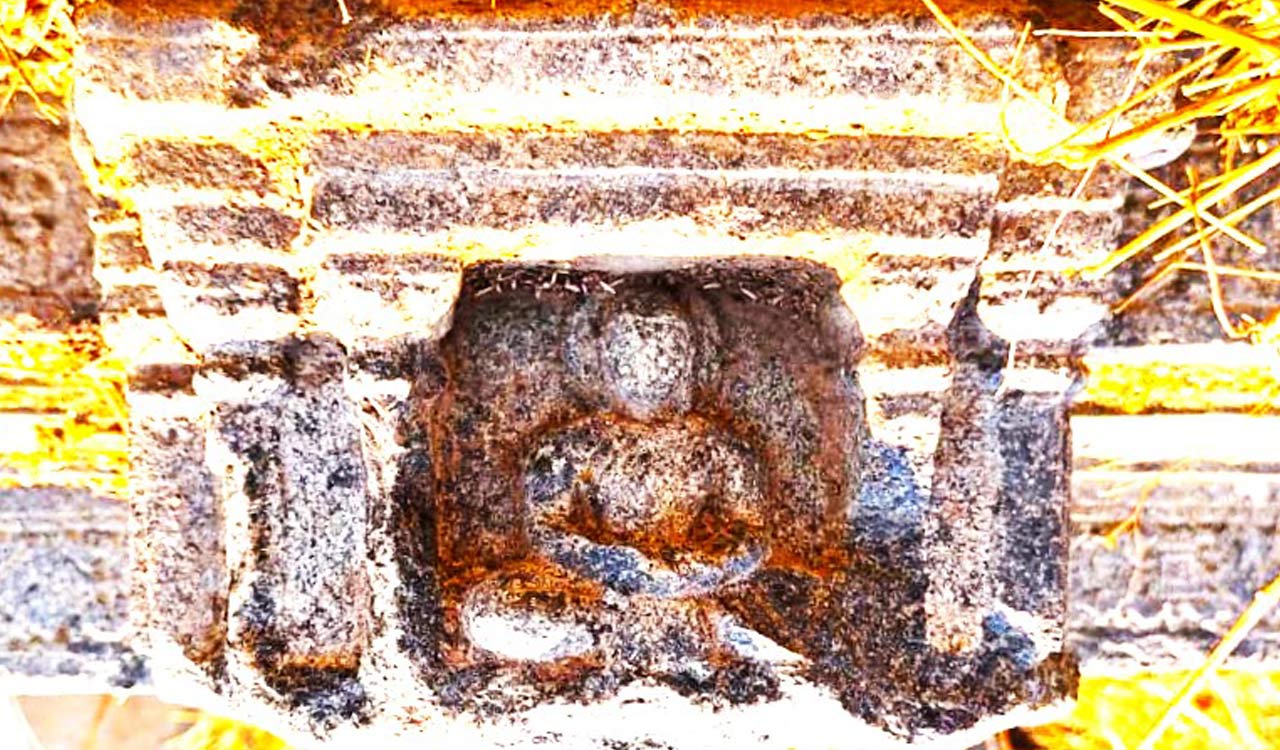
A member of Kotha Telangana Charitra Brundam has discovered the remains of a Jain Basadi near Jafargadh Fort. The find, supported by inscriptions and architectural elements, sheds light on Rashtrakuta-era history and religious structures in the region
Published Date – 28 April 2026, 02:45 PM
Hyderabad: Samudrala Raju, a member of the Kotha Telangana Charitra Brundam and a resident of Velpugonda, has discovered the remains of a Jain Basadi in the Patigadda area below the Jafargadh Fort.
From the inscription carved on the hill at Velpugonda by Shankaraganda Rasa, the representative, relative and administrator of Kolanupaka under the Rashtrakuta ruler Amoghavarsha, it is known that a fort (durga) was constructed here in the name of Amoghavarsha, a tank (kunda) was excavated, and a Jain Basadi existed at this location.
Until now, apart from Jain sculptures, a Jain Manastambha (pillar), and a few other Jain remnants found at Malchagutta, no trace of a Jain Basadi had been discovered.
With Samudrala Raju’s exploration, a significant historical structure has now been identified. Among the remains found here, the doorway (dwarabandham) of the Jain Basadi appears to have been very tall. The door jambs are carved in the pancha-shakha style with beautifully finished floral designs featuring swans and four-petalled gem-studded panels above.
This is a finely designed large doorway. On the lintel (lalata bimbam) of this fragmented doorway, a sculpture of Lord Mahavira is carved in a seated meditative posture under a patangam.
Sriramoju Haragopal, Convener, Kotha Telangana Charitra Brundam, said this lalata bimbam itself is strong evidence and historical proof that a grand Jain Basadi once existed in Jafargadh.
In the same area, Samudrala Raju has also identified two separate sculptures of Indrani and Brahmi belonging to different worship styles from the Saptamatrika (Seven Mothers) group, dating to the Rashtrakuta period.