
Forest department restrictions on tasar silkworm cultivation inside Pranahita Wildlife Sanctuary have alarmed 650 tribal families in Mancherial. Authorities cite conservation concerns, while officials say alternative land is being allotted to protect livelihoods and sustain sericulture activity.
Published Date – 25 April 2026, 01:15 PM
Mancherial: Forest department officials are denying permissions to the aboriginal tribals to cultivate silkworm cocoons of tasar, a variety of silk, in the forests situated in Pranahita Wildlife Sanctuary (PWS) in Chennur division for the first time.
Cultivating tasar cocoons has been an integral part of lives of the aboriginal tribals dwelling in remote villages in erstwhile Adilabad district for nearly 100 years. Considering their innate mettle proved in this field, the tribal welfare department has been supporting the farmers by extending a slew of services such as market linkage, production and supply of seeds, guidance, and upgrading their skills since 1982.
Currently, 650 tribals families, residing in remote yet forest-fringe villages in Vemanapalli, Kotapalli, Chennur, Kannepalli and Nennal mandals, have traditionally been excelling in sericulture for the past few decades. They grow silkworm cocoons in the forests of 14 villages in the five mandals. They are able to earn around Rs 1 lakh per annum by cultivating the cocoons.
“We are denied permission for the first time citing protection of wildlife in the sanctuary. The decision has come as a rude shock to us. We would lose livelihood if we were not allowed to grow the cocoons,” rued a senior tribal hailing from Vemanapalli mandal.
Forest officials said that the tribals, however, were alternatively allotted 3,000 hectares of land in Kotapalli, Chennur and Neelwai ranges, located outside the protected zone of PWS. Surveys were being conducted to identify the land suitable for cultivation of silkworms. A microplan was being jointly readied by the Forest and Sericulture departments, enabling the tribals to grow the cocoons without any hurdles.
Raising cocoons is risky affair
The tribals raise silkworm cocoons by risking their lives as they need to camp in the forests by facing attacks by wildlife for a temporary livelihood. Cocoons of tasar contain many insects that are processed to produce exquisite silk thread used in manufacturing saris and other clothing. They are cultivated on leaves of Terminalia Arjuna (Tellla Maddi) and Yeru Maddi trees grown in the land parcels.
Chennur produces 50 percent of silkworms
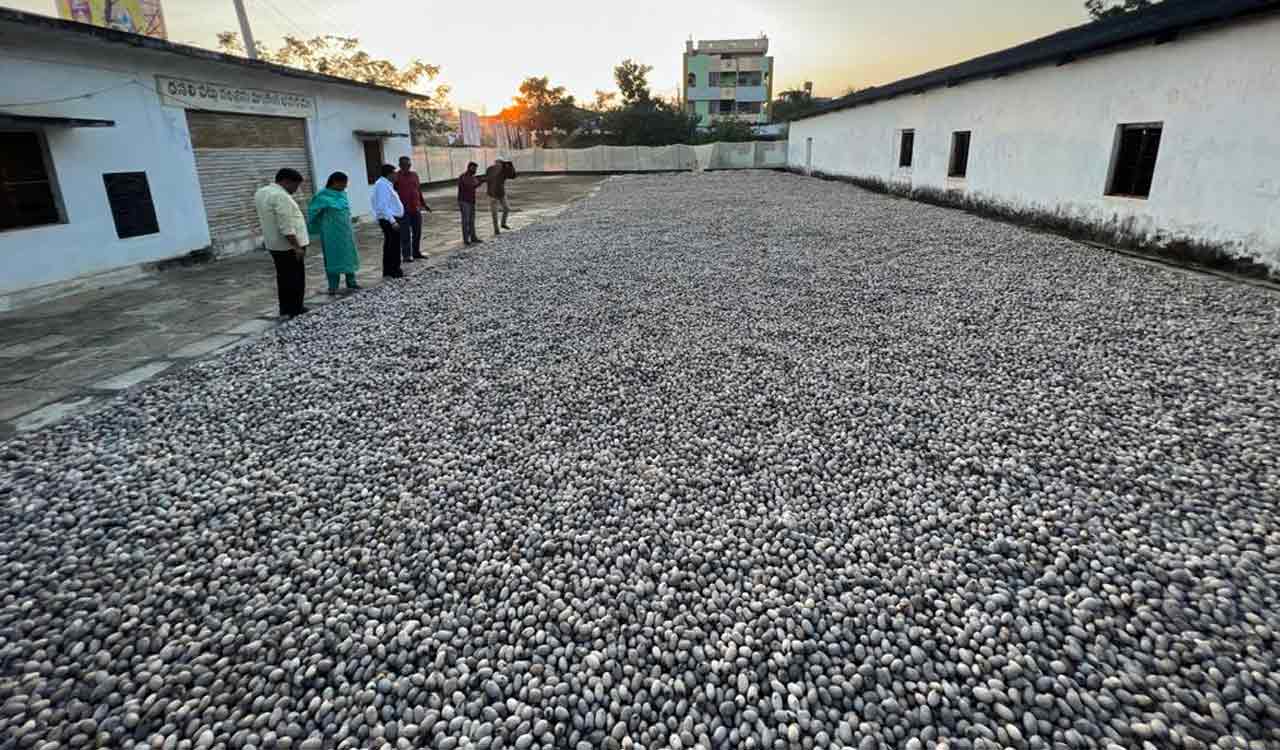
Tasar cocoons, procured from the tribals would be processed at a centre belonging to the Sericulture department in Chennur. They are sold to traders through an open auction. Traders belonging to Chhattisgarh, Jharkhand, Madhya Pradesh, West Bengal and many other parts of the country take part in the auction and buy the cocoons by quoting around Rs 6 per unit.
Eom with info for graphics
Tribal families that cultivate cocoon in district: 650
Mandals: 5
Villages: 14
Villages: Lingampalli, Kishtampet, Suddala, Kothapalli, Rajaram, Lingannapet, Bopparam, Kondampet, Parupelli, Pinnaram, Errayipet, Edulabandham, Mulkalapet, Manneguda
Tasar cocoon production in 2024: 29.10 Lakh
Total yield of tasar cocoons in 2023: 38 Lakh
Tasar cocoons produced in 2022: 24.10 Lakh
Target cocoons production in Telangana in 2024: 60 Lakh
Expected price to be quoted per cocoon in 2024: Rs 6.50
Price quoted per cocoon in 2023: Rs 5.10
Income earned by a farmer per annum: Rs 1 lakh
Silk traders from Chhattisgarh, Jharkhand, Madhya Pradesh, West Bengal show interest to buy tasar cocoons of Telangana
Cocoons of Tasar, a variety of silk, contain many insects that are processed to produce exquisite silk thread used in manufacturing saris and other clothing
Cocoons are traditionally grown by the tribals by camping in the forests as means of livelihood for many decades.
Cocoons are cultivated on leaves of Terminalia Arjuna (Tellla Maddi) and Yeru Maddi trees grown in the land parcels