West Bengal begins the first phase of its Assembly elections with around 3.6 crore voters across 152 constituencies. Heavy security deployment, electoral roll revisions and close contests between Trinamool Congress and BJP mark the high-stakes polls
Published Date – 22 April 2026, 06:32 PM
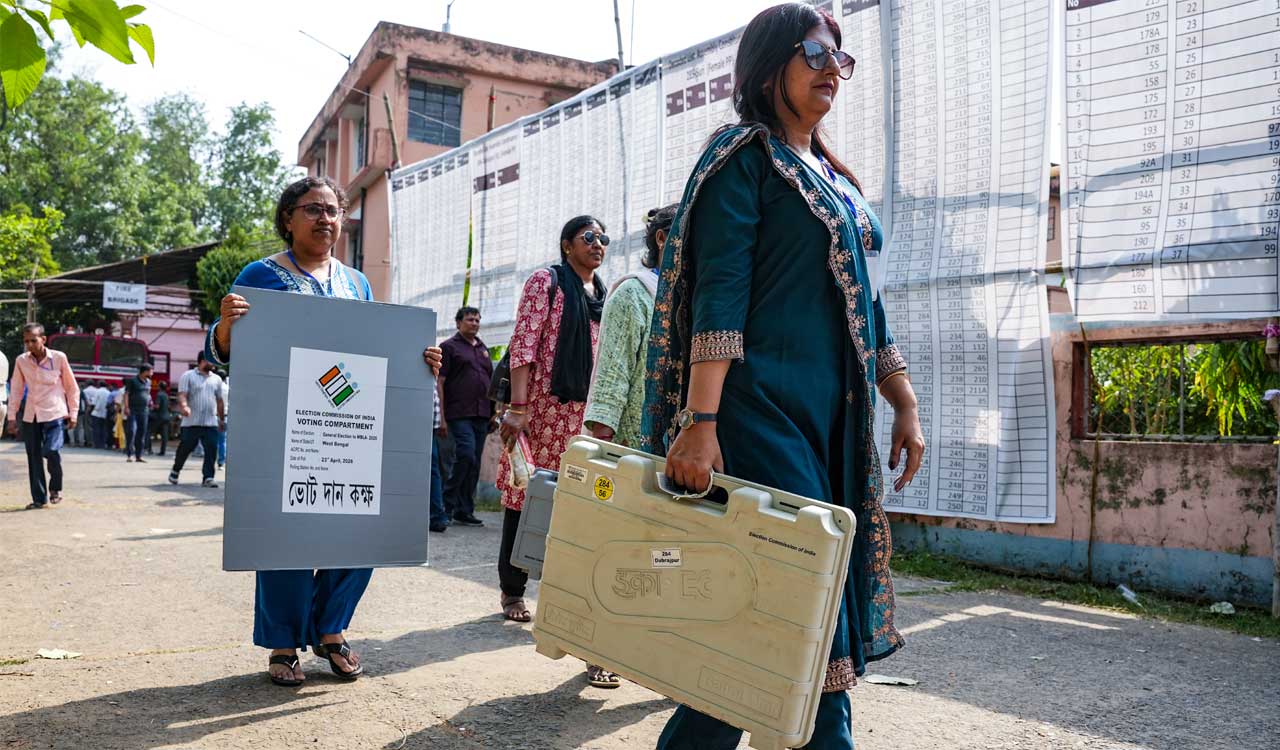
Kolkata: West Bengal goes to the polls on Thursday, in the first of the two-phase high-stakes, tightly-policed Assembly election, where about 3.6 crore voters are expected to exercise their franchise in roughly 44,000 polling booths across 152 constituencies in 16 districts.
Though there has been a significant reduction in phases compared to earlier elections, the state is witnessing an unprecedented deployment of central security agencies with new and unique Election Commission measures aimed at the strict imposition of rules.
The poll schedule has been compressed to just two from eight phases in 2021 and six in 2016, where the first phase was divided into two days in the latter.
This time, a close contest is expected in at least 80 seats in this phase between the ruling Trinamool Congress and main challenger Bharatiya Janata Party (BJP).
In some, a multi-cornered contest may be witnessed with the Left Front and Congress having parted ways and the entry of religion-based organisations.
The seats, going to polls on Thursday, are spread across Darjeeling, Kalimpong, Jalpaiguri, Alipurduar, Cooch Behar, Uttar and Dakshin Dinajpur, Malda, Murshidabad, Birbhum, Paschim Bardhaman, Purulia, Bankura, Jhargram, Paschim Medinipur, and Purba Medinipur.
There are 1,478 candidates in the fray.
Turnout patterns in minority‑dominated and tea‑garden areas, the functioning of super‑sensitive booths, and the poll body’s complaint channels will be immediate barometers of how the tightened arrangements play out.
The Trinamool faces the challenge of defending its 2021 dominance across a fragmented map where electoral roll revisions and concentrated security may alter turnout patterns.
The party will seek to retain the rural and minority‑dominated belts in this phase, which is crucial to its path to a majority.
The BJP, meanwhile, views this phase as an opportunity to consolidate gains in North Bengal, border districts, and key urban centres where a strong showing would sustain its narrative of a two‑front contest and put pressure on the ruling party.
The poll body has ensured a massive central security presence, comprising some 2,407 Central Armed Police Forces (CAPF) companies with over 2.4 lakh personnel. It is being termed unprecedented for a state not under extraordinary security laws.
Quick Reaction Teams (QRTs) have been positioned around polling stations, and some 7,384 booths have been flagged as “super‑sensitive” or “critical”.
The sheer number of CAPF personnel marks a sharp escalation compared with past polls and has prompted debate about the optics and impact of such a presence.
The Election Commission has also introduced a dedicated toll‑free number 18003450008 and an email ID, wbfreeandfairpolls@gmail.com, for complaints; has expanded voter facilitation with Braille‑enabled EVMs, ramps, priority queues; and intensified observer deployment.
Its Special Intensive Revision (SIR) of the voters’ list has been the centre of a political slugfest. The Trinamool Congress has alleged that the exercise was being undertaken to remove names from a particular community and those who support it. Such claims have also come from other non- BJP parties, where Congress leader Rahul Gandhi had initially launched a tirade ahead of the Bihar polls last year.
The opposition BJP has called the initiative an attempt at weeding out fake voters, claiming they comprise migrants from adjoining Bangladesh. Altogether, around 91 lakh names have been struck off the rolls while adding new voters and processing pending records – a change analysts say could reshape margins in tightly contested seats.
While most of these are names of voters who have died, shifted from the stated address, or reflected duplication, a new aspect called “logical discrepancy” has stirred controversy. It includes a mismatch in spellings of names, age difference with parents, among other things, that was determined using artificial intelligence.
Judicial officials are scrutinising appeals against such mismatches, where 126 of about 27 lakh names have been cleared for inclusion in the electors’ roll for the first phase at the time of writing. Appellate tribunals are hearing cases for the second phase now.