
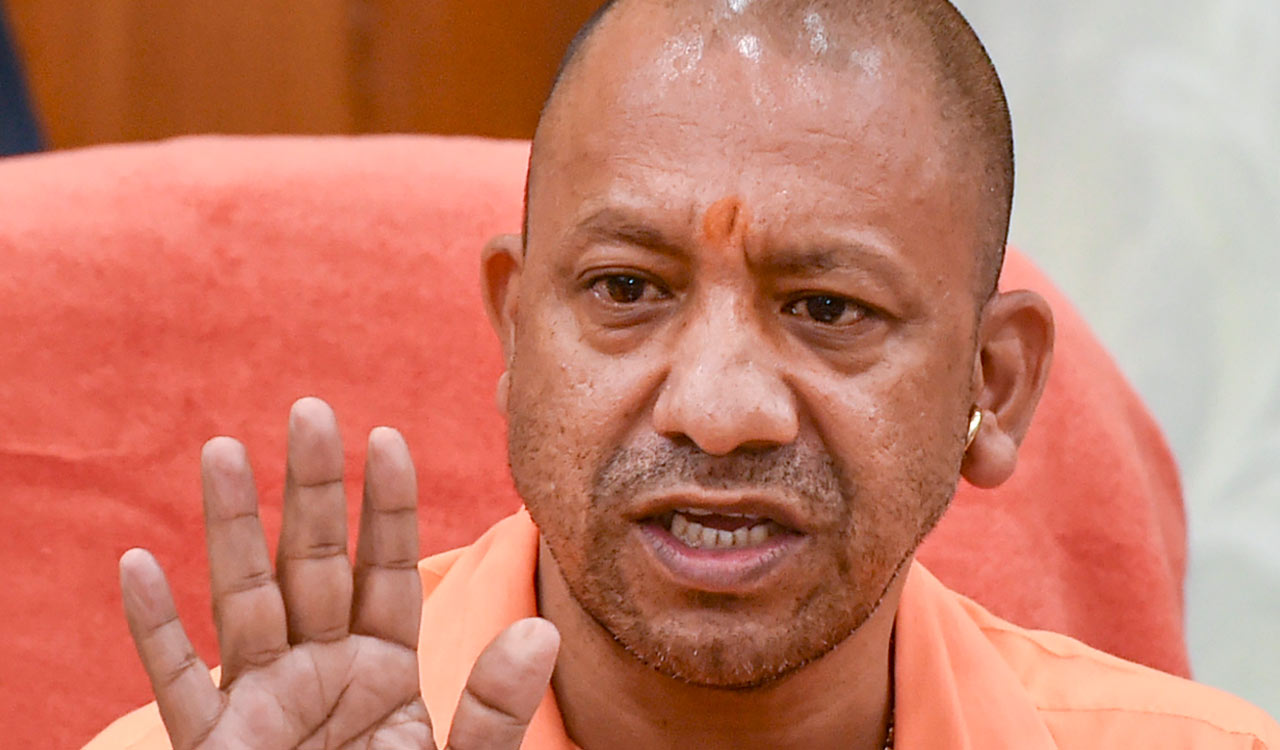
Uttar Pradesh Chief Minister Yogi Adityanath, speaking at the launch of the Somnath Swabhimaan Yatra in Lucknow, alleged that Jawaharlal Nehru opposed the reconstruction of the Somnath temple and discouraged President Rajendra Prasad from attending its consecration in 1951.
Published Date – 19 April 2026, 07:08 PM
Lucknow: Uttar Pradesh Chief Minister Yogi Adityanath on Sunday claimed that Jawaharlal Nehru acted as an “obstruction” in the reconstruction of the Somnath temple in Gujarat and advised then-President Rajendra Prasad against attending its consecration ceremony.
Addressing a gathering at the launch of the ‘Somnath Swabhimaan Yatra Uttar Pradesh’ here, Adityanath also alleged that the Congress undermined India’s “Sanatan faith”.
“India’s great son and architect of national unity, Vallabhbhai Patel, resolved to rebuild the Somnath temple after witnessing its dilapidated condition. But the country’s first prime minister, Jawaharlal Nehru, became an obstacle in this path. He did not want the work to proceed,” Adityanath claimed.
Despite this, Patel’s “firm resolve” prevailed, he said.
“When the reconstruction work was completed, the consecration ceremony had to be organised on a grand scale. The organising committee invited then-President Rajendra Prasad, but the Congress government and Pandit Nehru tried to create hurdles even then,” he said.
Alleging that Nehru had advised Prasad not to attend the ceremony, Adityanath said, “This shows the extent to which the faith of Hindus was being undermined. Nehru had said that the president’s participation in the consecration ceremony would go against the spirit of secularism.”
“Despite attempts to obstruct the president’s participation, Patel and Rajendra Prasad ensured that the ceremony was conducted,” he added.
In January this year, the Centre celebrated Somnath Swabhiman Parv to mark 1,000 years since the Somnath temple’s invasion by Mahmud of Ghazni.
After Independence, efforts to restore the temple were undertaken by Vallabhbhai Patel. A key milestone was achieved in 1951 when the restored Somnath temple was formally opened to devotees in the presence of then-President Rajendra Prasad.
Drawing a parallel with the present, Adityanath said that efforts initiated by Patel and Prasad are being carried forward today under Prime Minister Narendra Modi.
“The arrival of Narendra Modi as the prime minister is a continuation of strengthening India’s pride and its Sanatan heritage,” he said.
Referring to the Ram temple in Ayodhya, the chief minister said that attempts to “shake India’s faith” had always failed.
“Five hundred years ago, invaders tried to insult the Ram temple in Ayodhya and attack the faith of Hindus, but they could not succeed. Those who attempted it have no legacy today,” Adityanath said.
“Despite continuous attacks, India’s Sanatan culture has neither weakened nor bowed. India’s faith stands firm today, while the invaders have faded into history,” he added.
The chief minister also referred to some recent religious projects, such as the Kashi Vishwanath Corridor and the Vindhyavasini Corridor, along with the Maha Kumbh, calling them symbols of cultural resurgence.
Speaking about the Swabhimaan Yatra, Adityanath said more than 1,000 devotees from the state are travelling to Somnath in Gujarat.
“The Indian Railways is providing a train free of cost, while the remaining expenses are being borne by the tourism and culture ministry. I thank the Railways, the ministry, and the prime minister for this initiative,” he said.
The special train from Uttar Pradesh would pass through various pilgrimage sites en route Somnath, one of the 12 Jyotirlingas, he added.