The Lok Sabha was adjourned sine die after a stormy Budget session marked by the defeat of the women’s reservation bill, opposition protests and passage of key financial legislation, with the government and opposition clashing on several major issues
Published Date – 18 April 2026, 09:06 PM
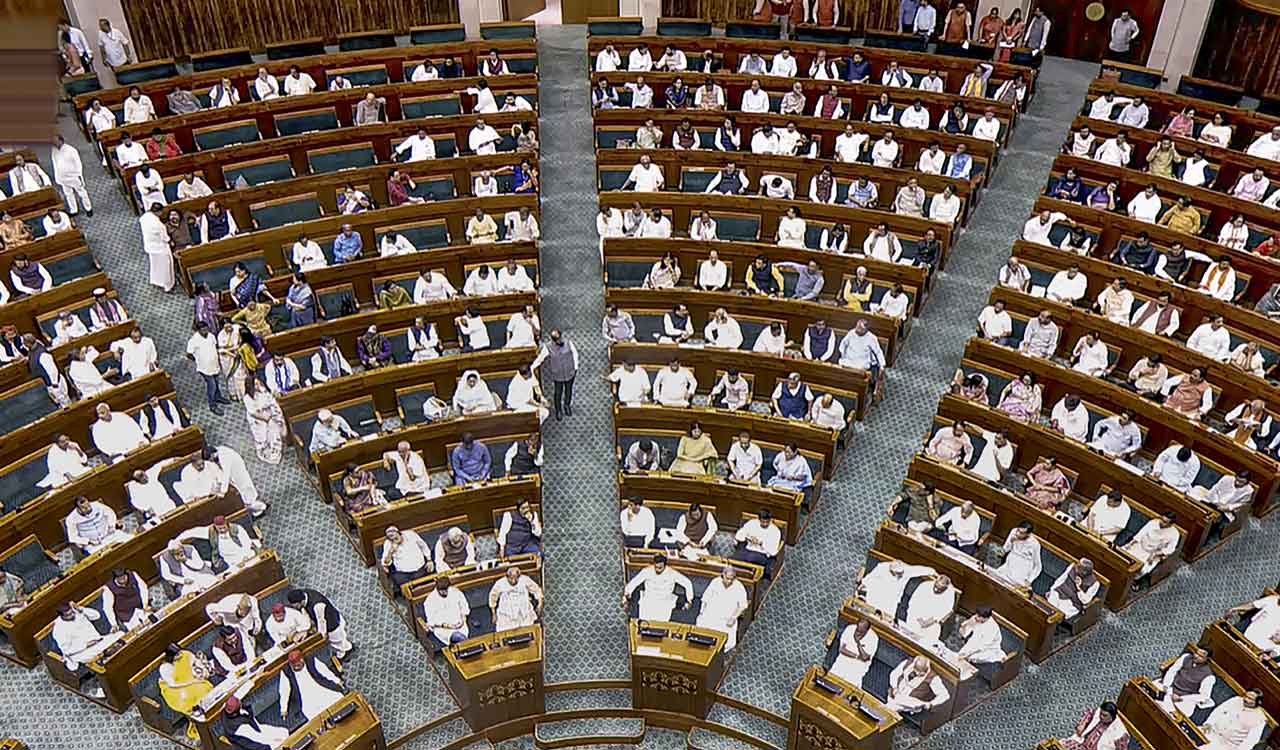
New Delhi: The Lok Sabha was adjourned sine die on Saturday, drawing curtains on a stormy Budget session that saw the defeat of a crucial bill to implement 33 per cent quota for women in legislatures by increasing the strength of the Lower House to 816 through a delimitation exercise.
The session, which began on January 28, saw the passage of the Union Budget and Demands for Grants.
As soon as the House met at 11 am, Speaker Om Birla read out his concluding remarks, following which he adjourned the House sine die (for an indefinite period).
The session concluded with a rendition of ‘Vande Mataram’. In a first, all six stanzas of the national song were played in the House. The government has mandated the singing of all six stanzas of ‘Vande Mataram’ at official functions, public events and in school assemblies.
In a major setback to the government, the Constitution (131st Amendment) Bill to implement 33 per cent reservation for women in legislatures in 2029 and increase the number of Lok Sabha seats to 816 was defeated on Friday, with the ruling NDA asserting that the struggle to give rights to women would continue.
While 298 members voted in support of the Bill in the Lok Sabha, 230 MPs voted against it. Out of 528 members who voted, the Bill required 352 votes for a two-thirds majority.
This is the first Bill of the Modi government to be defeated in Parliament.
According to the Bill, Lok Sabha seats were to be increased to 816 from the current 543 to “operationalise” the women’s reservation law before the 2029 parliamentary polls, following a delimitation exercise based on the 2011 Census.
Seats were also to be increased in state and Union territory assemblies to accommodate 33 per cent reservation for women.
The session, which was to conclude on April 2, was extended by three days from April 16 to discuss the crucial bills.
In his concluding remarks, Birla said 31 sittings were held during the session that lasted around 151 hours and 42 minutes. The productivity of the House during the session was 93 per cent.
The second half of the Budget session, which began on March 9, saw the passage of some key legislations despite opposition uproar.
The second part of the session saw the passage of the Finance Bill 2026-27 and the Demands for Grants for various ministries, apart from the Appropriation Bill, thus completing the budgetary exercise in Parliament.
Finance Minister Nirmala Sitharaman replied to the discussion on the Finance Bill in both Houses and answered queries raised by members.
The session started in the shadow of the West Asia crisis after the US and Israel attacked Iran on February 28.
The opposition demanded a discussion on the issue. Prime Minister Narendra Modi, External Affairs Minister S Jaishankar and Petroleum and Natural Gas Minister Hardeep Singh Puri gave statements on the West Asia conflict and its impact on India.
The opposition protested, claiming that its queries were not answered. It also staged several protests both inside and outside Parliament on the alleged shortage of oil and LPG in the country, while the government accused it of trying to spread rumours to create unrest among people.
The opposition walked out during the passage of crucial bills, claiming that it was dissatisfied with the government’s response.
There was also opposition uproar over the Central Armed Police Forces (General Administration) Bill. It demanded that the Bill be sent to a parliamentary panel for further scrutiny as it went against a Supreme Court ruling restricting the number of IPS officers in the central armed forces.
The legislation seeks to create a unified legal framework governing personnel across different Central Armed Police Forces (CAPFs), replacing the current patchwork of separate service-rule regimes for the five central forces.
The Andhra Pradesh Reorganisation (Amendment) Bill, 2026, saw Parliament give its nod to Amaravati as the new capital of Andhra Pradesh after amending the original Act of 2014.
The Transgender Persons (Protection of Rights) Amendment Bill, 2026, seeks to amend a law on the protection and rights of transgender persons and proposes excluding social orientations from the ambit of the statute. The Bill was passed by Parliament, even as opposition members demanded that it be sent to a select committee.
The legislation also provides for graded punishment based on the gravity of harm inflicted on such people.
The Foreign Contribution (Regulation) Amendment Bill, 2026, was not taken up by the government during the session, following strong objections from the opposition. The Corporate Laws (Amendment) Bill, 2026, was sent to the parliamentary committee for further scrutiny.
The session also saw the suspension of eight opposition MPs being revoked after the Lok Sabha passed a motion in this regard. They were suspended during the first part of the Budget session for creating a ruckus in the Lok Sabha over Leader of Opposition Rahul Gandhi allegedly not being allowed to speak in the House.