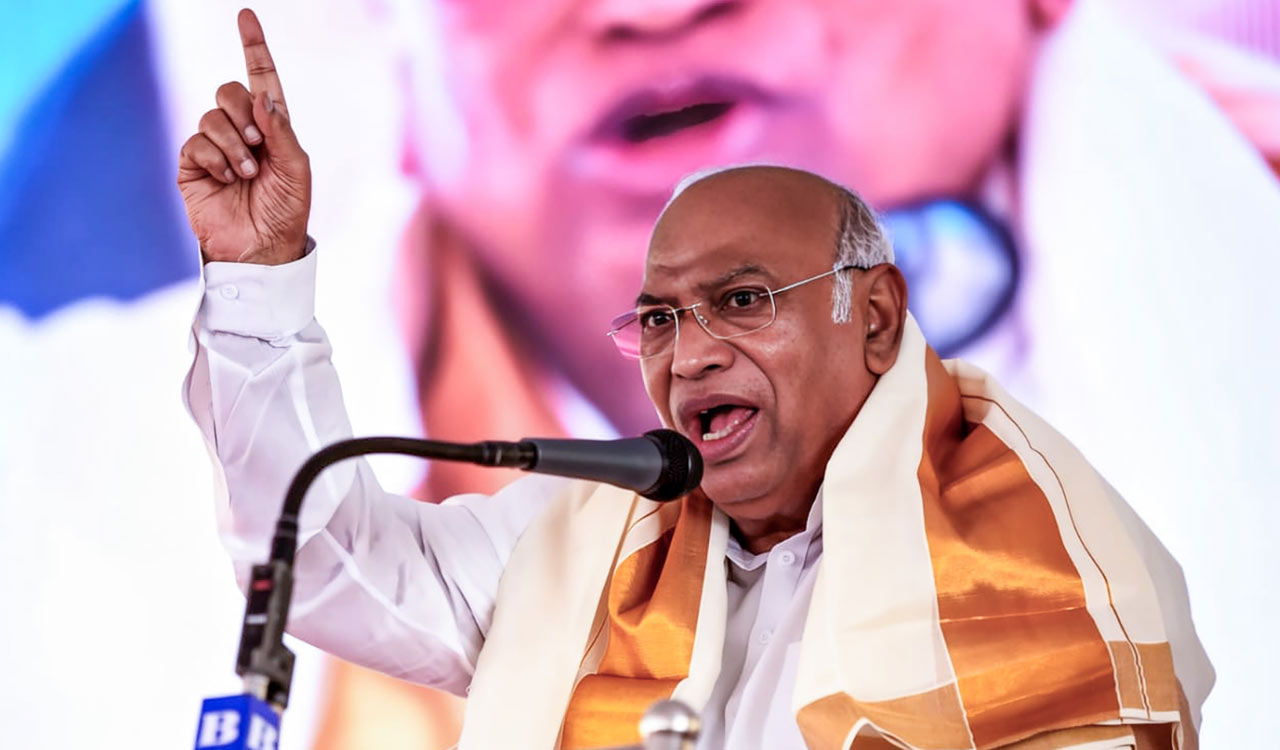
Top opposition leaders met at Congress president Mallikarjun Kharge’s residence to discuss a joint strategy on the women’s quota law ahead of a special Parliament session, raising concerns over its linkage with delimitation and seat increase based on the 2011 Census
Published Date – 15 April 2026, 05:06 PM
New Delhi: On the eve of a special three-day sitting of Parliament, top opposition leaders on Wednesday met at the residence of Congress president Mallikarjun Kharge to discuss and evolve a joint strategy on the women’s quota law.
Several opposition parties are opposed to linking the women’s reservation law with a delimitation exercise and an increase in seats in several state Assemblies as per the 2011 Census, and have accused the ruling NDA of indulging in politics over the law.
Leaders of the Congress, DMK, Trinamool Congress, Samajwadi Party, RJD, CPI and CPI-M were present at the meeting at Kharge’s residence.
Besides Kharge and Rahul Gandhi, the other leaders at the meeting included DMK’s T R Baalu, RJD’s Tejashwi Yadav, Trinamool’s Sagarika Ghosh, Shiv Sena (UBT) leaders Sanjay Raut and Arvind Sawant, and NCP-SCP’s Supriya Sule, with Samajwadi Party chief Akhilesh Yadav joining virtually.
CPI leader Annie Raja, CPI-M’s Nilotpal Basu, AAP leader Sanjay Singh, Independent MP Kapil Sibal, IUML’s E T Mohammed Bashir and RSP’s N K Premchandran also attended the meeting, besides Congress general secretaries K C Venugopal and Jairam Ramesh.
The special three-day sitting of Parliament will be held from April 16 to 18, during which amendments to the ‘Nari Shakti Vandan Adhiniyam’, commonly known as the Women’s Reservation Act, mandating 33 per cent reservation for women in Lok Sabha and state Assemblies, will be brought for implementation in 2029.
Kharge had earlier convened a meeting of the Congress Parliamentary strategy group at his residence, where top party leaders discussed women’s reservation and the delimitation exercise.
The government on Tuesday circulated bills related to the women’s quota law and delimitation among MPs.
The Congress has alleged that when the intent behind a bill is “mischievous” and its content “devious”, the extent of damage to parliamentary democracy is “enormous”.
According to the draft bill, Lok Sabha seats will be increased to up to 850 from the current 543 to “operationalise” the women’s reservation law in 2029, after a delimitation exercise to be carried out based on the 2011 Census.
Seats would also be increased in state and UT assemblies to accommodate 33 per cent reservation for women.