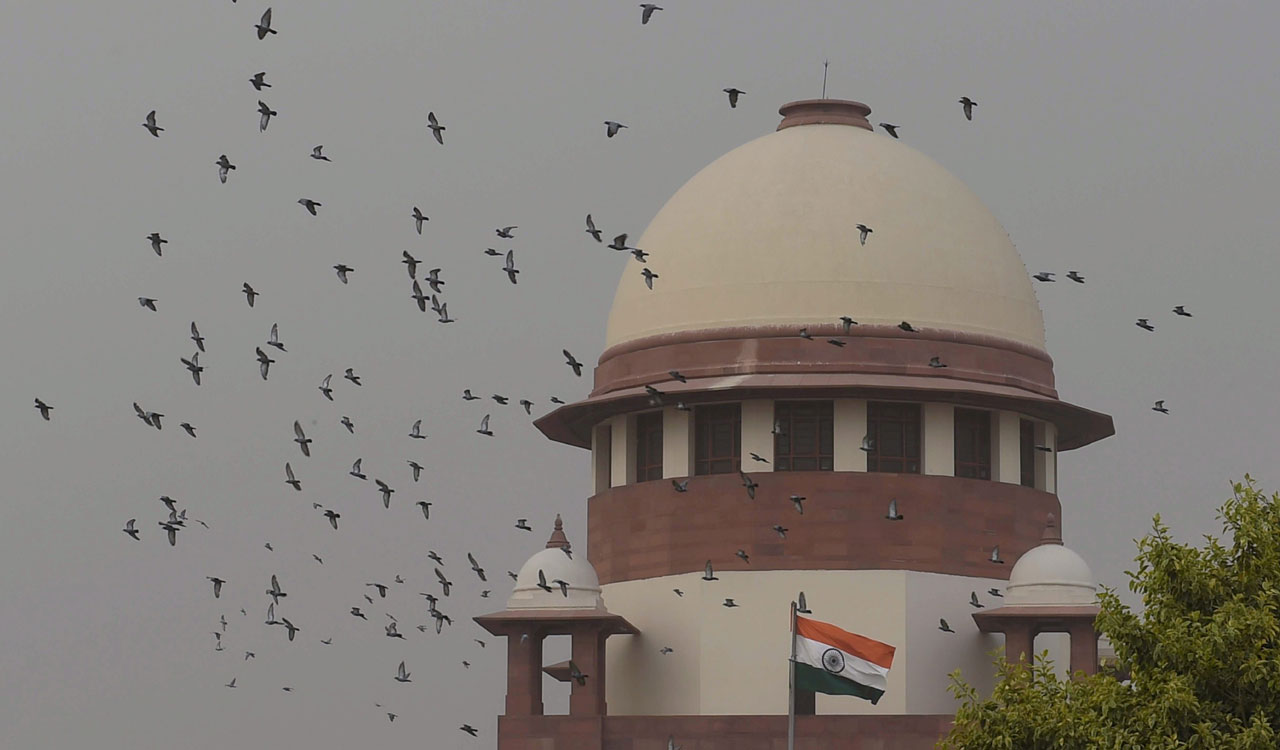
The Supreme Court’s nine-judge Constitution Bench, led by Chief Justice Surya Kant, continued hearings on the Sabarimala review reference, focusing on the tension between religious freedom and fundamental rights. Senior advocate Abhishek Manu Singhvi, representing the Travancore Devaswom Board, argued against the “essential religious practices” doctrine.
Published Date – 16 April 2026, 12:30 AM
New Delhi: As a nine-judge Constitution Bench continued hearing the Sabarimala review reference involving the interplay between religious freedom and fundamental rights, the Supreme Court on Wednesday orally remarked that one of the most difficult tasks for a constitutional court is to declare the beliefs of millions of people as erroneous.
The Constitution Bench, headed by Chief Justice of India (CJI) Surya Kant, observed submissions by senior advocate Abhishek Manu Singhvi, appearing for the Travancore Devaswom Board, which has opposed the continued application of the “essential religious practices” doctrine.
“The most difficult task for a court might be how to give a declaration that the belief of millions of people is wrong or erroneous,” the CJI Kant-led Bench remarked. In contrast, the apex court examined whether public interest litigations (PILs) by non-believers should be entertained in matters concerning religious faith and practices.
Justice BV Nagarathna cautioned against excessive judicial intervention in religious matters, remarking that “we cannot hollow out religion in the name of social welfare reform”.
During the hearing, Singhvi urged the top court to discard the essential religious practices test, contending that it wrongly permits judges to determine what constitutes the core of a religion.
“The moment Your Lordships allow the use of the word ‘essential’ or ‘integral’, Your Lordships necessarily start operating within the rubric of a concept called religion… it becomes a license to permit judges or external adjudicators to decide the essential and non-essential component of what is religion,” the senior counsel submitted.
Singhvi argued that religious beliefs and practices must be assessed from the standpoint of the community that professes them, rather than through external or judicial standards.
“The Court is bound to accept the belief of the community…it is not for the Court to sit in judgment on that belief,” he said.
Singhvi further contended that once a practice is shown to be genuinely and conscientiously held as part of a religion, it should receive constitutional protection, subject only to the express limitations of public order, morality, health, and other fundamental rights under Article 25.
At the same time, he acknowledged that courts may intervene in “extreme cases”, such as practices threatening life or public order. Still, he argued that the threshold for entertaining PILs in religious matters should be significantly higher than in other cases.
In the background, written submissions filed on behalf of the Travancore Devaswom Board have similarly urged the top court to adopt a “community-centric and subjective” understanding of religion under Article 25, cautioning against judicial reinterpretation of faith-based practices.
The submissions argue that the “essential religious practices” test finds no basis in the constitutional text and amounts to an impermissible judicial addition to the explicitly enumerated limitations.
The Supreme Court is currently examining broader questions concerning the interplay between religious freedom and other fundamental rights, including the extent of judicial review over religious practices and the scope of denominational rights under Articles 25 and 26.
Apart from the Sabarimala issue, the Constitution Bench will also consider allied questions such as the entry of Muslim women into mosques and dargahs, the rights of Parsi women to access fire temples after interfaith marriages, the validity of excommunication practices, and the legality of female genital mutilation in the Dawoodi Bohra community.