Global shocks, driven by inflation and supply chain disruptions, act as a ‘stealth tax’ on vulnerable groups, threatening gender equity
Published Date – 14 April 2026, 10:40 PM
By Sanjay Turi, Smriti
In global debates, particularly at the UN, it is widely acknowledged that women and the poorest of the poor are always the first to be forgotten in the chaos of war. In contrast, the International Committee of the Red Cross (ICRC), based in Geneva, notes that women are not only left to ensure their families’ survival but also to rebuild entire communities. However, the centuries-old patriarchal system continues to ignore their contributions.
With uncertainty looming over the Strait of Hormuz, policy discourse emanating from the Indian Parliament appears chaotic. Prices of essential goods, especially food and fuel, are soaring. Yet outside the conflict zone, a different kind of battle appears to be unfolding: in villages and the fragile economies of women-headed households. The contours of a ‘war-affected economy’ threaten to undermine the ‘gender dividend’ envisioned in the policy frameworks.
From Battlefield to Kitchen Table
To understand how geopolitics shapes vulnerabilities, one must start with the immediate site of survival: the kitchen. As India’s reliance on imported LPG is as high as 92%, primarily from West Asia, even minor disruptions in supply chains significantly affect energy prices, which are transmitted directly into almost every Indian household. In this context, the Pradhan Mantri Ujjwala Yojana remains a crucial initiative to reduce women’s exposure to indoor air pollution, though its effectiveness depends heavily on the affordability of LPG.
The Gulf Cooperation Council countries host around 9 million Indians. Remittances from this diaspora are vital for many households, where women often manage these finances. Regional uncertainty threatens employment and income streams, and any disruption in remittances directly impacts household resilience. For women, this results in a heightened financial insecurity.
Moreover, women also face an emotional toll of uncertainty, which could be called a ‘war-at-a-distance’. They bear the dual burden of managing household stability while worrying about the safety of family members abroad. Hence, be it energy or remittances or supply chain disruptions, the West Asian crisis is impacting women in India directly or indirectly.
Gender Hierarchies
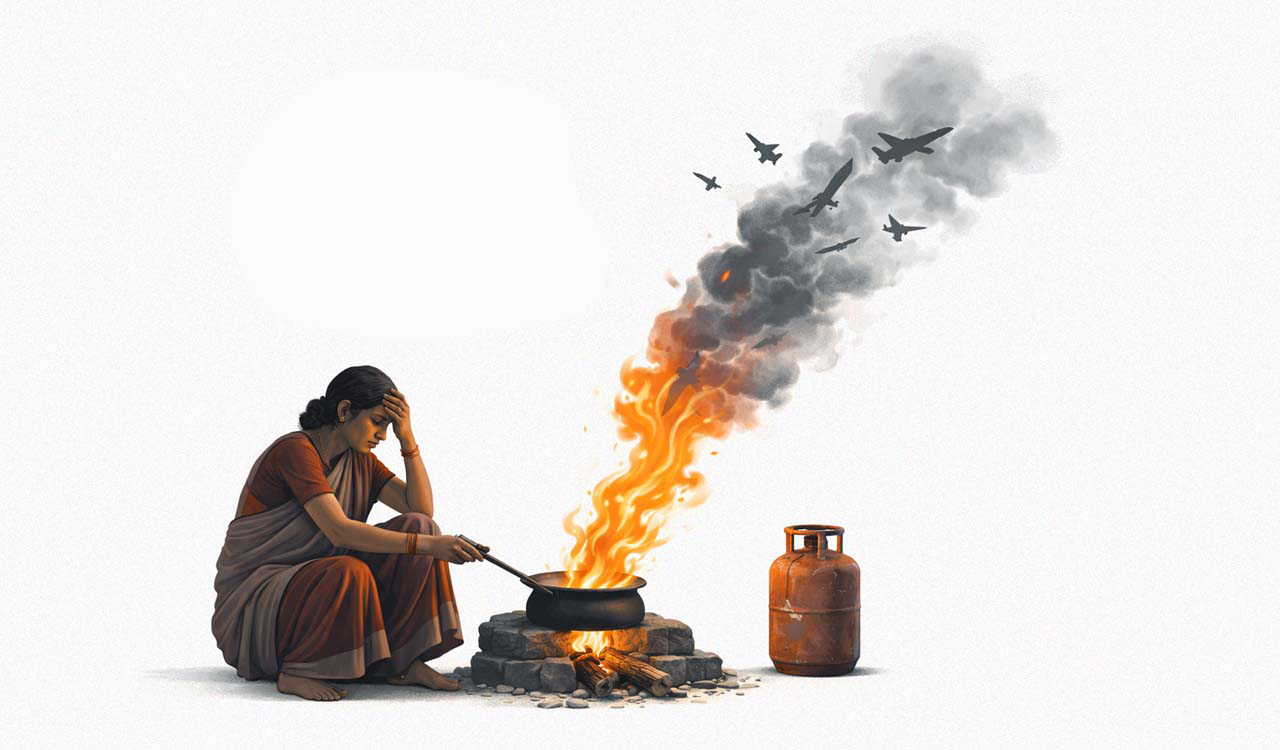
Applying intra-household bargaining theory, it can be argued that poor households in India do not function as unitary welfare-maximising entities. Resource allocation reflects entrenched gender hierarchies, where intersectionality is another dimension of deprivation. For example, rising LPG refill costs weaken women’s claims for cleaner fuel, pushing them towards coal, wood, and dung cakes. In the post-Strait of Hormuz crisis, initiatives such as PM Ujjawala then become increasingly irrelevant. This, in turn, is a return to hazardous living conditions, reintroducing women to time-intensive labour, harmful smoke exposure and complicated health issues.
At a macro level, these developments align with the feminist political economy perspective, which emphasises tensions between ‘social reproduction’ expenditure (health, education, welfare) and ‘securitisation’ expenditure. Historically, geopolitical instability often forces governments to rebalance their expenditure towards the latter. As a result, gender-focused welfare takes a back seat.Preview (opens in a new tab)
Rising LPG refill costs weaken women’s access to cleaner fuel, pushing them towards coal, wood, and dung cakes, and rendering initiatives such as the Pradhan Mantri Ujjwala Yojana increasingly irrelevant
Even with programmes like Mission Shakti, services for women function within a constrained budget. Rising input costs, such as transport and utility services, may further reduce programme effectiveness, even if the nominal amounts available for them remain unchanged. This leads to a gradual erosion in accessibility and service quality.
Global shocks, transmitted through inflation and currency pressures, function as a ‘stealth tax’ on vulnerable groups. Soaring prices for essential commodities have a direct impact on real income, disproportionately affecting women in low-income households.
Schemes such as MGNREGA, VB-G RAM G, Pratyaksha Hastantri Labh (PAHAL), PMAY, Pradhan Mantri Matru Vandana Yojana (PMMVY), and PM-KISAN act as critical buffers, with women comprising over 50% of beneficiaries in recent years. However, if wage subsidy amounts fail to keep pace with inflation, the real value diminishes, undermining the effectiveness of these programmes.
Besides, women’s participation in self-help groups (SHGs) and MSMEs— over 90% and 20% respectively — makes them vulnerable to credit disruptions as supply chain shocks strain the banking system. Prof Cynthia Enloe terms this as ‘militarisation of the everyday’, where geopolitical priorities alter the framework of ordinary economic life, frequently exacerbating gendered inequalities.
Defending Development
Amid rising tensions between Iran and Israel, it is imperative to note that while fiscal deficits may be corrected within years, a developmental deficit in women’s health and education can take generations to repair. Social welfare is not a ‘peacetime luxury’. It is the foundation of national strength. The impact of geopolitical conflict must be understood not merely in territorial or strategic terms, but in terms of the potential displacement of developmental progress.
To prevent the reversal of the progress made, policy interventions must be proactive. LPG subsidies under Ujjwala should be dynamically linked to global price fluctuations. Gender budgets must be indexed to inflation to preserve their real value. Strengthening rural safety nets like MGNREGA is essential to protect women from employment and price shocks.
Failure to protect gender-focused development may give away the hard-won gains. Hence, National security cannot be truly achieved if it comes at the cost of systemic insecurity for women.
(Sanjay Turi is Doctoral candidate at the Centre for West Asian Studies [CWAS], School of International Studies, and Smriti is Doctoral candidate at the Centre for the Study of Law and Governance [CSLG], Jawaharlal Nehru University, New Delhi)