The US military has begun a blockade of Iranian ports, intensifying tensions in the Gulf amid the ongoing war. Iran has issued counter-threats while shipping through the Strait of Hormuz has slowed sharply, raising fears of global economic disruption
Published Date – 14 April 2026, 01:06 AM
Washington: The US military announced it will begin a blockade of all Iranian ports and coastal areas on Monday, tempering US President Donald Trump’s previous vow to entirely block the strategic Strait of Hormuz, as early reports indicated that ships had stopped crossing the waterway.
However, Trump warned on social media that any Iranian warships that come “anywhere close” to the US blockade will be destroyed.
The move sets the stage for a showdown as Iran has responded with threats against ports in the Persian Gulf and the Gulf of Oman. The war, now in its seventh week, has killed thousands of people and shaken global markets. Ceasefire talks between the US and Iran over the weekend ended without an agreement, raising questions about what happens when the current two-week truce expires on April 22.
Meanwhile, the Israeli military is pushing ahead with its air and ground offensive in southern Lebanon, engaging in fierce fighting with Hezbollah militants over a strategic town while the group also fires rockets and drones at northern Israel.
Respect freedom of navigation: UN chief
Secretary-General Antonio Guterres stresses that freedom for ships to transit the strait, a key waterway for about 20% of global oil shipments, is guaranteed in international law, his spokesman said.
“No one should do anything that harms the freedom of navigation in the Strait of Hormuz,” spokesman Stephane Dujarric said, adding that Guterres believes “it is clear that there is no military solution” to the wider conflict.
The secretary-general says the US-Iran talks “underscored the seriousness of their engagement and constituted a positive and meaningful step toward renewed dialogue,” Dujarric said.
But an agreement cannot be reached overnight, and the secretary-general calls for the Pakistan-mediated talks and the ceasefire to continue, the spokesman said.
Finnish president says he doesn’t see US withdrawal from NATO
During a panel on Monday, Finland’s President Alexander Stubb said that he “sees no signs” of America abandoning the trans-Atlantic alliance despite Trump’s threats over NATO countries’ refusal to help with the Strait of Hormuz.
“So don’t underestimate the interest of the United States to stay engaged with the alliance,” Stubb said at an event at the Brookings Institution.
The European leader has often leveraged his good relationship with Trump – the two men have played golf together and speak regularly – to argue against his “America First” posturing. Stubb also reiterated that a “coalition of the willing” would help ensure the critical waterway was opened after the war ended.
“It’s my job as president of Finland to try to save the situation and convince the Americans that without allies, it’s difficult to project power,” he said.
At least 2 tankers turn around after approaching Hormuz
The vessel-tracker MarineTraffic said in a post on the social platform X that the ships reversed course within minutes of approaching the critical waterway, shortly after the US blockade began.
It said one of the tankers departed the United Arab Emirates’ Sharjah anchorage on Monday, bound for China. It was not immediately clear where the second vessel was headed.
Trump says ‘we’ve been called by the other side’
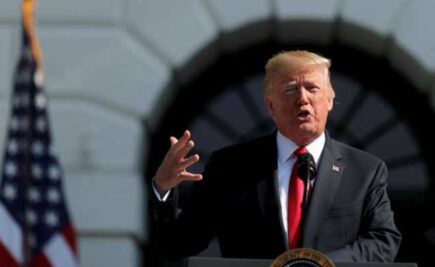
Speaking outside the Oval Office on Monday, Trump suggested the US is still willing to engage with Iran to negotiate a resolution.
“I can tell you that we’ve been called by the other side,” Trump said, adding, “We’ve been called this morning by the right people, the appropriate people, and they want to work a deal.” Trump did not say who called or what was discussed.
Trump confirms that Hormuz blockade started at 10 am Monday
“We can’t let a country blackmail or extort the world because that’s what they’re doing,” Trump said of Iran.
Trump repeated his argument that safeguarding the strait is of greater concern to other parts of the globe than the United States. The effective closure of the strait since the start of the war, however, impacts global oil prices – which has led to surging gas prices for American motorists and rising inflation on other goods.
“We don’t use this strait,” Trump said. “We have our own oil and gas, much more than we need.”
Trump says he won’t apologise to Pope Leo
Trump is refusing to apologize for sharply criticizing Pope Leo, saying that the pontiff “went public” in his criticisms of the war in Iran, and “I’m just responding.” In comments to reporters outside the Oval Office, Trump added, “There’s nothing to apologize for” and said of Leo, “He’s wrong.” Trump was also asked about posting an image of himself as a saint-like healer, which seemed to draw comparisons between himself and Jesus Christ.
The image was posted Sunday night and drew widespread condemnation from Evangelical Christian leaders and has since been taken down.
Trump said, “I did post it.” But he suggested it had something to do with the Red Cross and insisted: “It’s supposed to be me as a doctor making people better.”
US blockade will backfire: Iranian official
Foreign Ministry spokesman Esmaeil Baqaei derided the blockade as a “revenge of choice” against the global economy.
“Is it ever worthwhile to cut off one’s nose to spite one’s face?!” he wrote on the social platform X.