Baranica Elangovan’s historic bronze medal in pole vault at the Asian Games 2026 has opened a new chapter for Indian athletics. Her coach Milber Bertrand Russell believes the achievement will inspire young athletes and boost support for the event
Published Date – 29 September 2026, 11:50 PM
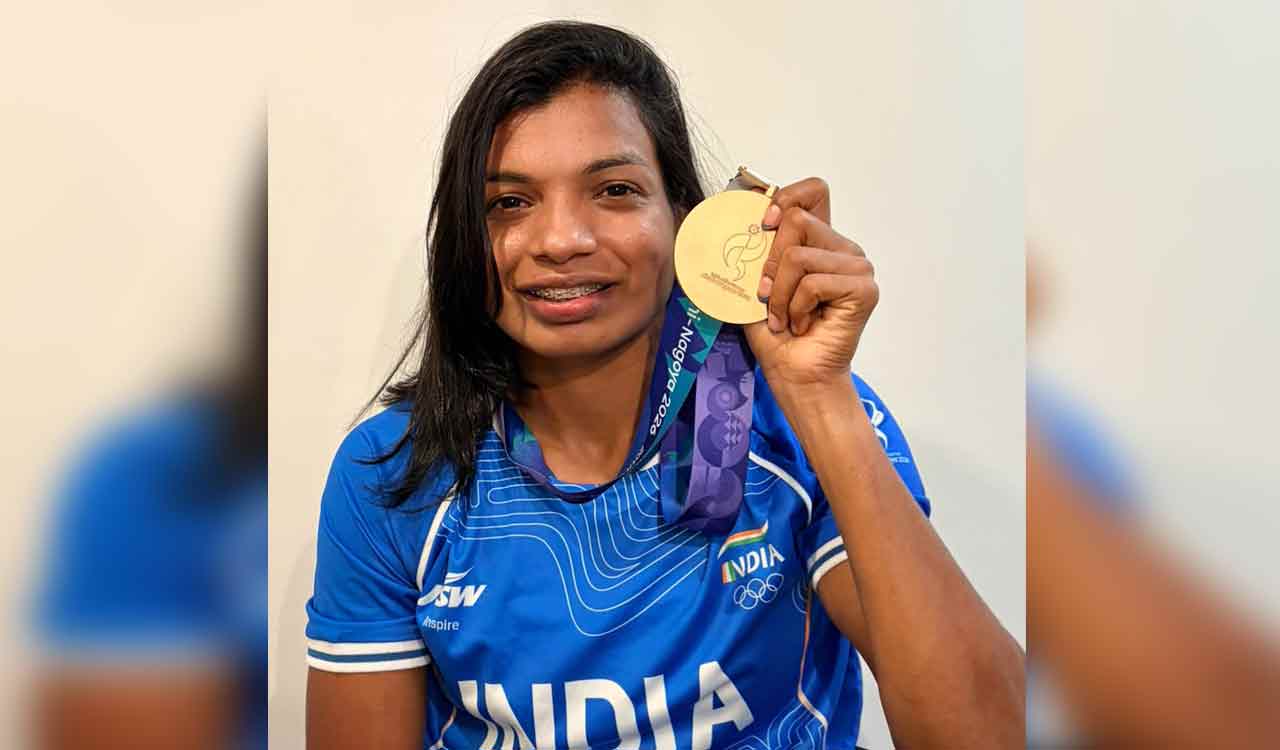
Hyderabad: One of the brightest spots in India’s campaign at the Asian Games 2026 in Aichi-Nagoya has been Baranica Elangovan.
The 29-year-old from Tamil Nadu won a historic pole vault medal on September 25 and entered the record books as the first Indian, male or female, ever to stand on the podium at the Olympics, Asian Games or Commonwealth Games, traditionally considered the big three multi-sport competitions globally.
Baranica, who made her Asian Games debut here in Nagoya, shared the bronze with Polina Kazakhstan after both cleared a height of 4.15 metres. Japan’s Misaki Morota (4.55 m) and China’s Niu Chunge (4.50 m) won the gold and silver medals, respectively.
Baranica’s rather unexpected medal has injected new belief in her long-time coach Milber Bertrand Russell. “The next targets will be to consistently improve her personal best and move towards the 4.40-4.50m level. Beyond that, we want her to compete strongly at major international competitions and continue improving her position at the world level,” said Russell in an interaction with SAI Media.
Basketball’s loss was athletics’ gain as Russell coached Baranica to become a national-level athlete. “I am a pole-vaulter by chance and it was my coach who brought me to this level,” said Baranica, whose best effort had been 4.23 m, a national record until G Sindhusree Ganesha broke it by clearing 4.25 m.
“No one was expecting me to win a medal. I only wanted to improve my personal best but I ended up on the podium. At least I have opened India’s account at the Asian Games and I thank my support team and family for this,” Baranica told SAI Media.
Baranica’s Asian Games bronze has really fired up Russell. “For me, this medal is not the destination. It is the beginning of the next chapter for Baranica. We came to Nagoya with a realistic approach. We knew the competition would be very strong and that every athlete would be capable of performing at a high level.
“Our target was to take the competition one height at a time and focus on the process rather than thinking too much about the medal. We believed Baranica had the potential to fight for a medal, but we also knew that she had to execute well on the day. She showed a lot of fighting spirit and eventually won the medal,” said Russell.
Russell feels Baranica’s medal will help lift the status of pole vault in India. Among field events, pole vault, although very attractive, has largely remained in the shadows of javelin, discus and shot put.
“When Indian athletes start performing well at international competitions, people begin to notice the event. Baranica winning an Asian Games medal will hopefully encourage more young athletes, coaches, and academies to take up the event,” says Russell.
Russell hopes Baranica’s medal will also spur the Athletics Federation of India to provide better facilities and support from the government, which invests significant funds in Olympic sports.
“We still need better facilities, equipment, proper coaching, and more opportunities for young athletes to compete and develop.
“As for Baranica, we need to make her stronger, improve her consistency in the approach and take-off, and develop her speed and power further. She also needs more experience at the highest international level,” said Russell.
Track and field events remain India’s best bet at international events. Athletics, almost always, has the biggest team at events like the Asian Games and the Olympics. After superstar Neeraj Chopra gave javelin a strong foothold in Indian athletics, Baranica’s bronze medal has at least given pole vault a good reason to rise and shine.