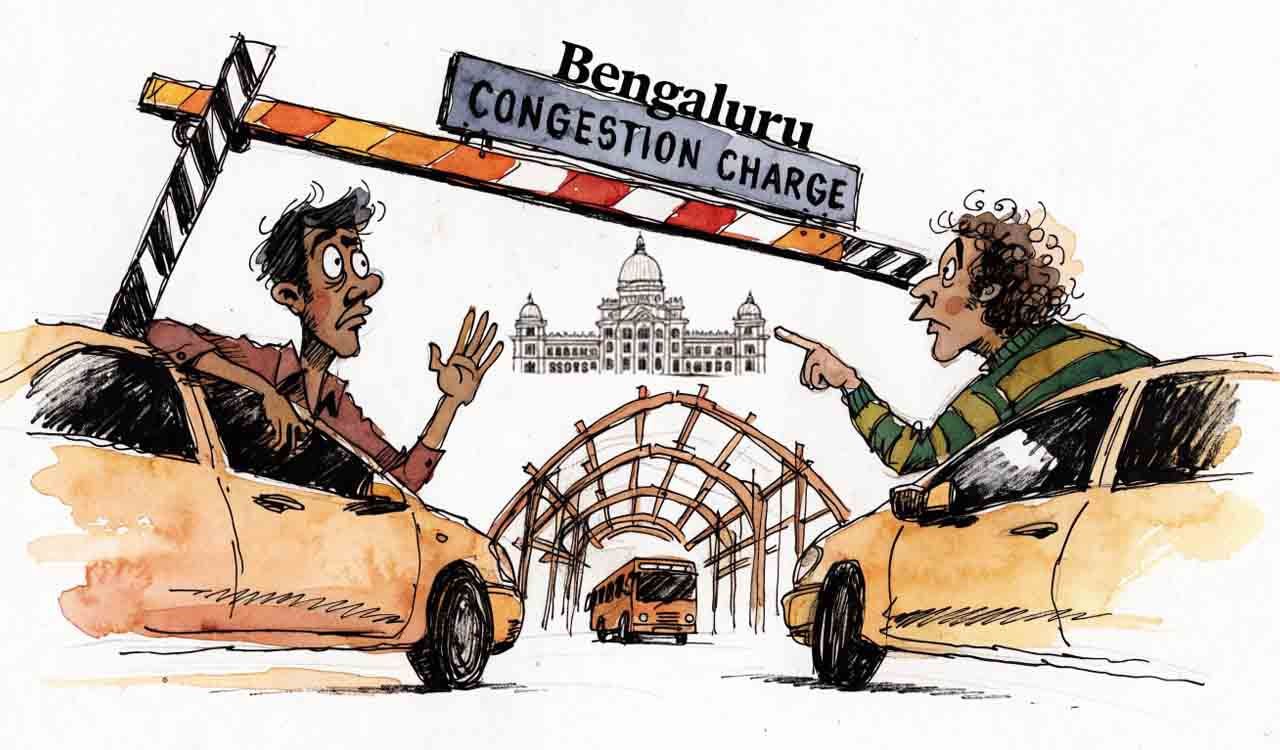
Bengaluru can price congestion, but without reliable, affordable public transport, a traffic tax could punish commuters by raising costs without reducing car use
Published Date – 29 September 2026, 11:32 PM
By Siddalingesh G Halemani and Arvind Pandey
Bengaluru’s traffic has become more than an inconvenience. It is now an economic and governance challenge. A city that has grown into India’s technology capital is struggling to move the workforce that drives its economy. Rapid urbanisation, expanding employment centres, and the steady rise in private vehicles have placed enormous pressure on a road network never designed for the city’s current scale.
Against this backdrop, the proposal for a congestion tax deserves attention. The Fifth State Finance Commission has recommended a London-style congestion charge for busy roads in Bengaluru, with the possibility of using FASTag for collection. The broad objective is to discourage unnecessary private vehicle use, reduce congestion, and generate resources for urban infrastructure.
The idea is economically rational. But the question Bengaluru must ask is more fundamental: is the city ready to charge people for using its roads when it has not yet provided a sufficiently strong alternative to the private vehicle?
Rational Tax, Irrational Sequence
Congestion is a classic negative externality. When one additional vehicle enters an already congested road, the driver considers the benefit of his journey but does not bear the full cost of the additional delay imposed on thousands of other road users. A congestion charge attempts to make the motorist internalise part of this social cost. This is the logic of a Pigouvian tax.
There is also a behavioural case for it. Rational Choice Theory suggests that people respond to incentives and tend to choose the option that provides them with the greatest benefit among the available alternatives. But what happens when there is no reliable alternative? A commuter may respond to a congestion charge by shifting to the Metro, bus, carpooling or another mode. But this requires public transport to be sufficiently frequent, affordable, accessible and reliable. Otherwise, the charge does not necessarily change behaviour; it simply increases the cost of commuting.
Planning Deficit
Bengaluru’s present congestion is partly the consequence of a planning deficit. The city has expanded rapidly towards Whitefield, Electronic City, Nelamangala, Kengeri and other peripheral areas. Roads and commercial developments have expanded alongside this growth, but public transport connectivity has not always kept pace.
This creates a vicious urban cycle: build more road capacity, attract more economic activity, generate more vehicle trips, and then discover that the new road is congested again. Mere expansion of high-capacity roads cannot, therefore, be the answer if land-use planning and public transport do not align with it. Better roads can themselves generate additional vehicle demand.
Bengaluru needs greater clarity on how much of its urban spending is being directed towards expanding public transport capacity rather than merely building or widening roads
Bengaluru’s mobility planning has envisaged a much larger bus network. The city is estimated to need around 15,000 buses, while BMTC operates only 7,000–7,100 buses. The gap becomes particularly important when the government proposes to make private vehicle use more expensive.
Though Namma Metro has expanded significantly in the last ten years, its capacity and frequency remain uneven across corridors. The Purple and Green lines have relatively frequent peak-hour services, whereas the Yellow Line, serving Electronics City corridors, does not have similarly frequent trains. Capacity and last-mile connectivity remain important determinants of whether commuters can shift from private vehicles to public transport.
Secondly, there is also a question of affordability. In January 2025, Karnataka increased state-run bus fares by 15 per cent, including BMTC fares. A month later, Namma Metro witnessed one of its most controversial fare revisions. Some station-to-station combinations initially saw increases of 100–105 per cent, but BMRCL subsequently recalibrated fares following public backlash and capped the maximum increase at roughly 70–71 per cent. The average increase was around 51.55 per cent.
Thirdly, the city also needs to improve its implementation record. Projects such as the long-delayed Bengaluru Suburban rail demonstrate how land acquisition, contractual disputes and administrative delays can keep critical infrastructure unfinished for years. The project, originally scheduled for completion years ago, has faced repeated delays and cost escalation.
This creates a difficult policy contradiction. If the government wants citizens to shift from private vehicles to public transport, the latter must become more attractive in all three factors: accessibility, availability and affordability.
Lessons from London and Singapore
London operates congestion charging in a defined central zone, while Singapore uses a dynamic pricing policy in some busy areas to minimise congestion. Both have developed pricing as part of a wider transport-management strategy.
So, the lesson for Bengaluru should therefore not be simply: “These cities charge motorists, so Bengaluru should too”. Bengaluru is currently considering only the push factor—making private vehicle use more expensive, while the pull factor, namely a sufficiently extensive and reliable public transport system, remains incomplete. The city should not copy the price without building a proper functioning ecosystem around it.
Road Less Travelled
To reduce the social cost of the congestion tax, the city’s fiscal priorities should be addressed. The first budget of the five city corporations under the Greater Bengaluru Authority for 2026-27 together totalled Rs 20,216.41 crore. Notably, there is no dedicated funding allocation for improving public transportation.
What Bengaluru needs is greater clarity on how much of its urban expenditure is being directed specifically towards expanding public transport capacity rather than merely building or widening roads. This becomes even more important if congestion pricing is introduced.
Revenue collected from commuters should not simply disappear into a general pool. It should be ring-fenced for urban mobility—more BMTC buses, better Metro connectivity, feeder services, pedestrian infrastructure, and completion of pending transport projects. Citizens should be able to see a direct relationship between what they pay and what they receive. Revenue from congestion should be reinvested in reducing congestion.
Secondly, Bengaluru should price congestion, but not before providing proper alternatives. The city cannot afford to reject every unconventional solution to its traffic crisis. Congestion pricing deserves serious consideration. But sequencing matters. The city should first build alternatives, improve the service, ensure affordability, and complete pending projects. Only then should it progressively introduce congestion pricing.
If implemented, the charge should also be dynamic, varying with the time and level of congestion rather than serving merely as a flat revenue-raising instrument. The objective should not be to make driving impossible. It should be to make driving unnecessary for journeys that can reasonably be made by public transport.
Bengaluru’s congestion is ultimately a symptom of a broader mismatch among economic growth, land-use planning, and transport infrastructure. A tax can manage demand, but it cannot repair decades of planning deficits. The city, therefore, needs to get the sequence right.
(The authors are associated with the Department of Humanities and Social Sciences at the Indian Institute of Technology Tirupati. Views are personal)