BRS leader T Harish Rao accused the Telangana government of failing to utilise available water and power, questioned Srisailam water-use figures and urged action to protect crops. He also criticised delays in repairing Kaleshwaram barrages and questioned rising project costs
Published Date – 19 September 2026, 07:09 PM
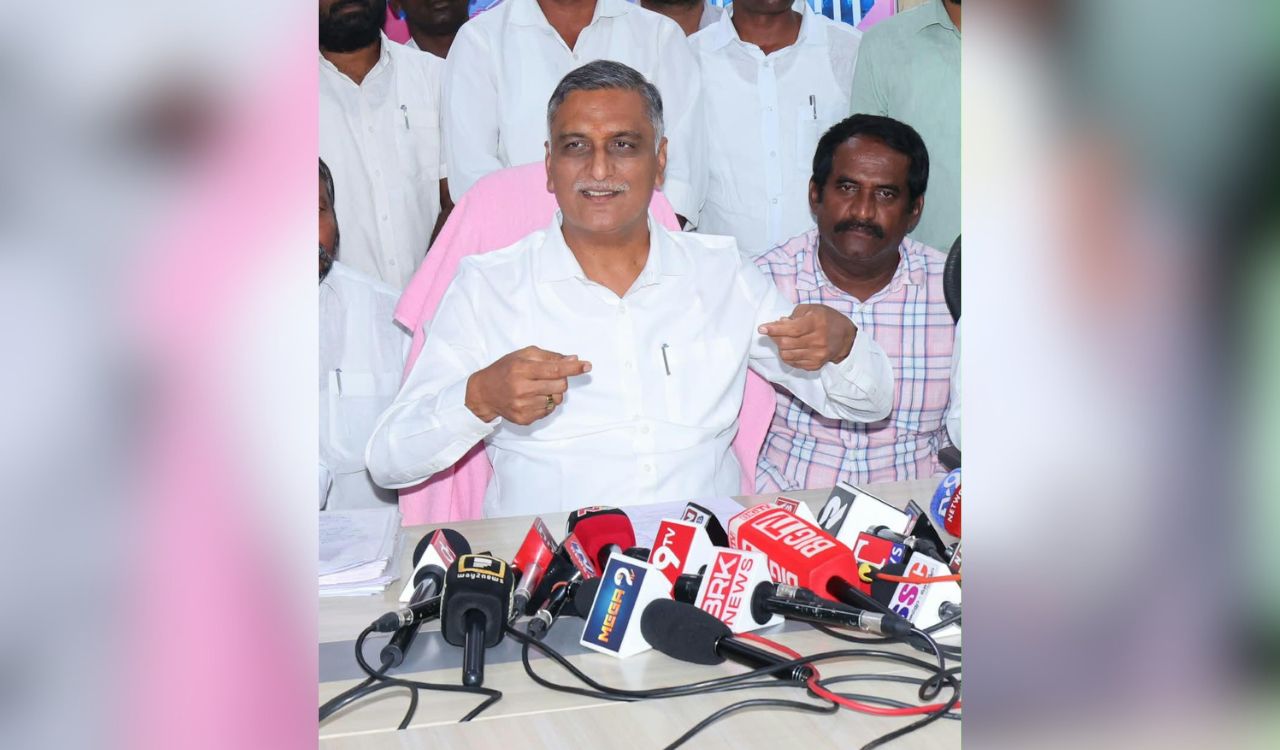
Hyderabad: Bharat Rashtra Samithi (BRS) deputy floor leader T Harish Rao lashed out at the Congress government over the water and power crisis this season, alleging that it had failed to protect the interests of the farming community.
Harish Rao said the government was blaming El Nino for a crisis that was largely the result of its failure to utilise available water and power capacity. “This is not a drought brought by nature. It is a drought created by the Congress government and the failures of Revanth Reddy,” he alleged at a press conference here on Saturday.
The former Irrigation Minister accused Minister Uttam Kumar Reddy of making incorrect claims in the Assembly about Telangana’s utilisation of Srisailam water. “Uttam Kumar Reddy said Telangana used 84 TMC from Srisailam this year. If 84 TMC was actually used, which reservoirs were filled and which fields received it?” he asked.
Telangana’s major projects drawing water from Srisailam include Kalwakurthy and Palamuru-Rangareddy. Palamuru pumps have remained idle for three years, while only around 8 TMC has been lifted through Kalwakurthy so far, Harish Rao said. “How can the government claim that Telangana used 84 TMC?” he asked.
Sharing official Central Water Commission figures, he said Telangana had recorded its lowest utilisation of Krishna water in recent years under the Congress government. He said that when sufficient water was available, Telangana had utilised 31 per cent, 35.8 per cent and 45 per cent during earlier years under the BRS government. In 2024-25, while Andhra Pradesh utilised around 71.5 per cent, Telangana utilised only around 28.4 per cent, he claimed.
“In 2025-26, Telangana’s utilisation fell further to around 25 per cent. When Telangana has a share of around 36 per cent, what is the point if the government cannot even utilise it?” Harish Rao asked.
He further alleged that during the current water crisis, Andhra Pradesh had utilised around 83 TMC, while Telangana, including Hyderabad’s drinking water requirement, had utilised only around 43 TMC.
Expressing concern over crops under Nettampadu, Bhima, Koilsagar and Jurala, covering nearly three lakh acres, withering, he suggested that the Revanth Reddy government could have requested the Congress government in Karnataka to release water from Almatti for a month.
The former Irrigation Minister also came down heavily on the Congress government over the delay in repairing the Annaram, Sundilla and Medigadda barrages. The Central Water and Power Research Station (CWPRS), Pune, had conducted technical tests on the three barrages.
“According to the CWPRS report, the concrete quality at Annaram and Sundilla was assessed as very good, good and excellent. At Medigadda too, except for the affected Block-7, the other six blocks were found to be safe,” he said.
Harish Rao said the National Dam Safety Authority had stated before the High Court that the State government could take a decision on lifting water. Retired engineers had also advised that water could be lifted by keeping the Medigadda gates open and allowing the required flow.
“Then why are the Kannepalli pumps not being operated and why is the government refusing to lift water despite availability?” he asked, stressing that more than 46,000 cusecs of water was flowing at Medigadda, equivalent to the loss of more than four TMC a day.
“Do not let political differences come in the way of farmers’ interests. Water belongs to the people,” Harish Rao said.
Responding to Uttam Kumar Reddy’s criticism over the escalation in the cost of the Kaleshwaram project, he questioned the increase in the estimated cost of the Kodangal-Narayanpet Lift Irrigation Project in the Chief Minister’s constituency.
Under the first GO, the estimated cost was Rs 1,450 crore. Before substantial work even began, it was revised to Rs 2,945 crore, then enhanced to Rs 4,725 crore and finally to Rs 6,825 crore, he said.
“Why did the estimate increase nearly five times for a project intended to provide water to around one lakh acres?” Harish Rao asked.