
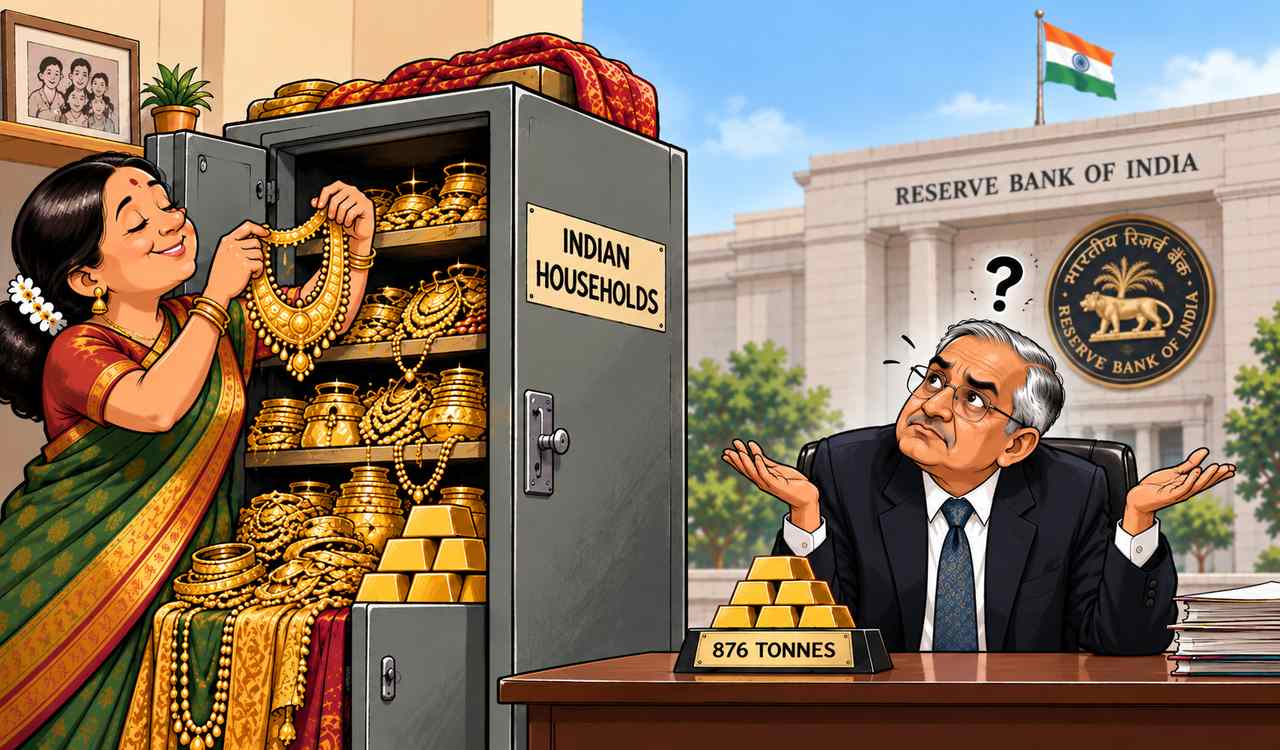
Generations of private savings reveal a striking disconnect between India’s accumulated real wealth and what its monetary architecture officially recognises
Published Date – 19 September 2026, 10:00 AM
By Chandu Kumar Potti
Every morning, the Reserve Bank of India opens for business.
It manages the rupee. It sets interest rates. It holds India’s official gold reserves, approximately 876 tonnes as of late 2024, one of the larger central bank gold holdings in the world.
That 876 tonnes is India’s declared monetary foundation. The official number. The one that appears in IMF reports and World Gold Council data.
It is also, by one honest measure, a small fraction of what India actually holds.
What The Households Hold
The World Gold Council, the global authority on gold markets, estimated in 2023 that Indian households hold approximately 25,000 tonnes of gold.
A more recent estimate by Morgan Stanley, published in October 2025, puts the figure at 34,600 tonnes, valued at approximately $3.8 trillion at current prices.
These are estimates. Not a census. Private household holdings are difficult to measure precisely. The honest range is somewhere between 25,000 and 34,600 tonnes.
Even the lower figure, 25,000 tonnes, is remarkable.
According to a study by HSBC Global, Indian household gold reserves exceed the combined gold holdings of the world’s top 10 central banks, including the United States,
which holds approximately 8,133 tonnes at Fort Knox, and Germany, which holds approximately 3,300 tonnes.
Indian households, not the government, not the central bank, hold more gold than the ten most powerful monetary institutions on earth combined.
This gold sits in steel almirahs, bank lockers, and family vaults. Accumulated over generations. Purchased through decades of savings. Worn at weddings. Passed from grandmother to granddaughter.
It is private wealth. It belongs to the families who hold it.
And it is completely invisible to India’s monetary system.
What The Temples Hold
Beyond household gold, India’s religious institutions hold significant wealth.
Industry estimates, cited by Business Standard, place total temple gold across India at approximately 3,000 to 4,000 tonnes. These figures are not officially verified.
Temple holdings are largely unaudited and undisclosed.
What is verified: the Tirumala Tirupati Devasthanam has confirmed gold holdings of approximately 9 to 10 tonnes in documented bank deposits. The temple receives approximately one tonne of gold annually from devotees.
The Sree Padmanabhaswamy Temple in Thiruvananthapuram, Kerala, one of the oldest temples in the world, is in a different category entirely. In 2011, the Supreme Court of India ordered an audit of its vaults. Five of six underground vaults were opened. The treasures discovered, gold idols, coins, chains, gems, and jewellery accumulated over millennia, were conservatively estimated at $22 billion by court-appointed assessors. The sixth vault remains sealed.
These temple assets are not monetary reserves. They are religious and cultural patrimony, belonging to the communities and traditions they serve. They are mentioned here not as assets to be mobilised, but as evidence of the depth of real wealth that Indian civilisation has accumulated over centuries.
What History Says
Before the British arrived, India was an economic giant.
According to estimates by economic historian Angus Maddison, published by the OECD, India’s share of world GDP was approximately 24 to 27 per cent in the early 18th century, as large as all of Europe combined at that time.
By 1947, when India gained independence, that share had fallen to approximately 3 to 4 per cent.
Maddison’s methodology has been debated by some historians. But the broad direction of his findings, a dramatic decline in India’s economic weight during colonial rule, is consistent across multiple independent historical studies.
India’s monetary decline, the rupee’s relative weakness today, did not emerge from Indian failure alone. It emerged from a specific history of extraction, deindustrialisation, and monetary subordination that reduced a 24 per cent share of world output to 3 per cent in two centuries.
The rupee today carries that history in its exchange rate.
The Gap Nobody Measures
Here is the honest picture: India’s official monetary base, the rupee, is backed by what the Reserve Bank of India holds and what the government declares.
India’s actual accumulated wealth, in households, in institutions, in the productive capacity of 1.4 billion people, is vastly larger and largely uncounted by the monetary system.
This gap is not unique to India. Most nations’ currencies reflect government-held assets, not the total real wealth of their citizens.
But in India’s case, the gap is particularly striking. A nation whose households hold more gold than the world’s top 10 central banks combined has a currency that does not reflect that wealth.
This is not a criticism of the RBI or of Indian monetary policy. It is an observation about how monetary systems are designed, and what they choose to count and what they choose to ignore.
A Question Worth Asking
The gold in Lakshmi’s locker, accumulated over three generations, is real. It exists. It has value. It cannot be printed or manufactured.
The rupee she holds alongside it is also real, also valuable, but backed by a system that does not see her gold as relevant to its foundation.
What if there were a voluntary way for citizens to connect their real assets to the national monetary story, with their consent, to their benefit, on their terms?
Not confiscation. Not compulsion. Not the government taking what belongs to families.
A question. An architecture worth imagining.
If a nation’s real wealth is significantly larger than its declared monetary base, what would honest accounting reveal? And what would honest money look like for such a nation?