The dollar’s global dominance gives the US extraordinary monetary power, leaving nations exposed to decisions they neither influence nor control
Updated On – 6 September 2026, 05:29 AM
By Chandu Kumar Potti
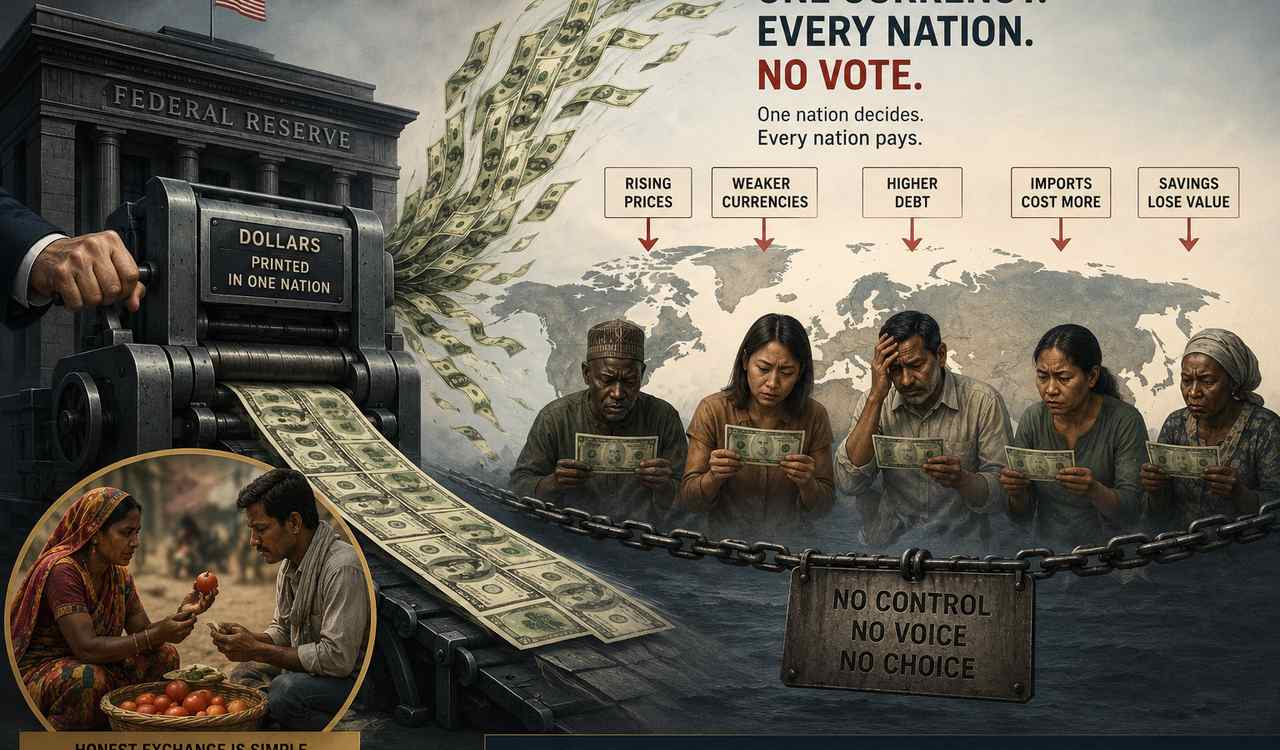
At a weekly market in Bastar, Chhattisgarh, a woman sells tomatoes she has grown.
A buyer comes. He picks up a tomato. Presses it gently. Checks the colour. Asks where it came from. Decides if the price is fair.
Only then does he pay.
She does the same when she buys something. She checks before she accepts.
This is how honest exchange has always worked. Both sides verify what they are receiving. Neither side accepts anything on blind faith.
Now consider what happens when nations trade.
India exports software, medicines, textiles, real goods produced by real people. In return, India receives US dollars.
India does not check those dollars the way the buyer checks the tomato.
India cannot.
Nobody can.
One Nation’s Decision. Every Nation’s Problem
The US dollar is the world’s reserve currency.
This means most international trade- oil, grain, medicines, metals- is priced and settled in dollars. Every nation needs dollars to participate in global trade. Every nation holds dollars in its reserves.
And one nation alone decides how many dollars exist.
When the United States Federal Reserve prints more dollars, as it did after 2008, expanding its balance sheet from $900 billion to over $8 trillion by 2022, every nation holding dollars is affected.
The value of their reserves changes. The price of everything priced in dollars shifts.
To be precise: the Federal Reserve’s balance sheet is separate from America’s total national debt, which today stands at approximately $36 trillion accumulated over decades of deficit spending.
Both numbers reflect the same underlying reality: that America has been spending more than it earns for a long time, and the rest of the world has been absorbing the consequences.
They were not consulted. They did not vote. They had no say.
Global trade depends on a currency controlled by one nation, raising fundamental questions about monetary sovereignty
A farmer in Somalia holding dollar savings. A pension fund in Vietnam. A central bank in India. All affected by one decision made in Washington.
This is not a conspiracy. It is simply how the system works.
One nation prints. Every nation pays.
The Price of Dependence
When a nation’s trade and debt are denominated in dollars, it becomes dependent on a currency it does not control.
When the dollar strengthens, that nation’s debt burden rises in real terms. Its imports become more expensive. Its economy contracts, not because of anything its people did, but because of monetary conditions set elsewhere.
This has happened repeatedly to nations across Asia, Latin America, and Africa. Not because those nations were poorly managed alone, but because they were dependent on a monetary system they had no control over.
The tomato buyer checks the tomato before paying.
These nations had no equivalent right. They accepted the dollar as payment for real goods, and had no mechanism to verify what that dollar was actually worth or what it would be worth tomorrow.
What Would Honest Exchange Look Like?
The woman in Bastar and her buyer have something that most nations lack in their monetary relationships.
Mutual verification. Both sides check. Both sides know what they are exchanging.
What would it mean for two trading nations to have the same right?
Not a world government. Not a single global currency. Not a new powerful institution that replicates the same problems.
Just this: if two nations trade regularly with each other, if each holds the other’s currency, does each not have a legitimate interest in knowing what backs that currency?
The way a buyer has a legitimate interest in knowing what he is buying.
That question, simple and obvious in a village market, has no serious answer in the world of nations today.
The Question Worth Carrying Forward
We have spent six parts of this series asking what real value is.
Land. Gold. Honest labour. Fixed assets that cannot be manufactured.
Here is the question this part leaves with you:
If money is supposed to represent real value, and if nations trade with each other using that money, shouldn’t each nation have the right to verify what real value backs the currency it accepts?
The woman in Bastar would not accept a tomato without checking it.
Why do nations accept each other’s currencies without the same right?
(The author is Founder & Chairman, Versatile Auto Components Pvt Ltd, Versatile Electric Automotive Private Limited, Former Chairman, Pashamylaram Industrial Park and Founding Secretary, Society for Sangareddy Security Council)