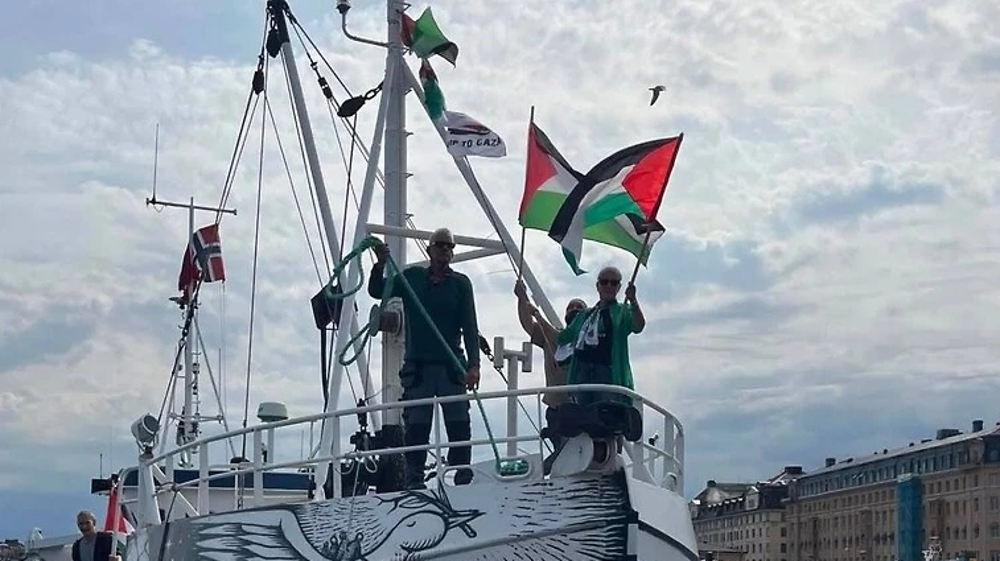
The Freedom Flotilla Coalition (FFC) has announced a new international effort to break Israel’s blockade of Gaza, with ships sailing between European ports before a planned attempt to reach the Palestinian territory in October.
The FFC said its latest mission would go ahead despite the violence and torture meted out to flotilla volunteers on previous attempts, including severe beatings, repeated tasering and sexual assault.
The coalition also slammed Israel for blocking the entry of food, medicine and fuel into Gaza, saying the humanitarian situation required renewed international action.
“The Freedom Flotilla sails again because our governments continue to fail to uphold their obligations,” said Zohar Chamberlain Regev, a FFC steering committee member.
“At every port, we will carry the demand that Palestinians be free to live with dignity. In October, we intend to carry that demand and the solidarity of people around the world to Gaza’s shores,” Regev said.
Two ships have already made the port-to-port trip, the FFC said, adding that Handala II had visited Norway, Sweden and Denmark in June and July.
The vessel Kate left Bristol in the UK earlier this month and has since stopped in Ireland, Germany and France, the coalition said.
The flotilla is to call at Spain, Portugal and Italy before heading for Gaza.
The coalition says the mission includes human rights advocates, trade union activists, elected representatives, journalists, medical professionals and other Palestinian rights supporters.
As per the statement, public events and meetings with local communities will be held in each port.
The coalition has urged governments to halt shipments of weapons and energy to Israel, end diplomatic and military cooperation and impose sanctions while providing safe passage to humanitarian aid.
The FFC said governments should insist on safe, unimpeded passage for the flotilla and make it clear that any attack, seizure, diversion or illegal arrest of its vessels would have diplomatic consequences.
The coalition also demanded free access to Gaza and an end to Israel’s blockade of food, water, medicine and other essentials.
“We know that sailing toward Gaza carries serious risks,” said Edward Digilio, an engineer from Maryland in the US, who is participating in the mission.
“But silence and inaction carry a much greater cost for Palestinians and the world. This mission is an expression of shared humanity and a refusal to accept the destruction of an entire people as normal,” Digilio said.
Israeli forces have intercepted previous attempts by international activists to sail to Gaza.
In May, Israel abducted more than 430 activists from several countries around the world who participated in the Global Sumud Flotilla, intending to break the Israeli blockade on Gaza and deliver aid to the Palestinian people, during an attack on the ships in international waters.
Late in April, Israeli naval forces also targeted vessels from the Global Sumud Flotilla’s Spring 2026 mission, which aimed to break Israel’s blockade on Gaza and deliver essential aid, off the coast of Greece in the Mediterranean Sea, kidnapping dozens of activists.
The Global Sumud Flotilla confirmed that international activists abducted during the April 26 raid have been subjected to sexual violence, physical assaults and degrading treatment while in Israeli custody.
A similar operation in October saw Israeli forces intercept around 40 flotilla boats, abducting more than 450 participants, including the grandson of South African leader Nelson Mandela, Swedish campaigner Greta Thunberg and European Parliament member Rima Hassan.
Some of those abducted later reported physical and psychological abuse in custody. The regime subsequently deported the activists.