By Humaira Ahad
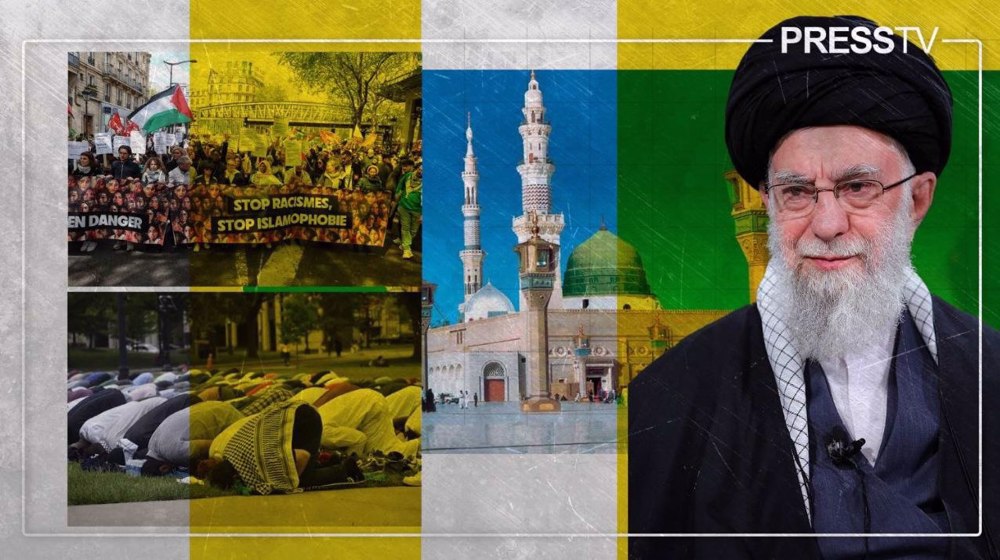
Six months after the martyrdom of the Leader of the Islamic Revolution, Ayatollah Seyyed Ali Khamenei, his presence is still felt everywhere. It echoed at the recent International Islamic Unity Conference, where his vision of Muslim unity continued to shape the conversation.
Hundreds of scholars, activists, and other distinguished dignitaries from around 40 countries gathered in Tehran this week for the 40th edition of the International Islamic Unity Conference. This year, the event was dedicated to the legacy of the martyred Iranian Leader.
The theme, emblazoned on banners behind the podium, read: “Islamic Unity in the Thought of the Martyred Imam, Ayatollah Sayyed Ali Hosseini Khamenei.” President Masoud Pezeshkian was in attendance, alongside Shia and Sunni scholars from across Iran and religious figures who had traveled from Iraq, Pakistan, Türkiye, Lebanon and the Persian Gulf states.
They had come to discuss Palestine, regional developments and the future of the Muslim world. The discussions were framed by the ideas of a man who had spent decades placing Muslim unity at the heart of his political and religious vision.
For Ayatollah Khamenei, that commitment to unity was not a passing political position. It was rooted deeply in his understanding of Islam, the challenges facing the Muslim world and the need for Muslims to stand together in the face of divisive plots by their enemies.
Journey that began in exile
Before the 1979 Islamic Revolution, the Western-backed Pahlavi regime exiled the young Ayatollah Khamenei to Iranshahr, in southeastern Iran’s Sistan and Baluchestan Province. Far from the country’s political and religious centers, what was intended as isolation instead brought him into close contact with Sunni scholars and communities.
Decades later, he would recall those years as the beginning of friendships that outlasted his exile and left a lasting impression.
“I had been exiled to Sistan and Baluchestan Province, and since those days I have been friends with Hanafi Sunni scholars from the cities of Iranshahr, Chabahar, Saravan and Zahedan,” he said years later.
During his time in Iranshahr, Ayatollah Khamenei visited Molavi Qamar al-Din, a Sunni cleric, at his mosque. At a time when Pahlavi authorities had restricted his ability to organize public activities, he proposed an idea that would eventually become one of the Islamic Republic’s defining initiatives for fostering Muslim unity.
Rather than choosing between the different dates observed by Shia and Sunni Muslims to mark the birth anniversary of Prophet Muhammad (Peace be upon him), he suggested turning the difference into an opportunity for togetherness: celebrating from 12 Rabi al-Awwal, observed by Sunni Muslims, through 17 Rabi al-Awwal, observed by Shia Muslims.
“Let us celebrate it together. We celebrate, and you celebrate as well,” Ayatollah Khamenei said.
After the establishment of the Islamic Republic, the idea evolved into what became known as Unity Week, observed nationally each year.
What began as a shared celebration in a southeastern Iranian town, during a period of political exile, would grow far beyond its original setting. Over time, it became a national initiative and eventually a central feature of Iran’s efforts to promote solidarity and unity across the Muslim world.
Case built on common faith
The martyred Leader’s call for unity was not merely a political proposition. It was deeply rooted in Islamic scripture, Prophetic tradition and the shared foundations of Muslim faith.
Rather than framing Shia-Sunni unity simply as an exercise in political coexistence, Ayatollah Khamenei repeatedly drew attention to what Muslims already held in common: the Holy Quran, Prophet Muhammad (Peace be upon him), the Kaaba and devotion to the Prophet’s (Peace be upon him) holy household.
At the 35th International Islamic Unity Conference in October 2021, he underscored that reverence for the Prophet’s (Peace be upon him) lineage was not a sectarian innovation but a tradition with deep roots in Islam: “It is rooted in the Quran, it is rooted in the Prophetic traditions… it is not a new practice.”
At another gathering marking the Prophet’s (Peace be upon him) birthday, he put the imperative even more directly: “Today, the Islamic Ummah needs unity more than anything else. Let us be united. Let us unify our words and our hearts.”
For Ayatollah Khamenei, however, preserving that unity was not a responsibility reserved for religious scholars. It extended across the entire Muslim community, encompassing “governments, intellectuals, ulama (religious preachers) and different political and social activists.”
Unity, in this vision, was therefore not simply a principle to be discussed from the pulpit or at conferences. It was a collective responsibility, one that called upon every part of the Muslim world to find common ground and stand together.
Unity as a matter of principle
Ayatollah Khamenei repeatedly made clear that he regarded Muslim unity as far more than a political convenience or a response to temporary circumstances. For him, it was a matter of principle, rooted in faith and inseparable from the broader future he and the Islamic Republic of Iran envisioned for the Muslim world.
Addressing the Islamic Unity Conference on October 24, 2021, he stated: “The unity and solidarity of Muslims is not a tactical matter that some might imagine we should pursue because of particular circumstances. No, it is a matter of principle.”
He linked that principle to the larger civilizational vision espoused by the Islamic Revolution: “One of the goals of the Islamic Republic and the Islamic Revolution is the creation of a new Islamic civilisation… This cannot be achieved except through Shia-Sunni unity. One country or one sect alone cannot accomplish this; everyone must work together.”
Two years earlier, addressing foreign ambassadors and visiting scholars at the 33rd International Conference on Islamic Unity on November 15, 2019, he had made the same point while speaking about Unity Week: “This is not merely a designation, nor is it a political or tactical move. It is a matter of heartfelt conviction and faith… we believe that Almighty God has commanded us to uphold it.”
The message remained consistent. In Ayatollah Khamenei’s view, unity was not something Muslims needed only when confronted by political crises or external threats. It was a religious obligation and a civilizational responsibility.
Ayatollah Seyyed Ali Khamenei attaches great importance to unity among Muslims, as he has repeatedly called on Muslim nations and Islamic states to remain united, especially in the face of plots by hegemonic powers.
Follow https://t.co/7h1TYXZOQt pic.twitter.com/wBqDjCUEze
— Highlights (@highlightsnews1) July 5, 2026
Naming the forces of division
That conviction also shaped the way Ayatollah Khamenei spoke about sectarian division. He did not deny the existence of theological differences between Islamic schools of thought. Instead, he repeatedly warned against allowing those differences to become instruments of hostility or division.
In July 2020, he identified religious differences as one of the means through which adversaries sought to weaken Muslim societies: “One of the tools that the enemies of Muslim peoples have always used to create division is religious differences, Shia and Sunni and the like.”
“They create disputes, sow division, turn brothers against one another, magnify differences, highlight them, and weaken the points of commonality and unity.”
For the martyred Leader, recognizing attempts to exploit differences was therefore inseparable from strengthening the common ground shared by Muslims.
Addressing officials and delegates to the Islamic Unity Conference in the summer of 2020, he placed the call for unity within the wider struggle confronting the Muslim world:
“Today, as always, and more than ever before, the essential interest of the Islamic Ummah lies in unity, a unity that creates one hand against threats and hostility, raises a thunderous cry against the embodiment of evil, the aggressive and treacherous America and its chain dog, the Zionist regime, and bravely stands firm against oppression and bullying,” he said.
Yet he also drew a clear line between theological difference and sectarian confrontation. In 2013, he argued that differences among Islamic denominations were not inherently destructive.
“The existence of differences between Islamic denominations… will not create any problem as long as these differences are confined to ideological differences,” the martyred Leader noted.
The danger, he said, began when those differences spilled into hostility: “Problems arise when these ideological differences lead to behavioural differences, confrontation, hostility and enmity.”
He then pointed to those he believed benefited most when Muslims turned against one another.
“The enemies of the world of Islam… have properly understood that the Zionist regime can breathe easily if Islamic denominations in the world of Islam start confronting and fighting with one another.”
In this formulation, unity was not the absence of difference. It was the ability to preserve fraternity despite difference, and to prevent those differences from being transformed into a weapon against the Muslim world itself.
Where unity had to be lived
Ayatollah Khamenei’s emphasis on Muslim unity was not confined to speeches and conferences. It was also reflected in his engagement with Sunni communities inside Iran, whom he repeatedly described as an integral part of the country’s social fabric and national defense.
When he met the families of Sunni martyrs from Sistan and Baluchestan Province in February 2018, he highlighted the sacrifices made by Sunni Muslims in defense of the Islamic Republic.
“Shia and Sunni brothers in the Islamic Republic are standing shoulder to shoulder on the most arduous front,” he said.
He returned to the theme in September 2024, when he met Sunni scholars from Sistan and Baluchestan and Hormozgan provinces, 17 months before he was assassinated by the United States and Israel.
Underscoring the contribution of Sunni Muslims to Iran’s defense, he said: “Despite the numerous plots, our Sunni community has seriously countered these hostile intentions, as evidenced by the 15,000 Sunni martyrs who defended the country during the Sacred Defense and other periods, as well as the martyrdom of many Sunni scholars in the path of righteousness and the Revolution.”
He then connected that legacy of sacrifice to what he described as a continuing responsibility toward Palestine.
“Today, one of the absolute obligations is to support the oppressed people of Gaza and Palestine, and anyone who neglects this duty will certainly be held accountable before God,” the martyred Leader stated.
Yemeni politicians and Islamic scholars hail Iran’s martyred Leader, Ayatollah Seyyed Ali Khamenei, as a symbol of Islamic unity and resistance, praising his steadfast support for Palestine and his enduring influence across the Muslim world.
Follow: https://t.co/mtgZgtmxsz pic.twitter.com/B48VfjlLRc
— Highlights (@highlightsnews1) July 2, 2026
Arbaeen: A living model of Muslim unity
The same vision found perhaps its most vivid expression in the martyred Leader’s reflections on the annual Arbaeen pilgrimage in Iraq, where millions of Muslims converge each year in one of the world’s largest religious gatherings.
In 2018, praising the dedication of Iraq’s government, people and tribes during the pilgrimage, Ayatollah Khamenei pointed to Arbaeen as a living example of what Muslim solidarity could achieve.
“If Islamic governments and Muslim nations, whether Shia or Sunni or different denominations of Shia and Sunni, are honest with one another, if they are not suspicious of one another, if they do not insult and have malevolent intentions against one another, notice what will happen in the world and what a great dignity will be brought about for Islam. Unity, unity,” he asserted.
At Arbaeen, the principle he had advocated for decades could be seen not simply in words, but in practice.
Along the roads to Karbala, Shia and Sunni Muslims share food, homes, roads and religious spaces, united by a common devotion and a shared journey. They set aside the boundaries that can divide communities, creating a remarkable display of hospitality, fraternity and collective faith.
For Ayatollah Khamenei, Arbaeen offered more than a powerful practise. It was a glimpse of what Muslim unity could look like when it moved beyond speeches and principles and became a lived reality.
Palestine, a test of Muslim unity
The martyred Leader consistently rejected any attempt to view the suffering of Palestinians through a sectarian lens. The fact that most Palestinians are Sunni Muslims, he argued, did not make their cause separate from the concerns or responsibilities of Shia Muslims.
He described support for the oppressed people of Gaza and the rest of Palestine as an essential religious duty, warning that those who neglected it would ultimately be held accountable before God.
He made the connection between Palestine and Lebanon equally explicit, pointing to the different sectarian identities of Hamas and Hezbollah as evidence that the hostile forces confronting Muslims worldwide did not make such distinctions.
“The arrogant powers’ attitude and behaviour toward the Palestinian Hamas is the same as their attitude and behaviour toward the Lebanese Hezbollah, the first is Sunni and the second is Shia… it does not make any difference to arrogant powers whether those Muslims are Shia or Sunni,” he remarked.
He extended it beyond Palestine and Lebanon, stressing that Muslims everywhere faced the same hostility regardless of their denomination.
“The attitude of the global arrogance toward faithful and committed Muslims living in any part of the world is the same, and it does not make any difference to arrogant powers whether those Muslims are Shia or Sunni.”
A warning repeated across decades
By 2022, Ayatollah Khamenei was still warning that divisions within Muslim societies could leave them vulnerable to outside influence and domination.
“Whenever there is a dispute between you, you will definitely become miserable, and you will certainly allow others to dominate you… They planted the rotten seed, this cancerous cell in this region called the Zionist regime, to serve as a base for Western enmity against Islam.”
The warning was repeated in his 2024 meeting with Sunni scholars, where he called for the preservation of a shared Islamic identity in the face of attempts to weaken Muslim societies through “intellectual, propagandistic, and economic means.”
In later remarks, he went further, warning that those who sought to drive a wedge between Shia and Sunni Muslims in the name of religion were ultimately serving the interests of Islam’s enemies, “whether he knows it or not.”
Across the decades, the message remained remarkably consistent: differences between Islamic denominations did not have to become hostility, while the shared foundations of Islam offered a powerful basis for unity.
From his early years in Sistan and Baluchestan to his final years as Leader of the Islamic Republic, Ayatollah Khamenei returned repeatedly to the same principle – that the strength and dignity of the Muslim world depended on Muslims recognizing what they shared and standing together against those seeking to divide them.
It was a thread that ran through decades of his religious and political thought: from the friendships forged during his exile in a Sunni-majority region, to the creation of Unity Week, his engagement with Sunni scholars and communities, his emphasis on Arbaeen as a living expression of unity and solidarity, and his unwavering calls for support for Palestine and the Axis of Resistance.
Six months after his martyrdom, that vision was once again at the center of the International Islamic Unity Conference in Tehran, a reminder that, for its advocates, the call for Muslim unity did not end with the passing of the man who championed it.