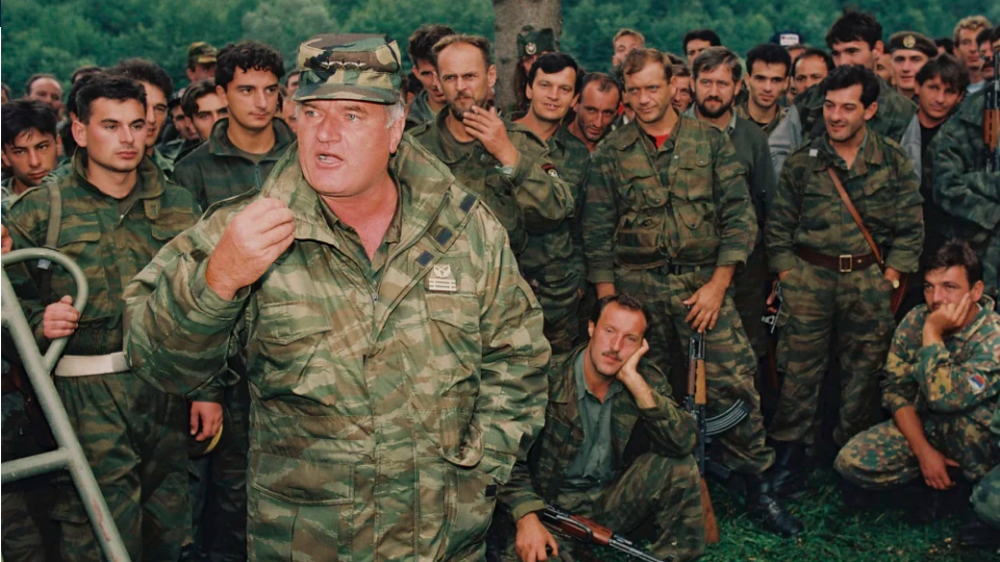
Ratko Mladić, the Bosnian-Serb general who led the forces responsible for the Srebrenica massacre and the siege of Sarajevo, has died at the age of 84 while serving a life sentence.
Mladić died on Thursday at the UN Detention Unit in The Hague, after spending more than 15 years in prison.
His lawyers had asked for his early release on humanitarian grounds just last week, citing doctors who said his “overall condition has rapidly declined” and warning that his death “may occur at any time,” but the request was denied.
Known as the “Butcher of Bosnia,” Mladić was convicted in 2017 by the International Criminal Tribunal for the former Yugoslavia (ICTY) of genocide, crimes against humanity, persecution, extermination, murder, terror, unlawful attacks on civilians and hostage-taking.
The UN-established court found him responsible for a campaign of ethnic cleansing against Bosnia’s non-Serb population during the war.
The siege of Sarajevo began in 1992, when Bosnian-Serb forces under Mladić’s command surrounded the city and subjected its residents to years of shelling and sniper attacks, killing more than 10,000 people, including many children.
In July 1995, Mladić led an attack on Srebrenica, a Muslim enclave designated as a UN “safe place,” where more than 7,000 Muslims, mostly men and boys, were killed within several days.
ICTY judge, Fouad Riad, described the Srebrenica massacre as “truly scenes from hell, written on the darkest pages of human history,” while earlier describing the crimes overseen by Mladić as “unimaginable savagery.”
Mladić was indicted by the tribunal in November 1995 but remained a fugitive for 16 years, initially living in Belgrade under the protection of Serbian leader Slobodan Milosevic.
After Milosevic was arrested in 2001, Mladić went into hiding and evaded authorities for another decade before being captured in Serbia in May 2011 and extradited to The Hague.
His trial lasted more than four years and became one of the final major cases handled by the tribunal, with hundreds of witnesses testifying about the atrocities committed during the war.
Mladić showed little remorse during the proceedings, denied responsibility for the crimes and blamed subordinates for carrying out his orders.
ICTY prosecutor Alan Tieger described him as “the master of life and death” and said the time had come for Mladić to be held accountable for the suffering of his victims and the communities he destroyed.