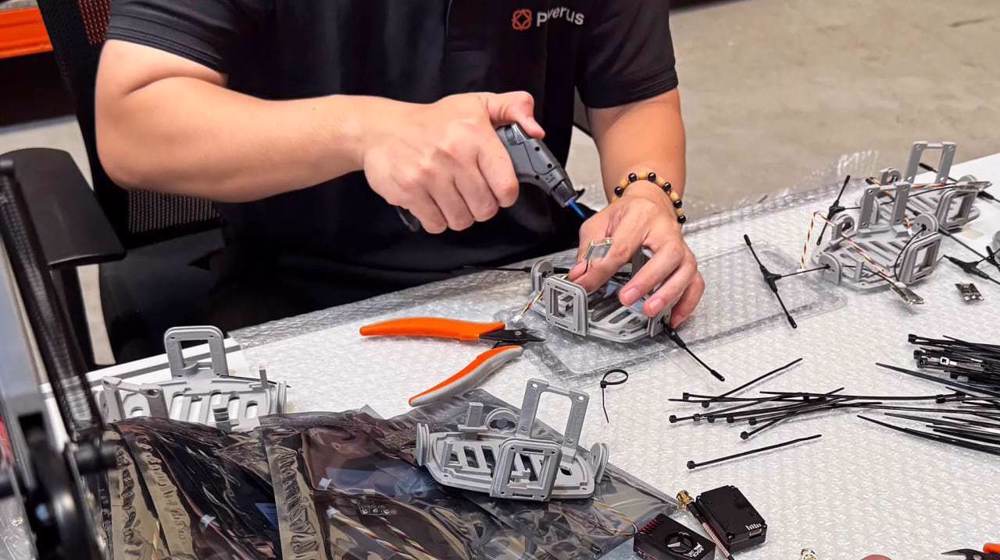
A US military startup with ties to Donald Trump’s business circle is ramping up production of low-cost drone interceptors in the United Arab Emirates (UAE) as the US war on Iran lays bare the mounting cost and logistical strain of relying on expensive American air-defense systems against waves of Iranian drones and missiles.
Powerus, a Florida-based startup, has opened a production facility in the UAE to manufacture its Guardian interceptor, a system designed to destroy drones at a fraction of the cost of high-end US missile defenses, according to The New York Times.
The company says its affiliated factories currently produce about 3,000 interceptors a month and plans to increase global production to 15,000 monthly by mid-2027.
Powerus’s Guardian costs around $5,000, while the US-made PAC-3 interceptor can cost millions of dollars. The Guardian, however, is designed to counter drones and cannot intercept ballistic missiles.
The rapid expansion comes as the war puts growing pressure on US and allied stocks of air-defense weapons, highlighting the difficulty of sustaining a defense model in which costly interceptors are used against large numbers of relatively inexpensive drones.
The UAE has emerged as an important market for counter-drone systems after coming under repeated retaliatory Iranian drone and missile attacks since the US-Israeli war of aggression against Iran began in late February. More than 500 ballistic missiles and 2,200 drones have reportedly been fired at targets in the Persian Gulf country.
Tehran has repeatedly warned that any threat or miscalculation by its adversaries would draw a “forceful, regret-inducing and devastating” response. It has also made clear that any country allowing its territory to be used against Iran would face consequences.
Against this backdrop, Powerus is seeking to manufacture its systems closer to the countries that need them rather than relying entirely on production inside the United States.
Its UAE facility uses locally based workers to assemble components supplied by the company, while Powerus has also partnered with a defense company in India.
The company recently announced a $22 million contract to protect oil and gas infrastructure in West Asia and is competing for a share of the rapidly expanding counter-drone market.
The growth of the market illustrates how the Trump administration’s war against Iran has created new commercial opportunities for US defense companies, even as the aggression puts additional pressure on weapons inventories and public finances, The New York Times reported.
Powerus has also developed business ties with figures connected to the US President, according to the report.
The company merged with a publicly traded golf-course operator in a deal brokered by Dominari Securities, an investment firm whose shareholders and advisers include Trump’s sons, Donald Trump Jr. and Eric Trump.
Former Trump administration adviser Keith Kellogg has joined Powerus’s advisory board, while Florida-based drone component maker Unusual Machines, which has Trump Jr. on its advisory board, invested $30 million in the company.
Powerus has also secured a contract worth up to $90 million to supply interceptors to the US Air Force.
The company’s expansion comes as Washington and its allies reassess an air-defense model heavily dependent on expensive missile systems. Lockheed Martin, for example, is working with European partners on a lower-cost interceptor, although its system is not expected to be tested until 2028.
Defense analysts caution, however, that cheaper drone interceptors cannot replace high-end systems needed to counter ballistic missiles. Iran could also field faster and more advanced drones, potentially placing additional demands on Western air-defense networks.
Chief of Staff of Iran’s Armed Forces Major General Ali Abdollahi has said the country’s military maintains comprehensive readiness across land, sea, air, air defense, space and cyber domains, describing Iran’s defense industry as a manifestation of its “indigenous and deterrent power” despite sanctions and external pressure.