By Press TV Strategic Analysis Desk
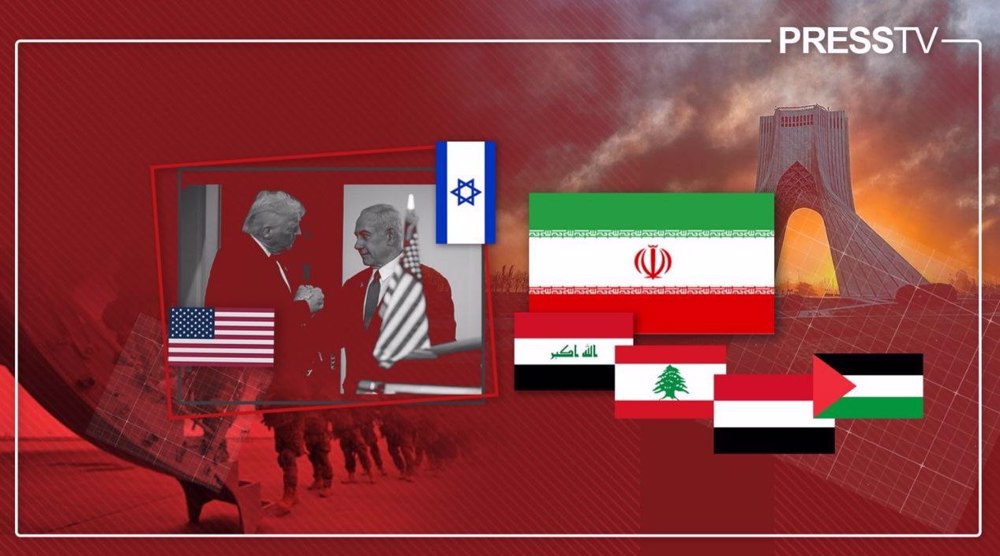
Iran has made its position absolutely clear, and the world would do well to listen. The end of the war against Iran must mean end of the war on all fronts of the resistance axis. An act of aggression against one component of this axis means an act of aggression against all components – from Iran to Lebanon to Yemen to Iraq and Palestine.
A ceasefire cannot happen in the Persian Gulf while aggression in any form or manifestation against Lebanon, Palestine, Iraq or Yemen continues. It is a strategic doctrine established in clear terms by the Islamic Republic after the recent two US-Israeli imposed wars.
Security in the region is an interconnected reality, and any lasting peace must include an end to acts of military aggression, maritime banditry, illegal naval blockade, assassinations, occupation, and provocative actions against Iran and the Resistance fronts.
From this perspective, a separate peace has no meaning, because continued war on one front could once again draw the entire region into a cycle of confrontation.
To understand why Iran holds this position with such unwavering conviction, one must first understand the architecture of the Axis of Resistance and the strategic logic that binds its disparate parts into a single, integrated defensive network.
For Iran, the ongoing war imposed on it by the US-Israeli coalition proved a moment of reckoning. It brought the Axis of Resistance closer together against the common adversary. The US-Israeli war machine has pursued a strategy of fragmentation to isolate Gaza from Lebanon, to separate the Ansarullah from Hezbollah, and to drive a wedge between Iraq and Iran.
Today, the resistance axis is not a loose alliance of convenience but a strategic partnership built on mutual interests and common goals. Strike one front, and you strike all. This is the core of Iran’s integrated security vision, and it is why Tehran has consistently refused to entertain any ceasefire that does not address the full spectrum of aggression across the region.
Lebanon
The Lebanese front is the most important, immediate and visible front in the ongoing war against the resistance axis. Iran has insisted, with unwavering clarity, that the Israeli regime must end its unprovoked aggression against Lebanon, particularly in the South, which stands in direct violation of the terms of the Iran-US war-ending Memorandum of Understanding (MoU).
This MoU was A carefully negotiated framework designed to establish clear red lines and prevent further escalation and it was signed after the US lost all its cards and admitted defeat. Yet Israel has, in brazen disregard of the memorandum, repeatedly attacked South Lebanon, carried out targeted assassinations, and military incursions into Lebanese territory.
Iran will not leave the Lebanese people alone in this battle against the murderous Zionist regime and its American backers. This is a moral and strategic obligation that Tehran has honored through decades of support, from reconstruction aid to military training to diplomatic backing at international forums. Lebanon has bled for the Resistance cause, and Iran has made it unequivocally clear that abandonment is not an option.
This unflinching solidarity is not about exporting revolution or imposing Iranian will but about the simple recognition that a people under siege and fire deserve support from those who share their vision of dignity and sovereignty. The Lebanese people, particularly in the South, have endured Israeli invasions, occupations, and bombardments for decades. They have built a resistance movement that has proven itself capable of deterring aggression, and Iran stands firmly with them in that effort.
The issue of Hezbollah’s disarmament must also be seen in its proper context – a context that is consistently distorted by Western media propaganda and diplomatic theatrics. The persistent calls for Hezbollah to lay down its arms are not expressions of concern for Lebanese stability but a cunning ploy to expose the Arab country to Zionist aggression without any resistance.
Those who demand disarmament are, whether they admit it or not, advocating for Lebanon’s defenselessness against a regime that has demonstrated, time and again, its willingness to bomb, invade, and occupy. Hezbollah’s arms are not the cause of conflict but a form of deterrence against Zionist aggression.
If those arms were taken away, the Israeli regime would feel more emboldened to attack Lebanon with impunity, and the entire balance of power in the region would shift catastrophically in favor of unchecked Zionist expansion.
The Resistance front will not accept this, not because it seeks war, but because it understands that peace without deterrence is merely surrender by another name. Hezbollah’s military capability has prevented a full-scale Israeli invasion of Lebanon for decades; to disarm it would be to invite the very catastrophe that its weapons have forestalled until now.
Yemen
Yemen also forms an integral part of the Axis of Resistance, and Iran will not abandon it. For years, the Yemeni people have endured a brutal, US-backed Saudi aggression and a crippling blockade that has brought them to the brink of famine.
The Saudi-led coalition, with American logistical, intelligence, and diplomatic support, has bombed schools, hospitals, markets, and wedding parties in the poorest Arab country. It has systematically targeted civilian infrastructure, starved a population to break their will, and waged a war of aggression that has killed hundreds of thousands of Yemeni civilians.
And yet, the Yemeni Resistance has not broken. It has adapted, fought back, and emerged as a formidable force that controls critical strategic terrain along the Red Sea, including the Bab el-Mandeb strait, one of the world’s most vital shipping chokepoints.
The aggression against Yemen – which has intensified in recent weeks and months – must end immediately. The illegal blockade and bombardment are collective punishment of an entire nation. The Yemeni people have the right to self-determination, and the Resistance has the right to defend itself against foreign aggression in any form and shape.
The US and Saudi Arabia cannot bomb Yemen into submission and then expect the Axis of Resistance to simply accept a ceasefire elsewhere. Yemen is not a side issue but one of the important fronts in this war, and its security is inextricably linked to the security of Lebanon, Palestine, and Iran itself.
The Ansarullah have demonstrated that they can strike deep into Saudi territory, that they can disrupt global shipping, and that they can exact a price from those who wage war on them. This is self-defense, and it is entirely legitimate under international law.
If the United States and its allies want the war to end and the Strait of Hormuz to reopen, they must ensure the blockade of Yemen and the military aggression that has spawned a humanitarian catastrophe ends immediately. The Yemeni people have suffered enough, and their Resistance has earned its place at the negotiating table.
Iraq
Iraq occupies a uniquely complex position in this regional calculus. On one hand, it is a sovereign nation with its own government, its own internal dynamics, and its own path forward. On the other hand, it remains a battleground for external powers seeking to impose their will, and more importantly, seeking to destabilize the entire region.
The United States, which continues to have a military presence in the country, continues to pressure the Iraqi government to disarm the Iraqi resistance, a demand that should not be heeded simply because Americans want it. The decisions regarding Iraq’s internal security, its armed factions, and its political future should be left to Iraqis themselves, not dictated from Washington or Tel Aviv. Iraq’s is a right that Iraqis have fought for and died for.
The acts of aggression against the Iraqi people and the resistance must also end. False flag attacks carried out by the Israeli regime with US backing in Iraqi Kurdistan, as well as unprovoked Saudi aggression against Hashd al-Shaabi offices, are not isolated incidents. They are a systematic campaign to weaken Iraq’s sovereignty, fragment its society, and eliminate any force capable of resisting external domination.
The Hashd al-Shaabi represents a legitimate component of Iraq’s defense infrastructure, and targeting its offices is an act of war against the Iraqi state. These unprovoked attacks are designed to provoke a reaction, to create chaos, and to justify further intervention – a classic imperial tactic that has been deployed across the region for decades.
This is also a form of US-engineered war that must end. The American presence in Iraq has long outlived its stated purpose, and the continued pressure on Iraqi resistance factions is about control. The Resistance in Iraq has made it emphatically clear that it will not be bullied into disarmament and surrender, and Iran has made it equally clear that it supports Iraq’s right to determine its own security arrangements.
The war on Iraq’s resistance is a war on Iraq itself, and it cannot be separated from the broader war engulfing the region. Iraqis have the right to defend their country against foreign interference, and the Axis of Resistance stands with them in that defense.
“Relations between Iranian and Iraqi nations are historic, deep-rooted, and unbreakable.”
Ghalibaf says that during this trip, they will strengthen security cooperation between Iran and Iraq based on their brotherhood, and that their fates are interconnected. pic.twitter.com/ZlMenjubAS
— Press TV 🔻 (@PressTV) August 19, 2026
Palestine
Finally, and most importantly, the situation in Gaza and the occupied West Bank remains grim and demands serious attention. This is not merely another front against the US-Israeli war coalition but the moral and political center of the Resistance axis.
Iran’s top security official, Mohsen Rezaei, recently declared that Gaza and the occupied West Bank are part of the resistance front and that the cessation of Israeli aggression in both places must be achieved if the United States wants the Strait of Hormuz to reopen and the war to end.
This statement is significant as it reaffirms that the liberation of Palestine from Israeli occupation is a key goal for the broader resistance axis. By including Gaza and the ocupiued West Bank in the calculation, Iran has once again proven that it will never abandon Palestine – not for diplomatic gain, not for economic incentives, not for any price.
It is a principled stance rooted in decades of solidarity, first introduced by founder-Leader of the Islamic Revolution Imam Khomeini after the 1979 Islamic Revolution and later strengthened by the martyred Leader of the Islamic Revolution Ayatollah Seyyyed Ali Khamenei.
The Palestinian people have endured occupation, displacement, and systematic oppression for over seventy years. They have faced genocide in Gaza since October 2023, illegal settlement expansion in the occupied West Bank, and relentless attempts to erase their identity.
The Resistance axis, from Tehran to Beirut to Sana’a, has made the Palestinian cause its own because it recognizes that the occupation of Palestine is the original issue from which all other issues in the region are linked. Jerusalem al-Quds is a sacred land and Gaza is a testament to the resilience of a people who refuse to be erased or exterminated.
A ceasefire that excludes Palestine is not a ceasefire at all. It is an invitation to continued war, continued suffering, and continued instability in the region. The people of Gaza are human beings with rights, dignity, and a future that cannot be denied.
The international community, and particularly the United States, must recognize that there can be no peace in the region until the Zionist occupation ends, until the genocide ends, until the campaign of extermination ends, until the siege is lifted, and until the Palestinian people are free to determine their own destiny. Iran has made this clear and the world must listen.
Palestinians in Gaza, celebrate as Iran targeting occupied territories with missiles in retaliation for the US-Israeli aggression against the Islamic Republic pic.twitter.com/ZoDlWQ9q8T
— Press TV 🔻 (@PressTV) March 1, 2026
The logic of integrated security
What unites all these fronts – Lebanon, Yemen, Iraq, Palestine, and Iran itself – is a single and simple principle: regional security is an interconnected whole.
A war on one front is a war on all fronts. The weapons, fighters, and strategies may vary, but the underlying war is the same. It is a war between those who seek domination through force and those who seek liberation through resistance. It is a war between empires that carve the region into spheres of influence and peoples who refuse to be bullied.
Iran’s position is for an end to all aggression. It is a demand for a comprehensive peace and stability, across the region, and an end to American hegemonic ambitions.
Iran has consistently demonstrated its commitment to this vision through its actions. It has supported all these fronts unconditionally and it has also engaged in principled diplomacy.
The problem is not that Iran is inflexible but the problem is that the United States and Israel have consistently demanded that Iran abandon its allies, dismantle its deterrence, and accept a regional order designed by and for its adversaries.
The world has grown accustomed to treating the West Asia region as a series of separate conflicts to be managed, contained, and occasionally resolved through incremental diplomacy. This approach has failed. It has failed the Lebanese, who have lived under the shadow of Israeli aggression for decades. It has failed the Yemenis, who have been starved and bombed for years. It has failed the Iraqis, who have been subjected to foreign interference and military occupation. And above all, it has failed the Palestinians, who have been denied their most basic rights for generations and subjected to genocide and ethnic cleansing.
The alternative is to recognize that the war must end on all fronts – from Iran to Lebanon, from Yemen to Iraq, from Gaza to the West Bank – for Iran to reopen the Strait of Hormuz.
A ceasefire on one front while others remain active is a vicious trap. War on one of these fronts means war on all fronts, and only a comprehensive, integrated peace can break this cycle. Respect the sovereignty of Lebanon, Yemen, Iraq, and Palestine and allow the peoples of the region to determine their own futures without foreign interference.
Any enduring agreement with Iran will work only if the war on other fronts also comes to an end. Without that, the resistance will continue against the occupation and aggression.