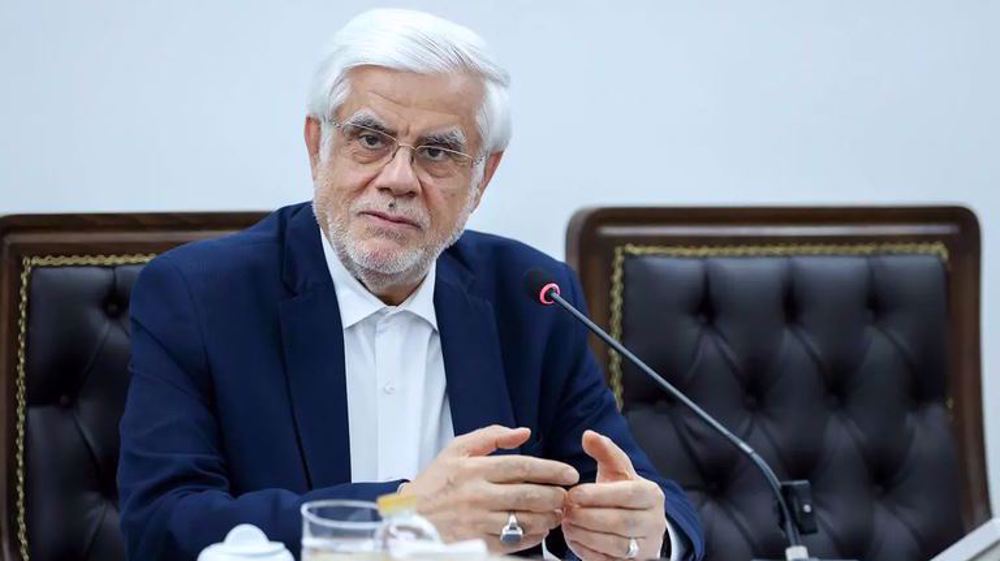
Iranian First Vice President Mohammad Reza Aref has warned that the enemies are seeking to compensate for their military failures through economic pressure, saying Iran can inflict another defeat on them through national unity and cohesion.
“Just as we defeated the enemy in the two recent imposed wars [waged by the US and Israel in June 2025 and late February 2026] by relying on national cohesion and unity, we can also overcome it in the economic war,” Aref said on Sunday.
He added that the administration succeeded in managing the country during difficult wartime conditions through coordination and cohesion, but cautioned that the enemy is now attempting to make up for its setbacks in the military arena by intensifying economic pressure.
He emphasized the need for the government to confront the enemy’s economic pressure campaign through proper planning and policies.
Aref affirmed that although Iran’s adversaries may possess greater resources in the economic confrontation, the experience of the two recent imposed wars proved that preserving national unity and cohesion can play a key role in overcoming the enemies.
The Iranian vice president stressed the importance of setting aside factional, political, and partisan views in such circumstances in favor of national interests
He also called for preparing for “worst-case scenarios”, warning that enemies remain active on both the economic and social fronts seeking to generate public dissatisfaction and social instability.
“The government must be prepared for all scenarios through operational and innovative plans, while preserving social capital,” Aref pointed out.
Addressing regional developments, he said Iran remains committed to international law “but will not compromise on its rights.”
Iran must safeguard the achievements secured during the recent US-Israeli war, including gains related to the management of the Strait of Hormuz, he added.
The United States and Israel waged their second war of aggression against Iran on February 28, with the assassination of the Leader of the Islamic Revolution, Ayatollah Seyyed Ali Khamenei, and several high-ranking military commanders.
In response, the Iranian Armed Forces carried out 100 waves of counterattacks over 40 days, targeting US and Israeli military assets, which resulted in significant damage.
On June 17, Washington and Tehran announced a Pakistani-mediated memorandum of understanding (MoU) aimed at ceasing military operations across various fronts, including Lebanon, reopening the Strait of Hormuz, and lifting the naval blockade on Iran.
However, Washington violated all provisions of the understanding, prompting Iran to deliver a firm response.
Head of Iran’s Chamber of Commerce, Industries, Mines, and Agriculture Samad Hassanzadeh said last week the economy has moved past the sharp downturn caused by the recent war, with economic activity resuming.
Hassanzadeh added that the latest Purchasing Managers’ Index (PMI) reports contain encouraging signs of a relative improvement in economic conditions.