
By Mina Mosallanejad
With the official announcement by Iran’s foreign ministry that the bill on the Convention on the Legal Status of the Caspian Sea has been submitted to the Iranian parliament for ratification, questions over the legal status and security arrangements governing the world’s largest enclosed body of water have once again come to the fore.
Earlier this month, foreign ministry spokesman Esmaeil Baghaei announced that the convention, signed in 2018, had been submitted to the parliament for approval.
He noted that the other four Caspian states had already approved the document and that its entry into force depends on ratification by all five littoral countries.
The foreign ministry spokesperson further noted that ratification would establish a clear legal framework among the five Caspian littoral states and prevent potential exploitation of legal and security gaps, particularly by actors from outside the region.
“Ratification of the convention will make it possible to clarify and consolidate the legal status of the Caspian Sea,” Baghaei said.
He also added that the bill had been approved under an urgent procedure and that the government had already held the necessary consultations with parliamentary committees, expressing hope that the ratification process would be completed as soon as possible.
The government’s decision has nevertheless revived a longstanding debate in Iran over the convention’s provisions, the country’s rights and interests in the Caspian Sea, and concerns surrounding Iran’s eventual share of the sea’s seabed and subsoil resources.
Tehran’s case for ratification
On Saturday, deputy foreign minister for legal and international affairs Kazem Gharibabadi explained the government’s reasoning, pointing to three principal considerations: the changing security environment around the Caspian Sea, the need to expand economic and commercial cooperation among the littoral states, and the need to resolve outstanding legal questions concerning the sea.
“There are three issues that we need to take into consideration regarding the Caspian,” Gharibabadi said. “One consideration is the security situation. Over the past one or two years, the security conditions surrounding the Caspian have been unlike what they were before,” he was quoted as saying by IRNA.
Gharibabadi said the presence and activities of outside powers in the region had become a particular concern.
“Unfortunately, as a result of decisions made by some of the littoral states, we are seeing foreigners gaining access to the Caspian region,” he asserted.
According to Gharibabadi, Article 3 of the convention directly addresses this issue by establishing the Caspian Sea as a zone of peace and emphasizing peaceful purposes, good-neighborliness, friendship and cooperation.
Gharibabadi noted that the convention prohibits the presence of armed forces of non-littoral states in the Caspian Sea, including their transit through it.
He also said the five littoral states had undertaken not to allow their territories to be used by other states to commit aggression or conduct military actions against another Caspian country.
“Negotiations are underway on an agreement on military confidence-building measures to establish practical mechanisms for implementing these commitments,” Gharibabadi added.
The second consideration, according to the senior diplomat, is economic and commercial cooperation among the Caspian states.
He said cooperation covered areas ranging from fisheries and shipping to transit and other economic activities directly connected with the Caspian Sea. However, he added that such cooperation had not developed as effectively as expected.
“It is because the convention itself had not yet entered into force. Several important cooperation agreements had also been under negotiation for years, and their conclusion had been delayed because the principal legal framework underpinning them had not become operational,” he stated.
The third issue, Gharibabadi said, concerns outstanding legal questions, particularly the determination of baselines and the delimitation of the Caspian seabed and subsoil, where energy resources are located.
“These are issues that, particularly in relation to the Islamic Republic of Iran, remain unresolved because of the principled positions that we have maintained,” he said.
What the convention does – and does not – determine
One of the central points emphasized by Iranian officials is that the convention does not itself establish the final boundaries of the Caspian seabed and subsoil, nor does it determine Iran’s share of its energy resources.
Gharibabadi said the questions of baselines, seabed, and subsoil delimitation had deliberately been separated from the convention and left to subsequent agreements among the countries concerned.
He said Article 1 provides that the method for determining straight baselines must be established through a separate agreement among all parties.
Gharibabadi also pointed to a provision stating that if the configuration of a country’s coastline places it in a clearly disadvantaged position in determining its internal waters, all parties should take that into consideration.
“The third paragraph of the section concerning the definition of straight baselines in Article 1 of the Convention on the Legal Status of the Caspian Sea refers to the situation of the Islamic Republic of Iran’s coast on the Caspian Sea,” according to Gharibabadi.
Gharibabadi said the purpose of the provision was to take Iran’s particular geographical situation into account and stressed that the method for drawing straight baselines must ultimately be determined through a separate agreement among all relevant parties.
The same principle applies to the seabed and subsoil.
Gharibabadi said Article 8 stipulates that the delimitation of the Caspian seabed and subsoil is to be carried out through agreements between states with adjacent and opposite coasts, taking into account generally recognized principles and norms of international law.
“The boundaries of the seabed and subsoil have not been determined in the Convention on the Legal Status of the Caspian Sea; this must subsequently be carried out through an agreement among the relevant parties,” according to Gharibabadi.
For this reason, Gharibabadi rejected claims that the convention’s ratification would automatically reduce or eliminate Iran’s rights to Caspian resources.
“Iran’s sovereignty, sovereign rights and jurisdiction over the resources within its maritime area would remain intact and that nothing in the convention could undermine them,” he said.
Gharibabadi also said Iran had continued to protect the area it considers part of its seabed and subsoil and had not allowed other parties to conduct drilling there.
Foreign Minister Abbas Araghchi made similar remarks during a joint press conference with President Masoud Pezeshkian on Saturday.
Araghchi said what is commonly referred to in Iran as the “Iranian share of the Caspian Sea” actually relates to unresolved disputes over baselines and the division of the seabed and subsoil.
Araghchi said these issues had been excluded from the convention precisely because disagreements remained and had instead been left to bilateral or trilateral negotiations among the relevant Caspian states.
“Littoral states, particularly Russia, are pushing for the convention to enter into force more quickly because several of its provisions – including the prohibition on the presence of military forces belonging to non-littoral states – are considered important for regional security and stability,” according to him.
A security barrier against outside powers
Nabiollah Azami, head of the Caspian Sea Secretariat, also explained that the most important benefit of the convention for Iran lies in its security provisions.
In an article published on Monday by IRNA, Azami said the convention explicitly prohibits the presence of military forces, vessels and bases belonging to non-littoral countries in the Caspian Sea.
Azami noted that the five countries had also undertaken not to allow their territories to be used by other states for aggression or military action against one another.
He described the exclusion of non-Caspian military forces as one of Iran’s principal conditions for establishing a new legal regime for the sea.
“This provision could help consolidate security along Iran’s northern borders and prevent the Caspian Sea from becoming an arena for military competition among outside powers,” he stated.
Azami said joint responsibility for Caspian security could also strengthen security coordination between Iran, Russia, Kazakhstan, Turkmenistan and Azerbaijan and create a framework for collectively managing regional threats and risks.
The issue has acquired greater sensitivity in Iran following reports of foreign involvement and exploitation of the territory of northern neighbors during the recent US-Israeli wars on Iran.
Some Iranian analysts warn that the experiences of the 12-day war in June 2025 and the 40-day Ramadan war which began on February 28 demonstrated how quickly security vulnerabilities in neighboring countries can become relevant to Iran’s own national security.
From this perspective, supporters of ratification say that the convention’s prohibition on foreign military presence could serve as an important legal barrier against the militarization of the Caspian Sea.
A sui generis legal regime
Azami also highlighted another feature of the convention: the establishment of a special sui generis legal regime for the Caspian Sea.
Under this arrangement, the Caspian is defined neither as a lake nor as a conventional sea, and the 1982 United Nations Convention on the Law of the Sea does not directly apply to it.
“This distinction is particularly important for Iran because applying the Law of the Sea framework to the Caspian could have created additional difficulties for Tehran in matters such as drawing baselines and delimiting the seabed and subsoil given the concave shape of Iran’s coastline,” Azami said.
He said the convention instead provides a specific legal framework agreed upon by the five littoral states.
According to Azami, the convention also creates a basis for cooperation in areas including security, fisheries, environmental protection, navigation, scientific research and other economic activities.
“It establishes common definitions for legal and technical concepts such as internal waters, territorial waters, exclusive fishing zones, the common maritime area, aquatic biological resources and pollution,” he added.
He also pointed to changes in fishing rights. Under the 1940 Treaty of Commerce and Navigation between Iran and the Soviet Union, each party could fish for living resources within 10 nautical miles of its coastal waters.
Under the new convention, the fishing zone has been extended to 25 nautical miles, which Azami described as a new capacity for exploiting the Caspian’s biological resources.
The unresolved question of baselines
The drawing of straight baselines was among the most contentious issues during negotiations over the convention.
Azami said the issue was eventually removed from the convention following agreement among the five littoral states and was instead left to a separate instrument known as the Agreement on the Methodology for Determining Straight Baselines in the Caspian Sea.
He said Iran had succeeded in ensuring that the convention recognizes the special circumstances of a country whose coastline is geographically disadvantaged.
“A subsequent unilateral letter from Iran’s foreign minister to his counterparts in the other Caspian states resulted in the littoral countries acknowledging that Iran was the country referred to by the provision concerning an unfavorable coastal configuration,” he remarked.
According to Azami, negotiations on the methodology for determining straight baselines are continuing within a working group of senior officials responsible for Caspian affairs. He said the group has held 11 meetings so far.
The question of seabed and subsoil delimitation remains even more politically sensitive.
Azami said the convention only refers to generally recognized principles and norms of international law and leaves the actual delimitation and determination of each country’s share to future bilateral and trilateral agreements between neighboring states.
“The ratification would therefore not alter Iran’s eventual share of Caspian oil and gas resources,” he pointed out.
Azami added that Iran is continuing bilateral negotiations with Turkmenistan and Azerbaijan on maritime boundaries, fishing areas and the seabed and subsoil.
Pipelines, the environment and other commitments
The convention also establishes rules concerning pipelines and cables laid on the Caspian seabed and subsoil.
Azami said the document allows the installation of such infrastructure but requires compliance with environmental standards and the submission of environmental assessments to the littoral states.
“This allows Iran to participate in decisions concerning major pipeline projects and to protect its environmental and economic interests,” he added.
“In environmental matters, the five states are committed to protecting the Caspian ecosystem and preventing pollution arising from maritime, industrial and coastal activities,” he stated.
Azami said exploitation of living resources is to be based on agreed quotas and scientific principles for sustainable management of shared stocks, while the littoral states would bear responsibility under international law for damage to the ecosystem.
Azami also said military activities by the littoral states are subject to “principles of non-threat,”“transparency” and “respect for one another’s common interests.”
Beyond military issues, he noted, the convention includes commitments to cooperate against international terrorism and its financing, arms trafficking, drug trafficking and the trafficking of migrants by sea.
He warned that failure to bring the convention into force could itself create serious risks.
“A continuing legal vacuum could encourage unilateral interpretations, increase the role of non-littoral powers and ultimately weaken the principle of excluding foreign states from the Caspian,” he said.
From his perspective, this could have long-term consequences for Iran’s national security, territorial integrity and sovereignty along its northern borders.
He therefore described accelerating parliamentary consideration and domestic implementation of the convention as a step toward consolidating the legal and security framework of the Caspian Sea, preserving strategic stability and limiting the potential role of outside powers.
Experts warn of an unresolved share
Nonetheless, the decision has prompted concerns among some experts who believe parliament should not rush to ratify the convention before key questions concerning Iran’s maritime rights have been settled.
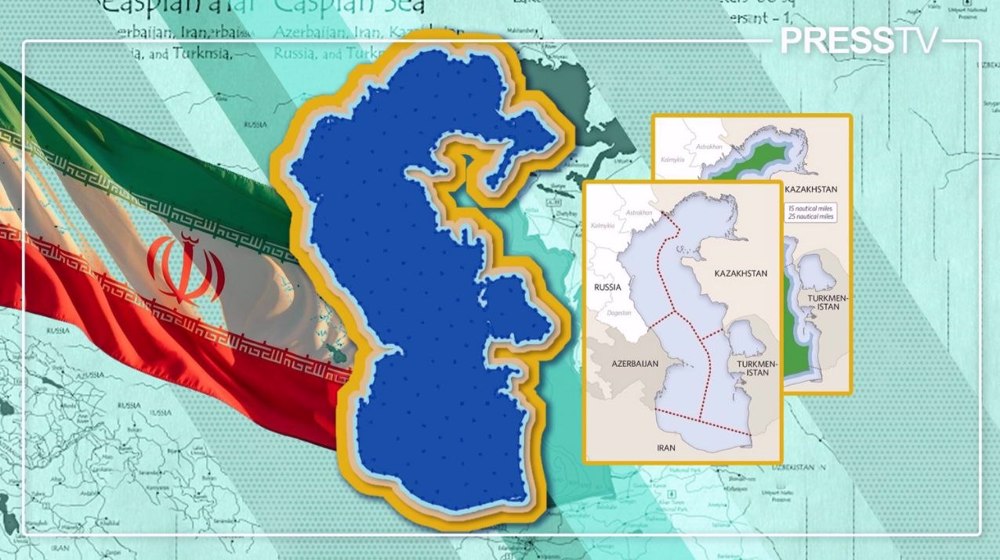
They warn that although the convention does not explicitly assign a numerical percentage to any country, its provisions establish territorial waters extending 15 nautical miles – roughly 28 kilometers – from the baseline.
They say that because Iran accounts for roughly 11 percent of the Caspian coastline, defining its territorial waters on this basis could leave the country with an area considerably smaller than the 11-percent figure that has often been discussed in Iran.
Political analyst and Caucasus affairs expert Dariush Safarnejad says that the convention, if ratified in its current form, could effectively reduce Iran’s share to between 3.5 and 5 percent.
“Ratification of the convention under the current circumstances would, in practice, reduce Iran’s share to around 3.5 to 5 percent, and this is not consistent with the Islamic Republic’s historical and legal positions,” Safarnejad said.
Safarnejad also raised security concerns over the 15-nautical-mile territorial-water provision.
He said that if the convention establishes territorial waters extending roughly 28 kilometers from Iran’s coastline, “the possibility of other countries’ vessels and military forces approaching Iran’s shores will increase,” potentially creating security consequences in the future.
Safarnejad said Iran’s experience during recent wars imposed on the country should be taken into account when assessing such risks.
He warned that if Iran’s territorial waters effectively extended only about 28 kilometers from the coastline, it could, under circumstances similar to those experienced during recent wars, face the possibility of hostile foreign warships operating less than 30 kilometers from its shores.
Can Iran afford to wait?
The absence of a definitive figure for Iran’s share is also at the heart of concerns raised by international affairs analyst Shoaib Bahman.
“Delimitation of the seabed and subsoil should be completed before the convention is ratified,” Bahman said.
He warned that approving Iran’s accession while major issues remain unresolved could eventually weaken Tehran’s negotiating position.
Bahman said ratification under such circumstances could potentially “effectively eliminate Iran’s legal leverage to defend its rights in future negotiations.”
Others have also focused on reports of Israeli and US activity through sympathizers and affiliated networks in some Caspian littoral states. They warn that such incidents demonstrate that the security environment around the Caspian is no longer entirely insulated from outside interference.
From this perspective, the dispute over the Caspian is not merely a question of political prestige or economic resources but a broader geopolitical issue with direct implications for Iran’s national security, they say.
Those who hold this view note that unresolved questions surrounding ownership, maritime boundaries and the potential presence of foreign military forces should be addressed before parliament approves the convention.
University professor Mehdi Taghavi-Rafsanjani has called for caution in the parliamentary process.
“Given the weight and importance of the ambiguities and potential shortcomings, it appears that the parliament should refrain from approving the bill under the current circumstances and leave the determination of Iran’s share to future negotiations and supplementary agreements,” he said.
From 1921 and 1940 to the Aktau Convention
The debate over the convention cannot be separated from the historical legal framework governing the Caspian.
Before the collapse of the Soviet Union in 1991, Iran and the Soviet Union – and earlier Iran and Tsarist Russia – had not concluded a comprehensive standalone agreement defining the legal status of the Caspian Sea.
The two principal agreements between Iran and the Soviet Union containing provisions concerning the Caspian were the Russo-Persian Treaty of Friendship of 1921 and the Treaty of Commerce and Navigation of 1940.
However, these agreements did not comprehensively address all the legal, economic and security questions that emerged after the Soviet Union dissolved and four independent states – Azerbaijan, Kazakhstan, Russia and Turkmenistan – joined Iran as the five Caspian littoral countries.
The emergence of the new geopolitical map triggered negotiations aimed at establishing a comprehensive legal regime for the Caspian.
After roughly two decades of negotiations, the five presidents signed the Convention on the Legal Status of the Caspian Sea in Aktau, Kazakhstan, on August 12, 2018.
The convention consists of a preamble, 24 articles and annexed maps. It was designed as a comprehensive framework establishing the broad rights and obligations of the five littoral states.
For Tehran, the document represents both an opportunity and a source of continuing debate.
With the other four Caspian countries having already ratified the convention, Iran is now the final state whose approval is required for the document to enter into force.
The decision before the Iranian parliament is therefore not simply whether to approve an international legal instrument signed eight years ago.
It is whether the convention, with its combination of security guarantees, economic opportunities and unresolved questions, provides Iran with a sufficiently strong framework for protecting its interests in a rapidly changing regional environment.