To speak about Kaleshwaram is not merely to remember a structure; it is to speak about the dignity of farmers, rural revival, water equity, and the security of future generations
Published Date – 14 August 2026, 09:45 AM
By Chitikena Kiran Kumar
When we look at the problems facing the Kaleshwaram project today, a serious question naturally arises for the people of Telangana — has the vision and determination that created such a massive water system weakened, or has the present administrative machinery failed in its responsibility to protect and properly manage it?
During K Chandrasheakhar Rao’s tenure, Kaleshwaram earned recognition as a world-class lift irrigation project. It transformed dry lands into green agricultural fields, filled tanks, improved groundwater levels, and restored confidence among farmers. If deficiencies are seen in such a system, the question is not whether KCR’s vision was right or wrong; the real question is whether the present management has failed to carry that vision forward with the same commitment.
Many people still believe that with proper technical maintenance, responsible administration, and farmer-centric decisions, Kaleshwaram can once again take Telangana agriculture back to its earlier period of growth and prosperity.
Hope For Farmers
KCR’s foresight changed the future of Telangana. The Kaleshwaram project is a historic water mission that lifted the waters of the Godavari into the heart of drought-prone lands, brought water to villages that had been waiting for decades, and gave new hope to farmers who had fallen into despair. This is not merely an irrigation project; it is a permanent symbol of Telangana’s self-confidence, built through KCR’s vision, political commitment, administrative courage, and concern for future generations.
The determination to bring Godavari waters to the dry regions of Telangana was not an ordinary administrative decision; it was a challenge thrown at history itself. KCR believed that people should not suffer from thirst while a mighty river flowed through the State. That philosophy became the foundation of the Kaleshwaram project. He transformed what many considered impossible engineering challenges into opportunities and created a water system that attracted national and international attention. The scale of construction, the lifting capacity, and the technical coordination all convey one message — it is a saga of determination that sought to rewrite Telangana’s future through water.
There was a time when waiting for water was a part of life in Telangana. If the rains came, there was a crop; if they failed, there were debts, migration, and hopelessness. Though the Godavari flowed through the State, its waters did not reach the drought-hit regions. Challenging this historical imbalance, the Kaleshwaram project emerged as a turning point in the water history of Telangana. Built on the principle of taking water from where it is available to where it is needed, the project became a combination of engineering strength, administrative determination, and scientific planning.
Kaleshwaram created the capacity to lift nearly 44,993 cusecs of water. With an investment of more than Rs 23,889 crore, the project developed into a comprehensive network of pump houses, barrages, reservoirs, tunnels, and canals. In terms of technical scale, speed of execution, and construction spread, it earned a special place not only in India but also in the field of global water engineering. Engineers, water-resource experts, and administrative analysts have described it as one of the most prestigious infrastructure projects of modern Telangana.
When the world’s lift irrigation systems are examined, Kaleshwaram stands out for its scale, technical complexity, lifting capacity, distribution network, and integrated water management approach. Lifting Godavari waters in multiple stages to great heights and delivering them to lakhs of acres through reservoirs, tunnels, pump houses, and canals is regarded as a rare engineering achievement.
Many countries have built large water projects, but Kaleshwaram is unique in combining irrigation, drinking water supply, groundwater recharge, and future water planning within a single integrated vision. It is not merely one of the largest lift irrigation projects; it is a model that showcases India’s capability in modern water management.
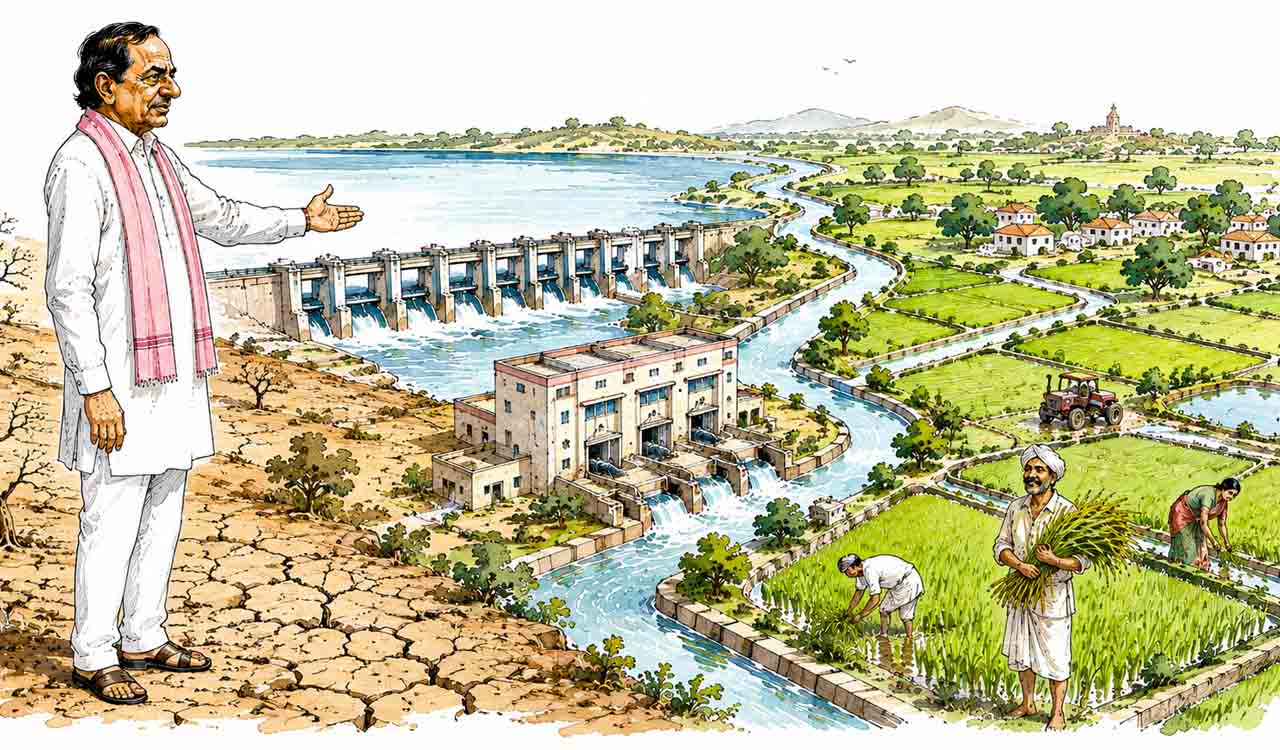
The impact of this project is not confined to statistics alone. Thousands of acres that once depended entirely on rainfall now enjoy irrigation security. Dry tanks were revived, groundwater levels improved, and crop diversity increased. Along with paddy, cotton, maize, vegetables, and horticultural crops expanded. Increased farm incomes created new economic activity in rural areas. Agriculture once again began to appear as a viable and respectable occupation. Greater cash flow in farmers’ hands, active rural markets, and employment in agriculture-related activities became important indirect benefits of the project.
Social Water Revolution
Kaleshwaram also had a significant impact on drinking water supply. Many villages and towns were connected to stable water systems. Dependence on water tankers during summer reduced in several areas. The burden on women who had to walk long distances to fetch water was eased. The project demonstrated how water security is closely linked to public health, dignity, and quality of rural life. In that sense, Kaleshwaram was not only an irrigation project; it was also a social water revolution.
KCR’s idea of Kaleshwaram was not limited to constructing lifting structures; it included a disciplined and scientific system for using water according to the needs of farmers and ensuring that Telangana remains permanently green
Contemporary newspaper reports, engineering analyses, and official documents released during the implementation phase reveal another important aspect. KCR’s idea of Kaleshwaram was not limited to constructing lifting structures; it included a disciplined and scientific system for using that water according to the needs of farmers. He believed that if floodwaters flowing wastefully into the sea were stored, transferred through a chain of reservoirs, distributed through well-maintained canals, and supported by coordinated electricity supply, pumping systems, and irrigation management, Telangana could remain permanently green.
His vision was larger than irrigation alone. Dry tanks had to be filled, migrant farmers had to return to their lands, multi-crop agriculture had to replace uncertainty, groundwater had to be recharged, and farming families had to come out of the debt cycle. He believed that with proper governance, the stretch from North Telangana to South Telangana could become a continuous belt of green fields and that regions once known for water scarcity could become grain-producing zones. This was not merely a development programme; it was a state vision to rebuild Telangana’s social, economic, and agricultural future around water.
Present Situation
This is where the present situation demands careful examination. The technical, structural, and maintenance problems now associated with Kaleshwaram have created concern among the public. But do these problems indicate the failure of the project’s original idea, or do they expose weaknesses in the present administrative system that has failed to preserve it with the same commitment? When a water system that once inspired confidence among farmers begins to face difficulties, the more relevant question is not whether the vision was wrong, but who has failed to maintain it effectively.
With proper technical care, transparent management, accountable administration, farmer-oriented decisions, timely repairs to pumping systems, scientific reservoir management, and systematic canal maintenance, Kaleshwaram can once again restore Telangana agriculture to its earlier momentum. The same flow of water that once turned dry lands green still possesses the power to transform farmers’ lives. The growing public feeling is that the problem lies not in the project’s conception, but in the administrative will required to carry it forward with the same determination.
Kaleshwaram is not merely a system that lifts water; it is an integrated water civilisation. It reflects the idea of storing floodwaters and using them when needed. In an era of climate change, uncertain rainfall, and increasing water demand, such planning becomes a guide for the future. The project treats water not simply as a resource to be consumed, but as a foundation for long-term security.
To speak about Kaleshwaram today is not merely to remember a structure. It is to speak about the dignity of farmers, rural revival, water equity, and the security of future generations. Water is not only a gift of nature; Kaleshwaram showed that determined governance can transform it into a people’s right. Some structures survive through concrete, while others survive through the memory of the people. Kaleshwaram achieved both.
The time has come to view the water system created under KCR not as a narrow political issue, but as a life-support system for Telangana’s future. Protecting it means protecting the hopes of lakhs of farming families. Strengthening it means recovering the agricultural progress already achieved. If Telangana is to shine again with green fields, Kaleshwaram must move forward with the same vision, the same commitment, and the same administrative determination that inspired its creation.

(The author is a poet, writer and columnist)