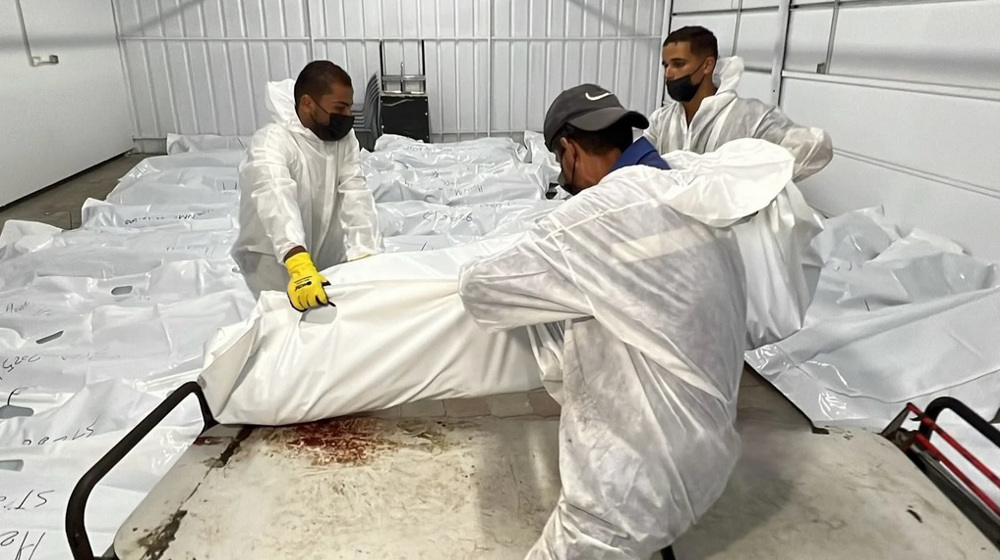
Israel is holding the bodies of roughly 1,700 Palestinians, including some who were not involved in retaliatory operations against Israeli forces and extremist settlers, despite the fact that the Hamas resistance movement has released all living and dead Israeli captives.
The Hebrew-language Haaretz daily newspaper, citing two sources familiar with the matter, reported on Monday that the bodies are being used as bargaining chips for future hostage negotiations.
The newspaper added that the figure was brought up during recent deliberations within Israel’s so-called security establishment.
According to Haaretz, the majority of the bodies are identified as Palestinians from the Gaza Strip who were involved in the large-scale Operation al-Aqsa Flood against Israel on October 7, 2023, or in the fighting that followed.
The report further revealed that David Zini, the director of Israel’s so-called internal security, Shin Bet, advocates for the retention of the bodies in the event that Israeli troops or settlers are captured or reported missing in the future, a stance that is also endorsed by the Israeli army.
Legal sources, cited by Haaretz, have argued that Israel has no legal justification for holding onto the remains of Palestinians with no proven involvement in fighting.
In October 2025, the Palestinian National Campaign for the Retrieval of Martyrs’ Bodies and the Disclosure of the Fate of the Missing stated that Israel was retaining approximately 1,500 bodies of Palestinians from Gaza at the Sde Teiman military facility in the southern part of the occupied territories.
Despite a ceasefire between Israel and Hamas that went into effect on October 10, 2025, the Israeli army continues its offensives against Palestinians in various regions of the Gaza Strip, resulting in the deaths of at least 1,258 individuals and injuring 4,139 others, as reported by Gaza’s Health Ministry.
Since October 2023, Israel has claimed the lives of over 73,000 Palestinians and inflicted injuries on more than 174,000 individuals in what can be described as a genocidal military campaign. This war has led to extensive devastation, impacting 90% of the infrastructure in the besieged coastal sliver.