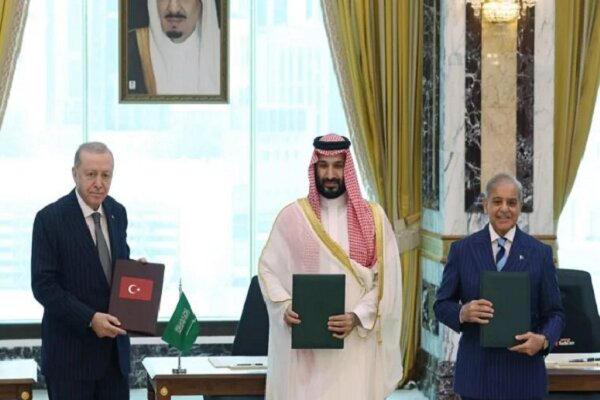
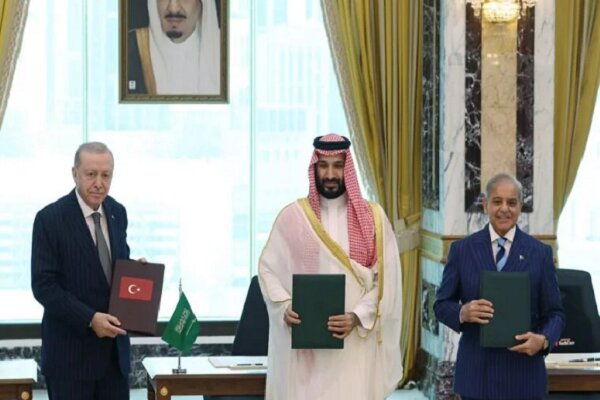
Turkey, Saudi Arabia and Pakistan signed a “defense pact” to strengthen deterrence against foreign aggression, which was called the “Mecca Mutual Defense Agreement”. The three countries announced that this pact is not “against any specific country” and that its goal is to strengthen “collective deterrence”. Turkey also considered the signing of this pact a form of regional partnership to establish peace and stability and emphasized that membership in the Mecca Pact is not a substitute for its presence in NATO.
Regarding this pact and Iran’s possible approach to it, it is important to note the following points.
1. These three countries have entered into this agreement with different motives. Pakistan, as a nuclear power that considers competition with India as the most important axis of its foreign policy, will use this agreement to strengthen Islamabad’s position against New Delhi. Pakistan, which has enhanced its regional position by mediating between Iran and the United States, intends to increase its geopolitical weight in the Islamic world and the region by participating in the trilateral alliance with Saudi Arabia and Turkey. Turkey, as a member of the North Atlantic Treaty Organization (NATO), although it announced that the Mecca Treaty would not replace NATO, by signing this treaty, it will increase its playing cards towards NATO and reduce its reliance on its Atlantic allies. Turkey considers Western security structures to be powerless against its security needs and will use the Mecca Agreement as a complementary lever to play a greater role in regional security. Saudi Arabia, which considers Yemen’s Ansarullah movement to be its most important security threat, also considers its main motivation for entering the Mecca Treaty to be to contain Yemen and break the naval blockade at Bab al-Mandab. At the same time, Riyadh hopes that if Iran attacks American interests on Saudi soil, it can use the participation of Turkey and Pakistan to deter Iran.
2. The aggression of the US and Israel against Iran and the failure to achieve their goals against the Islamic Republic of Iran, which was seen as a clear military defeat, caused the Arab countries, especially Saudi Arabia, to review their security calculations and reduce their reliance on the US. In fact, the hundreds of billions of dollars spent on purchasing weapons and military equipment from the US proved that this country not only lacks the necessary capacity to ensure the security of the Persian Gulf, but also prefers supporting Israel’s interests over the interests of the Arabs. Turkey, after its failure in Syria and the loss of the Golani, was dubbed the main loser against the US and lost its trust in Washington. Pakistan, which is aware of the strategic relations between the US and India, like Turkey and Saudi Arabia, views joining the Mecca Pact as part of reducing security dependence on the US. Therefore, if the Mecca Pact is a prelude to the attention of the countries of the region to creating a kind of joint security mechanism, it can be considered a positive approach.
3.The Mecca Pact can also be considered a kind of regional alliance against the expansionism of the Zionist regime. Netanyahu’s recent approaches to create a “greater Israel” and threats to Arab countries including Lebanon, Syria and Jordan, as well as the terrorist attack on Qatar to eliminate Hamas leaders, have seriously worried the countries of the region. On the other hand, Israel’s efforts to annex Gaza and to put pressure on the people of the West Bank, especially through continued settlement construction, have increased attention to some kind of alliance against Israel among Islamic countries. Among the signatories of the Mecca Pact, Pakistan has the most anti-Zionist approach. Despite numerous ups and downs, Turkey has been among the serious opponents of the Israel in recent months. Saudi Arabia has also distanced itself from normalizing relations with Israel by supporting the idea of two states in the occupied territories and supporting the creation of an independent Palestinian state with al-Quds as its capital. Strengthening the anti-Israel approach among the members of the Mecca Pact could increase the motivation of other Arab and Muslim countries to enter into similar coalitions or join the Mecca Agreement.
4. Since the victory of the Islamic Revolution, the Islamic Republic of Iran has supported the idea of ensuring common regional security without the presence of foreign countries and has always sought cooperation with these countries to realize this important idea. In recent months, the leaders of the countries of the region have acknowledged, secretly or openly, that the United States is no longer trustworthy and that the presence of its numerous military bases in the region, the construction and maintenance of which are the responsibility of the host countries themselves, is used to secure the interests of Israel and not to maintain regional security. Accordingly, if the defense pact of the three Muslim countries can be a prelude to implementing Iran’s idea of ensuring common regional security, it will be considered a positive step. Iran, which is in a superior position by demonstrating its extraordinary power in the fight against the United States and Israel and its honesty in creating a regional order without the presence of foreigners, can intelligently turn a potential threat into an opportunity and, with active diplomacy play a role in completing the defense pact of the Islamic countries. The Islamic Republic of Iran has always been the standard-bearer of Islamic unity and close relations with neighboring countries and has not and will not initiate any war against them. Iran has good relations with Pakistan and Turkey and welcomes improved relations with Saudi Arabia. Naturally, Iran’s attacks on US military bases in the region do not mean hostility towards neighboring countries. These circumstances have created a very good opportunity for a regional alliance to establish peace and stability, and if the neighboring countries appreciate this opportunity, a bright future is in store for the region.
MNA