The US-backed Board of Peace has made Israeli withdrawal from the besieged Gaza Strip conditional on Hamas’s complete disarmament, in a move that runs counter to the terms of last year’s agreement, even as Israel has yet to fulfill its own withdrawal commitments.
In a statement on Sunday, the board said Israeli forces would not withdraw beyond the so-called “Yellow Line” until the Palestinian resistance movement had fully completed the decommissioning of its weapons.
“Contrary to inaccurate reports, we note that the withdrawal of the [Israeli military] beyond the ‘Yellow Line’ will take place only once decommissioning is complete, as Hamas committed to the mediators,” the board said in a statement posted on X.
The board said implementation would be overseen by the so-called International Stabilization Force (ISF) and the Implementation Verification Committee, which includes representatives of both the United States and the Board of Peace. It added that further progress would depend on “both sides” fulfilling their commitments.
The announcement came after a meeting in occupied al-Quds between Board of Peace director Nickolay Mladenov, senior adviser Aryeh Lightstone and Israeli prime minister Benjamin Netanyahu.
Mladenov described the negotiations as entering a particularly difficult phase following the meeting.
“Long day in al-Quds, sitting down with … Netanyahu and his team. This is the start of the hard phase and I have never pretended otherwise. Not much of what we do now is dramatic. It is slow, grinding and technical work,” he said.
Under last year’s agreement, the “Yellow Line” was designated as the initial withdrawal boundary for Israeli occupying forces, with further pullbacks to take place alongside the gradual decommissioning of resistance weapons.
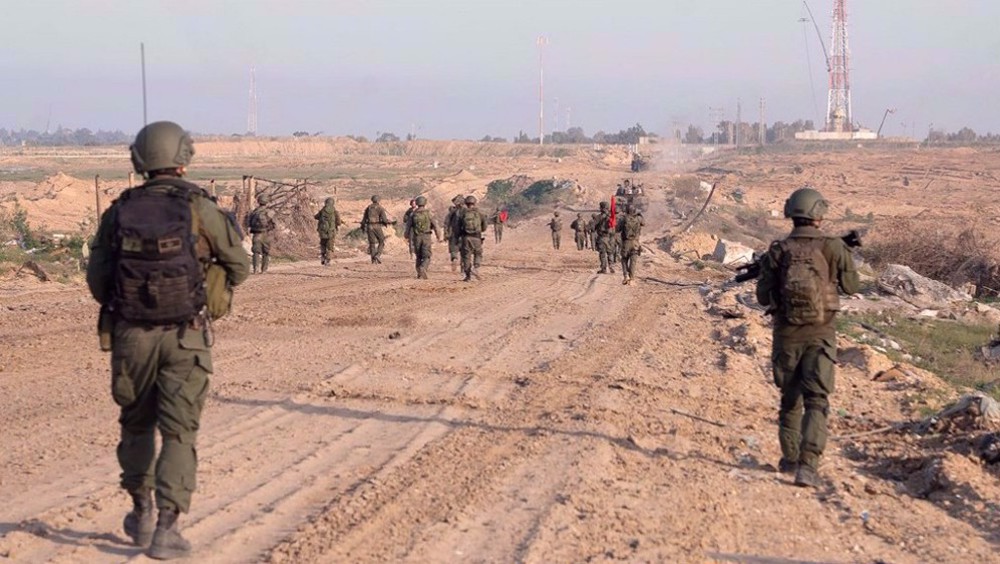
Israeli forces, however, did not carry out the planned withdrawals. Instead, they continued their military aggression, moved beyond the “Yellow Line” and established permanent military positions after Washington launched its so-called peace initiative in October 2025.
The revised position comes just days after US President Donald Trump announced what he described as a “historic” agreement under which Hamas and other Palestinian resistance factions would surrender their weapons.
Hamas has rejected that characterization, saying it will not agree to disarm unless Israel first fulfills its own obligations under the agreement.
Negotiators had spent weeks working on the wording of the weapons clause. Hamas is reportedly prepared to transfer its weapons to a US-backed technocratic body for secure storage rather than hand them over to Israel.
Other Palestinian resistance factions have likewise rejected Washington’s interpretation, maintaining that full disarmament can only take place following the establishment of an independent Palestinian state.
Israel, meanwhile, has continued its brutal military aggression across Gaza while reiterating that it will not withdraw from the besieged territory until what it calls “complete demilitarization” has been achieved.
The Israeli position comes despite recent reports that the regime’s authorities had approved the deployment of the so-called ISF. Israeli forces have nevertheless continued to expand their military presence inside the blockaded Palestinian territory.
Israeli broadcaster Channel 12 reported on July 4 that Israel could resume a full-scale military offensive in Gaza within two months.
The broadcaster also reported that Israeli authorities expect Washington to issue a declaration in the coming months accusing Hamas of violating the ceasefire by refusing to disarm. Such a declaration, according to the report, could provide the “political justification” for Israel to resume military operations in parts of Gaza that remain outside its direct military control.
Palestinian authorities say Israel’s genocide has killed more than 73,375 Palestinians and injured over 174,220 others, most of them women and children, while destroying or damaging around 90 percent of civilian infrastructure. The United Nations estimates the cost of rebuilding Gaza at approximately $70 billion.
Since the so-called ceasefire deal was signed, at least 1,250 Palestinians have been killed and another 4,110 injured in Israeli attacks, according to Gaza’s Health Ministry.