
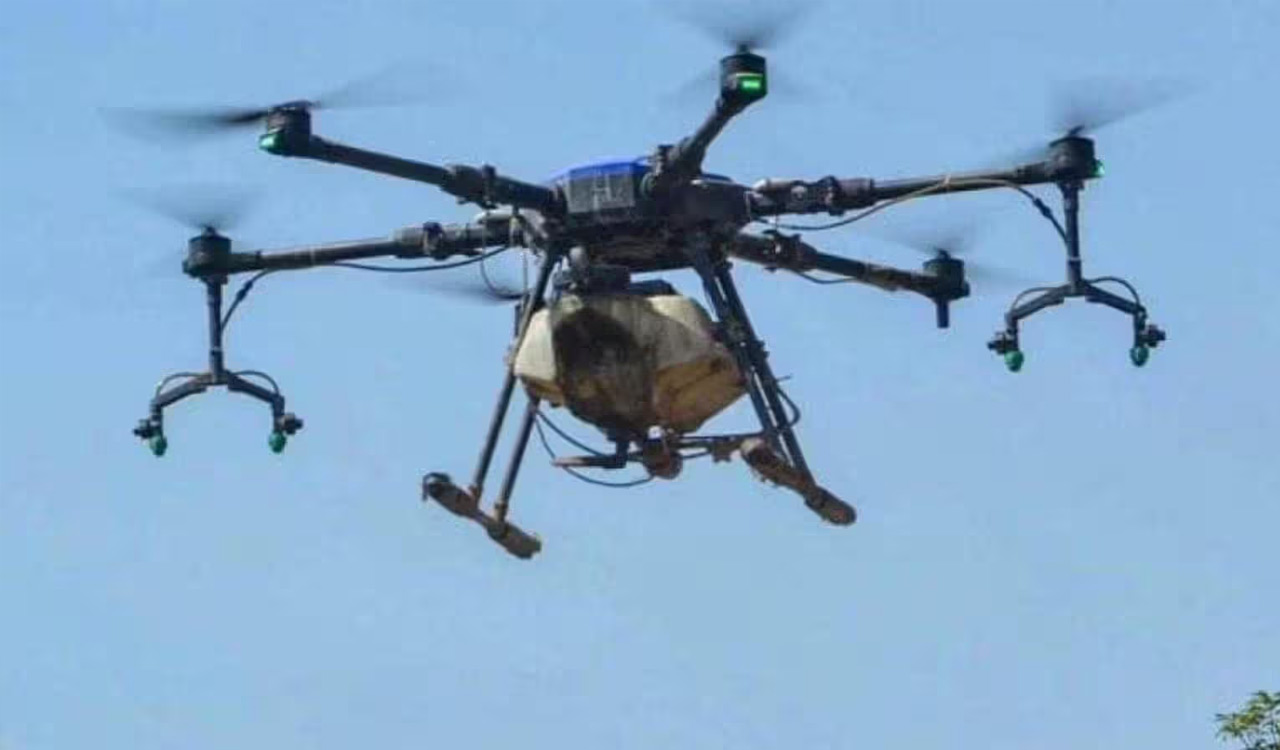
Smuggling syndicates in Pakistan have embraced technology faster than our law enforcement, using drones to dump narcotics and weapons in India
Published Date – 4 August 2026, 12:38 AM
Drones have become the preferred tool for Pakistani smugglers for moving drugs and weapons along the border with India, particularly targeting Punjab and Jammu and Kashmir. What started as a surveillance tool has now evolved into a full-fledged logistics network for dumping narcotics and weapons. There is growing evidence linking the smuggling activity with Pakistan’s Inter-Services Intelligence (ISI). The Border Security Force (BSF) had seized 245 drones from Pakistan in Punjab in 2024 alone, more than double the previous year, and by October 2025, the force had seized 200 Pakistani drones carrying 287 kg of heroin, 174 weapons, including AK-47s, hand grenades and over high explosives in that year. Individual seizures this year continue at a steady clip. Punjab has emerged as the epicentre of drone-assisted narcotics trafficking, with almost all such incidents reported in the country occurring along its border. Early this year, the BSF’s Punjab frontier alone had neutralised 47 drones — a sign both of intensity of activity and improved interdiction capacity. In this backdrop, Punjab’s decision to deploy ‘hawai nakas’ —aerial checkpoints — to intercept drones carrying drugs and weapons from across the border is an innovative response to an evolving security threat. Smuggling syndicates have embraced technology faster than law enforcement, replacing human couriers with GPS-guided drones capable of dropping heroin, arms and ammunition deep inside Indian territory. Conventional road checkpoints can do little against an enemy that flies overhead. The scale of the challenge is daunting. Each time Indian forces field new technology, smugglers respond with something more advanced.
Forensic analysis of one downed drone even showed it had operated across both Pakistani and Chinese territory, hinting at more sophisticated sourcing than a purely local cottage industry. The drug trade is not merely a law-and-order problem but a public health emergency that has devastated countless families, while also posing a grave national security threat as the same routes are used to ferry weapons and finance terror networks. The concept of ‘hawai nakas’ reflects a welcome shift from reactive policing to proactive strategy. Instead of merely recovering drug consignments after they land, the focus is on having eyes on the sky to detect drones, track their flight paths, identify intended drop zones and apprehend the local operatives waiting to collect the payload. Combined with intelligence inputs, anti-drone systems and close coordination between the Punjab Police, the Border Security Force and Central intelligence agencies, this strategy can significantly raise the risks for smugglers. However, the experience shows that smuggling networks constantly adapt, deploying larger drones, encrypted communication and ever-changing tactics. Thus, technology must be matched by sustained intelligence gathering, stronger financial investigations to dismantle trafficking syndicates and swift prosecution of those involved. Equally important are effective de-addiction, rehabilitation and awareness programmes. The ‘hawai nakas’, if implemented with adequate resources, could become a model against the next generation of cross-border crime.