By Press TV Website Staff
A Hamas official says the newly announced agreement to end Israel’s genocidal war on Gaza does not signify abandoning resistance, but outlines a conditional, Palestinian-led process contingent on the Tel Aviv regime fulfilling its obligations under the agreement.
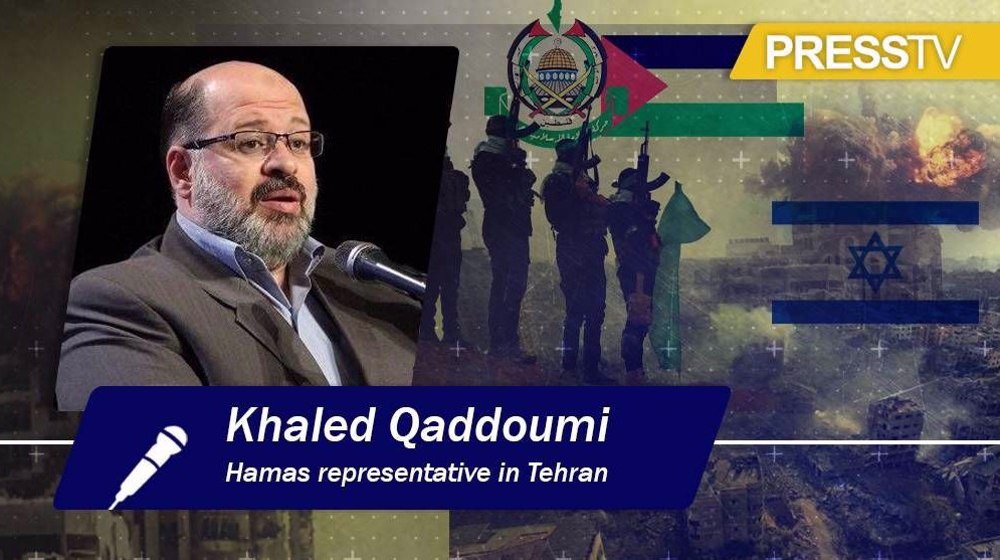
Speaking to the Press TV website, Khaled Qaddoumi, the representative of Hamas in the Islamic Republic of Iran, expounded on how the Palestinian resistance movement views the newly announced agreement, which has been widely portrayed in media reports as a “Hamas disarmament” deal.
“There is no question of surrendering or relinquishing weapons. What we specifically offered was to discuss the gathering or storage of heavy weapons under a Palestinian administrative authority – from Palestinian factions to a Palestinian authority. No authority other than a Palestinian one has any role in this matter,” he stated.
The remarks came after Hamas announced it had agreed to a phased deal intended to bring Israel’s genocidal war on Gaza to a complete end.
The proposal, announced by US President Donald Trump after mediators from Egypt, Qatar, Turkey and the United States finalized a roadmap for the next phase of the ceasefire, outlines a mechanism under which heavy weapons would be inventoried and stored under a Palestinian National Committee while Israeli occupation forces gradually withdraw from Gaza.
Israel has not publicly endorsed the proposal, while Hamas has maintained that no provisions related to its weapons can be implemented unless Israel first fulfills its own obligations under the agreement.
Addressing concerns among Palestinians that any discussion of weapons could undermine Gaza’s future ability to defend itself from external aggression, Qaddoumi rejected media portrayals of the proposal as a disarmament deal.
“It is not a relinquishment of weapons. It is not an isolated step. It is not a withdrawal from, or retreat from, the concept of resistance,” he told the Press TV website.
Resistance inherent right of Palestinians
The Hamas representative noted that resistance, in all its forms and by all its means, “is an inherent right of any nation living under occupation – especially the Palestinian people, who have lived under occupation for nearly a century.”
“They have the right to defend themselves in whatever way they consider appropriate, including armed resistance,” he stated.
According to Qaddoumi, even that discussion would depend entirely on the Israeli regime implementing the broader agreement.
“Moreover, this step is conditional upon Israel fulfilling and implementing the other parts of the agreement, including the withdrawal of its forces, the opening of the border crossings, the entry of humanitarian aid into Gaza, and the complete cessation of the genocide,” he said.
He further noted that Israel would have to allow the Palestinian National Committee to enter Gaza to administer civilian affairs, oversee reconstruction and prepare for “a political electoral process that will ultimately lead to an independent Palestinian state.”
“Only within that framework and according to those benchmarks can any discussion regarding weapons take place. Beyond that, there is no such thing as the resistance relinquishing its weapons,” he remarked.
“Our strength comes from our faith, our people, and our just cause. We will continue until this occupation ends and until our nation achieves independence, peace, and prosperity.”
The proposed roadmap envisages a phased process in which heavy weaponry, military production sites, weapons depots and tunnel infrastructure would be inventoried and stored under Palestinian oversight while Israeli troops withdraw in stages.
Hamas has repeatedly said those steps cannot proceed independently of Israel’s commitments regarding withdrawal, humanitarian access and reconstruction.
The genocidal onslaught on the besieged Gaza Strip has killed more than 73,000 Palestinians and injured over 174,000 others since October 23, 2023, most of them women and children, and caused widespread destruction affecting 90% of civilian infrastructure.
The UN estimates reconstruction costs at approximately $70 billion.
‘No trust’ in US, Israel
Asked whether Hamas trusted Washington and Israel to uphold any agreement, Qaddoumi said experience had left little room for confidence.
“There is no such thing as trust or confidence. Historical experience has not been positive when dealing with the Americans or the Israelis,” he told the Press TV website, pointing to failures to implement previous commitments. “On the one hand, President Trump, before the whole world, proposed this ceasefire agreement, saying that the genocide would stop. It did not stop.”
Since the ceasefire came into effect, he noted that more than 1,200 innocent civilians lost their lives, killed in cold blood by the Israeli occupation forces in the refugee camps.
Qaddoumi also noted that border crossings remain closed, humanitarian aid has yet to enter Gaza, reconstruction materials continue to be blocked, and the Palestinian National Committee formed in Egypt has not been allowed into the territory.
“That’s why we’re skeptical,” he said. “We have every right to be.”
Even so, he added that Hamas has continued participating in negotiations in coordination with other Palestinian factions.
“On the other hand, we are still moving toward improving the lives of our people because we have carried this responsibility in consensus with the other Palestinian factions,” he stated.
“With an open mind and a good heart, we entered these negotiations to prevent the genocide from resuming. We sought to achieve a fair political solution for our people.”
Palestine has nothing more to give
The Hamas official said Palestinians have already fulfilled their part of the process.
“At this point, nobody should ask the Palestinians to give anything more, because the Palestinian side has already given everything that was asked of it. There is nothing more to give,” he told the Press TV website.
Instead, he said, responsibility now rests with international guarantors. “Now it is time for the guarantors. It is time for the President of the United States to put sufficient pressure on Israel to abide by its commitments.”
Qaddoumi said statements by members of Israeli regime prime minister Benjamin Netanyahu’s coalition have further reinforced Hamas’s doubts about the implementation of the deal.
“The presence of extreme figures in Netanyahu’s cabinet, such as Ben-Gvir, gives us little reason for optimism because they openly say that these proposals do not meet Israel’s demands; but what are Israel’s demands? What we see today is that Israelis are obsessed either by personal agenda or ideological extremist agenda,” he said.
“Netanyahu wants to remain in power, while ideological fanatic elements like Ben-Gvir are driven by the belief that Palestinians have no right to live in Gaza. They believe Palestinians should leave Gaza and that Israelis should replace them and build settlements there. With such a mentality, hope is very scarce.”
Nevertheless, he said Hamas would continue urging international actors to ensure implementation of the agreement to end the Israeli genocidal war on Gaza.
“We will continue to call on the international community to fulfill its responsibility by guaranteeing the implementation of the agreement and creating mechanisms to move the process forward, rather than allowing the genocide to resume,” he stressed.
“The world must compel and pressure the Israeli forces to withdraw from Gaza, allow the Palestinian National Committee to enter Gaza, permit the entry of food, water, and reconstruction materials, and reopen the border crossings.”
Palestinian consensus
On coordination among Palestinian resistance factions, Qaddoumi said the latest proposal reflects a unified Palestinian position.
“The latest statement announcing a positive step toward strengthening the ceasefire stems from Palestinian consensus. Our brothers in Islamic Jihad and the other Palestinian factions were with us in Egypt, and we discussed it together,” he noted.
He emphasized that discussions about weapons should not be confused with surrendering resistance.
“By the way, the term ‘disarmament’ must be clearly understood,” Qaddoumi said. “When we talk about heavy weapons, we have conditioned any discussion on the implementation of the first stage of the agreement, and the political solution to a Palestinian independent state”
He reiterated that those conditions included humanitarian measures, Israeli military withdrawal, reconstruction, reopening crossings, allowing the Palestinian National Committee into Gaza and progress toward an independent Palestinian state.
“Only then can any political solution and any step toward disarmament–or, as we have said, gathering or storing the weapons, whatever term is used–be addressed,” he said.
“First, this is a matter of national Palestinian consensus; second, it is an entirely Palestinian issue that concerns the future shape of Palestine, its political life, and how Palestinians choose to address these matters.”
Remembering Martyr Haniyeh
This week marked the second martyrdom anniversary of former Hamas political leader Ismail Haniyeh, who was assassinated by the Israeli regime in Tehran on July 31, 2024.
Qaddoumi said the Hamas resistance movement views the sacrifices of its martyred leaders, including Haniyeh, as part of a broader struggle for Palestinian self-determination.
“Those great people gave their lives for a noble cause,” he said. “Martyr Haniyeh himself said that there is a price for this cause and this responsibility.”
Haniyeh’s assassination came a day after he attended the inauguration ceremony of President Masoud Pezeshkian.
“We carry this responsibility knowing that the price will be heavy and that our lives are at stake — for the sake of our people, for the sake of our noble cause, and for the sake of our homeland,” Qaddoumi said.
He concluded by recalling remarks delivered by Hamas’s newly-elected leader Khalil al-Hayya at Haniyeh’s funeral in Tehran one day after the assassination.
“The enemy is deluded if they think that we will be diverted from our path or from the path of those great leaders and martyrs. On the contrary, we will insist on continuing our road toward independence because those people who offered their lives for the sake of their people did so for a reason. That reason is to live in peace and prosperity and to give our children a better life. Martyrdom is a school that teaches us how to live,” he said.
“Martyrdom is the art of those great people who gave their lives to grant future generations a prosperous, peaceful, and dignified life. Today, we are strong enough to carry the flag of those great people and move forward toward the development of our people and our nation.”