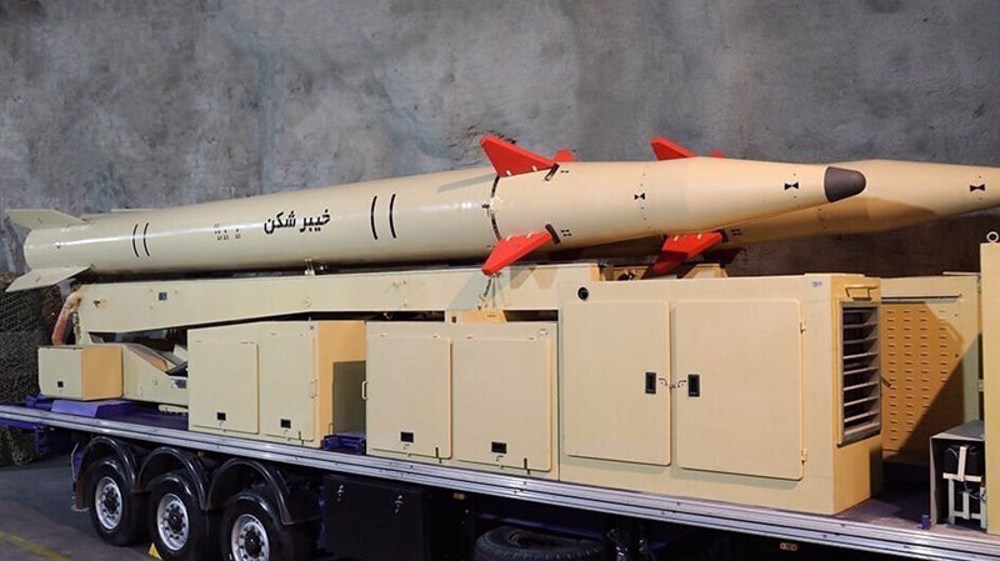
A report by the Wall Street Journal has shown how Iran has used an inexpensive but accurate and powerful missile to destroy US bases in the West Asia region in recent days.
The WSJ report, published earlier this week, said that Kheibar Shekan had emerged as a central element of a resilient Iranian strategy that poses a persistent and cost-effective threat to US forces and allies in the region.
The report described the Kheibar Shekan as the workhorse of Iran’s arsenal, capable of carrying a maneuverable warhead designed to evade air defenses.
The solid-fuel, medium-range ballistic missile has a satellite-guidance system and a range of at least 900 miles (approximately 1,450 km), it said, adding that the missile’s solid-fuel design allows for rapid deployment and launch from mobile launchers.
The report said that Kheibar Shekan’s design is a significant advantage over older liquid-fuel models that require lengthy refueling, making it harder to detect and destroy before firing.
It said some versions of the missile have a small engine in the warhead for terminal-phase course changes at speeds around 6,000 miles per hour, further complicating interception.
The WSJ said in its report that Iran has also used tactics like combining flight paths and different speeds to confuse US air defense systems.
It said that Kheibar Shekan was likely used in a recent attack on the Muwaffaq Salti Air Base in Jordan, which killed three US service members.
The report said Iran’s successful attacks on US bases in the region demonstrate that the country still retains a significant capability, despite weeks of US and Israeli strikes on its military infrastructure in March and early April.
It said that Iran has been able to restore operations at some of its underground missile bases and has reopened tunnel entrances and access roads that were damaged in US and Israeli strikes.
That comes as US military and government officials have claimed that they have totally destroyed Iran’s missile and drone capabilities in the recent war of aggression on the country.
The WSJ report said, however, that Iran has been analyzing past attacks and adapting its tactics, including using a combination of high-speed drones and simpler missiles to saturate and overwhelm air defenses.
It said the production cost of each Kheibar Shekan missile is significantly lower than that of American and Israeli interceptors, which can cost between $2 million and $15 million per interceptor depending on the system.
This cost asymmetry makes Iran’s strategy economically sustainable for Tehran while being very expensive for its adversaries, the report said.