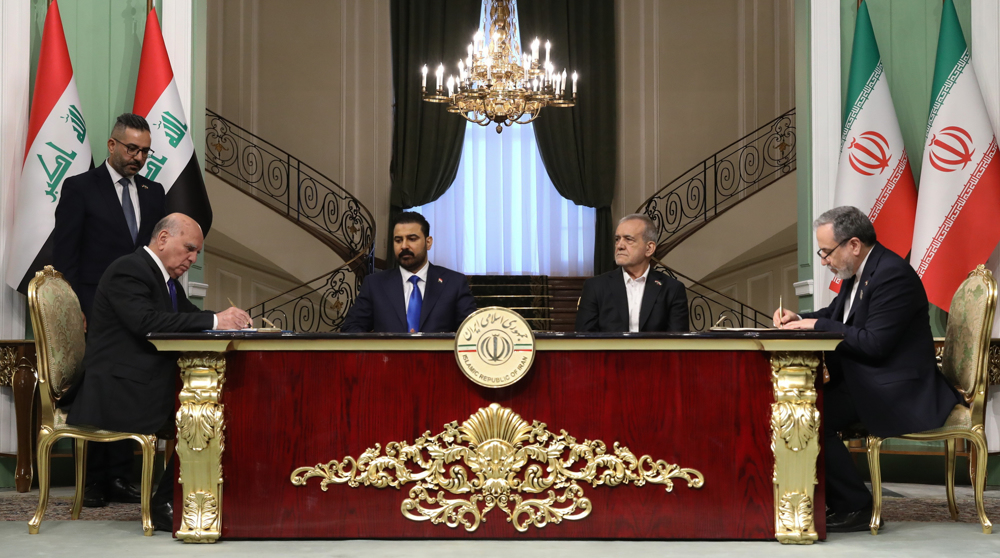
Iran and Iraq have issued a comprehensive joint statement at the conclusion of Iraqi Prime Minister Ali al-Zaidi’s official visit to Tehran, reaffirming their commitment to expanding strategic cooperation across political, economic, security, cultural, and regional fields.
Al-Zaidi visited Tehran on Thursday at the invitation of Iranian President Masoud Pezeshkian, leading a high-level political, security, and economic delegation.
During the visit, he held talks with Pezeshkian and other senior Iranian officials on bilateral ties, regional developments, and international issues.
Based on the statement, the two sides underscored the importance of strengthening their strategic partnership on the basis of mutual trust, good neighborliness, and shared interests.
They also agreed to draft a comprehensive long-term cooperation document covering political, economic, cultural, security, and other areas of mutual interest.
The foreign ministers of both countries were tasked with finalizing the document for approval and implementation as soon as possible.
Iran and Iraq described closer cooperation in political, economic, security, scientific, technological, infrastructure, and people-to-people exchanges as a strategic necessity and pledged to transform their relationship into a model of regional cooperation based on mutual respect and common interests.
The two countries also agreed to hold the Iran-Iraq Joint High Commission annually at the level of the two heads of government, with meetings alternating between Tehran and Baghdad to oversee the implementation of bilateral agreements.
Iran also expressed appreciation to the Iraqi government and people for their solidarity, hospitality, and participation in the funeral ceremonies of the martyred Leader of the Islamic Revolution, Ayatollah Seyyed Ali Khamenei, describing the event as a reflection of the deep historical, religious, and popular ties between the two nations.
On economic cooperation, both sides stressed the need to accelerate completion of the Basra–Shalamcheh railway project, expand bilateral trade and joint investment, facilitate commerce, strengthen banking and financial cooperation, and broaden collaboration in energy, transport, transit, industry, agriculture, and engineering services.
They also called for removing legal, administrative, and executive obstacles delaying joint projects.
The two governments reaffirmed their commitment to fully implementing all bilateral agreements, memoranda of understanding, and other signed documents.
Addressing environmental challenges, Iran and Iraq pledged closer cooperation to tackle climate change, drought, dust storms, and water resource management.
They also agreed to protect shared wetlands and biodiversity, promote environmental technologies, and establish joint mechanisms to address regional environmental crises.
On security, the two countries emphasized enhanced cooperation against terrorism, extremism, organized crime, smuggling, and other cross-border threats, stressing that continued bilateral and multilateral coordination is essential for preserving regional security, stability, and development.
They further agreed to deepen cooperation in culture, science, higher education, media, tourism, and religious pilgrimages, highlighting stronger people-to-people ties as a cornerstone of their long-term strategic partnership.
The joint statement concluded with both countries reaffirming their commitment to sustained strategic dialogue, full implementation of bilateral agreements, and broader cooperation, saying stronger Iran-Iraq relations would contribute to regional stability, security, prosperity, integration, and sustainable development in West Asia.
Iran and Iraq also stressed that regional crises can only be resolved through dialogue, diplomacy, and constructive engagement among regional states.
Reaffirming their support for political solutions based on international law, they reiterated their longstanding backing for the Palestinian people and their legitimate rights, including the establishment of an independent Palestinian state with al-Quds as its capital.