By Press TV Website Staff
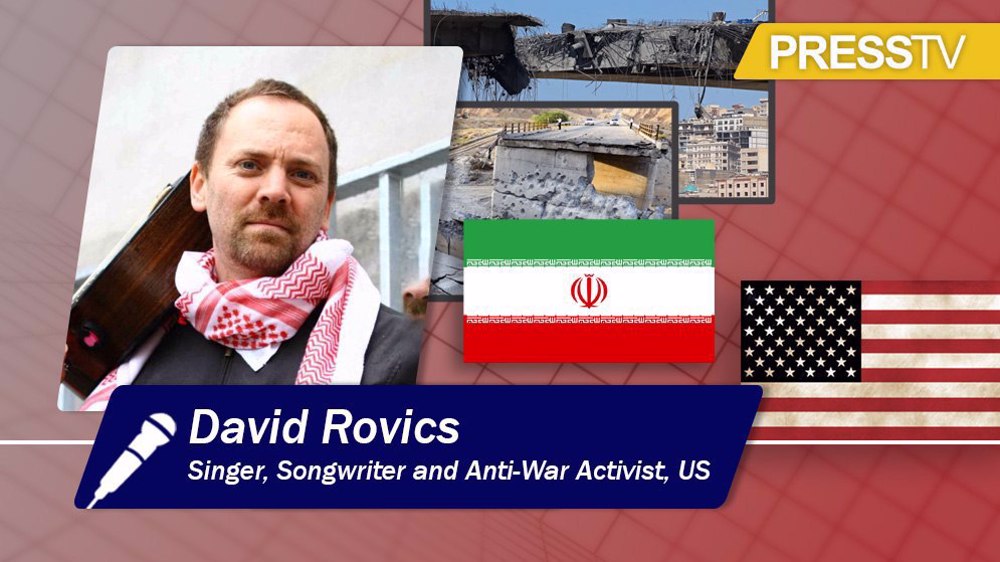
US conduct following the signing of the Islamabad memorandum of understanding (MoU) with Iran reveals a consistent pattern of diplomatic contempt, says an American singer and activist, noting that Washington began violating the MoU almost as soon as it was inked.
Speaking to the Press TV website, Oregon-based songwriter, singer, podcaster and activist David Rovics noted that the MoU, signed by the presidents of Iran and the US on June 18 to end the imposed war, was clear but was quickly undermined by the United States.
“I don’t think many people who follow (US President Donald) Trump were at all surprised that immediately after signing it, the US started violating it and wildly misinterpreting the text, which is not a complicated text,” he asserted.
Rovics, however, said many Americans were surprised that Trump agreed to sign the Pakistan-mediated memorandum in the first place because it effectively acknowledged Iran’s victory against the US-Israeli war of aggression which began on February 28.
“Many people in the US were surprised that Trump signed it in the first place, because it basically reads as an acknowledgement that Iran won the war,” he said.
Iranian armed forces delivered heavy blows to the US and Israeli military assets across the region during Operation True Promise 4, which began immediately following illegal and unprovoked strikes on February 28 that led to the assassination of top officials and military commanders, including the Leader of the Islamic Revolution Ayatollah Seyyed Ali Khamenei.
An attack on an elementary school in southern Iran’s Minab city on the same day killed more than 160 schoolchildren inside their classrooms.
In response, Iran carried out large-scale military operations and closed the Strait of Hormuz.
Faced with economic repercussions and heavy pressure at home as well as losses on the battlefield, Trump was forced to accept the understanding, but violations of the truce by Washington started almost immediately.
According to the document, Iran was responsible for reopening the Strait of Hormuz, on which it had imposed restrictions targeting vessels linked to aggressors and their supporters. However, Washington tried to undermine this clause in the memorandum by opening a new unauthorized route in the strait, which prompted Iran’s legitimate response.
After weeks of sporadic incidents, the US military launched a fresh wave of largescale attacks on Iranian soil two weeks ago amidst the funeral for Iran’s martyred Leader, targeting military and civilian sites mainly in southern provinces. The attacks have so far destroyed several infrastructure sites, such as bridges and water desalination plants, and killed over 50 Iranians.
✍ Analysis – Strategic miscalculation: How US violations of MoU bolster Iran’s Hormuz leverage and regional deterrence
By Press TV Strategic Analysis Deskhttps://t.co/hz7NVcmeD0
— Press TV 🔻 (@PressTV) June 27, 2026
Rovics denounced Western media for their coverage of the war and the MoU.
“The way the Western media just pretended they couldn’t read the MoU to see whether the US was really violating it or not was a new low for the already completely debased and servile institutions that we inaccurately refer to as the ‘free press,’” he told the Press TV website.
Asked about the “quagmire” the US finds itself in, Rovics pointed to the Israeli role.
“My impression is Trump believed the Israelis who told him all the nonsense about how the Iranian government would fall quickly after the leadership was assassinated, and once that didn’t happen, he had no plan B,” he stated.
He noted that regardless of any broader strategy, the war itself had been misguided.
“Whatever strategy the administration may or may not have had, it was a terrible initiative, making war on Iran, that will hopefully spell the end of US imperialism in the region.”
Rovics is known for writing and singing songs against US wars worldwide, using art as a medium to raise awareness.
“Music, art, and other forms of culture are essential in so many ways. It is the most effective way to communicate in a way that actually communicates,” he said.
“But when you communicate through songs, poetry, and other artistic forms, you can reach people emotionally, so they really understand what you’re trying to say,” said the artist.
He also referred to popular Lego videos Iranian social media content creators produced during the recent war that were circulated widely and attracted attention worldwide.
“The people in Iran making those Lego videos know this very well,” he said.
The short clips recreated battlefield events, Iran’s military operations and political developments, using characters and settings, combining humor with patriotic messaging.