
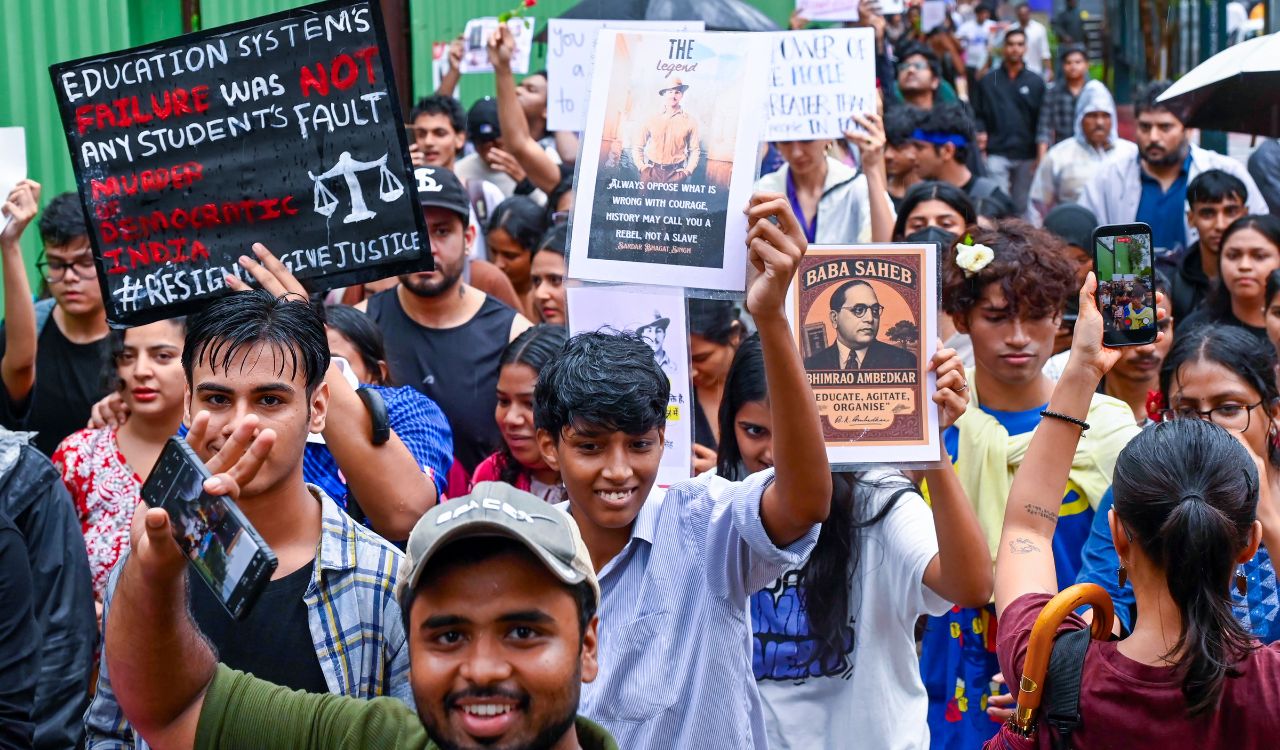
Inspired by historic revolutionaries, hundreds of students have secretly left home to join the CJP-led NEET paper leak protests at Delhi’s Jantar Mantar. Facing police action and parental pushback, the young demonstrators vow to continue their agitation
Published Date – 23 July 2026, 03:55 PM
New Delhi: “Revolution is an inalienable right of mankind. Freedom is an imperishable birthright of all,” Bhagat Singh said during his 1929 Assembly Bomb case trial. Nearly a century later, that sentiment echoes at Delhi’s Jantar Mantar, where 15-year-old Raj arrived with no backpack, spare clothes or certainty of when he would return home.
After quietly slipping out of his house in Uttar Pradesh’s Prayagraj four days ago to join the ongoing agitation led by the Cockroach Janta Party (CJP), Raj, who is still wearing the same clothes he left his house in, eats at the protest site with other protestors.
“I did not get my bag because I ran away from home. If my family had suspected anything, they would have stopped me,” he said while handing out cold drinks to fellow demonstrators.
Raj is among many students and young people from different parts of the country who arrived at the Jantar Mantar after concealing their plans from their families, travelling overnight by train or buses for a cause they believe is bigger than themselves.
Another young woman from Prayagraj has chosen to hide not just her plans but also her identity. She said her father, members of her village community and several relatives are BJP supporters.
Fearing they would oppose her participation in the agitation, she has been wearing a mask to conceal her identity.
“I am scared. They will not support this cause. Whatever is happening is wrong. Why is the government sleeping? This is wrong,” she said.
Like their own stories, the symbols they carry also tell a story.
Throughout the month-long agitation, portraits of India’s revolutionaries like Bhagat Singh, BR Ambedkar, Chandrashekhar Azad, Savitribai Phule and Jyotirao Phule have become a major part of the protest being led by youth, reflecting the ideals they say inspire their movement.
Among the most striking visuals has been a banner mentioning Bhagat Singh’s jail protest in 1929.
When Bhagat Singh was imprisoned in the 1929 Central Legislative Assembly bomb case, he launched a prolonged hunger strike demanding political prisoner status, turning the agitation into a powerful symbol of resistance against British rule.
During their trial, Bhagat Singh and Batukeshwar Dutt said the act was meant “to make the deaf hear”, not kill anyone.
For many young protesters at Jantar Mantar, these stories are not just chapters from history books but a source of inspiration.
A teenage girl from Mumbai secretly left home and boarded a train to Delhi to take part in the July 20 march to Parliament, without informing her parents.
“I told them I am here in the protest. My mother asked me, ‘Who gave you permission to come here?’ My father told me to come back home,” she said.
But the teen refused and said, “I told them I will fight for my rights.”
She does not know how long she will remain in Delhi but said she would stay for as long as she could and continue fighting for the cause. Her parents have repeatedly urged her to return, warning that they would stop giving her pocket money if she continued participating in the protest.
“If they stop giving me pocket money, I will look for a job. I can do graphic designing, art, content creation and video editing. I am trying to become independent,” she said.
She was among the protesters on July 20 when police used tear gas and force to disperse the march towards Parliament. She returned to the protest site the very next day, raising slogans of “Inquilab Zindabad”.
“Inquilab Zindabad” — a slogan immortalised by Bhagat Singh — echoes through the crowd several times a day. It has become part of the protesters’ identity, portraying their belief in the country’s revolutionary leaders.
During Monday’s march to Parliament, CJP founder Abhijeet Dipke walked alongside demonstrators wearing a black “Inquilab Zindabad” T-shirt, as thousands of young protesters raised the same cry.
The protest, however, has also left several families searching for loved ones they say have not returned home.
Some posts circulated on social media seek information about 19-year-old Rohini Kumar, a NEET aspirant known for painting at the Jantar Mantar protest site, who had said she was missing since July 20. She has since been found, another post read.
Rizwan, a friend of a 33-year-old man from Seelampur, said the man had been camping at the protest site for nearly a month and was on hunger strike.
“Police detained him around 4.30 pm on Monday. Since then, we have not been able to find out where he is,” Rizwan said.
The deeply personal stories have unfolded against the backdrop of Monday’s massive march towards Parliament, when tens of thousands of protesters demanding Pradhan’s resignation over repeated examination paper leaks advanced through central Delhi.
As crowds surged forward and some barricades were toppled, Delhi Police and paramilitary personnel used tear gas and lathicharge to stop the march.