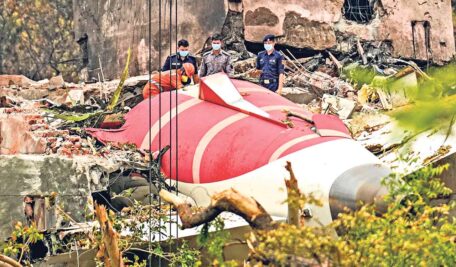
The Aircraft Accident Investigation Bureau informed the Supreme Court that the draft final report into the June 2025 Air India AI-171 crash in Ahmedabad is expected in October 2026, emphasising that the treaty-governed investigation prioritises aviation safety over fixing liability
Published Date – 15 July 2026, 12:46 AM
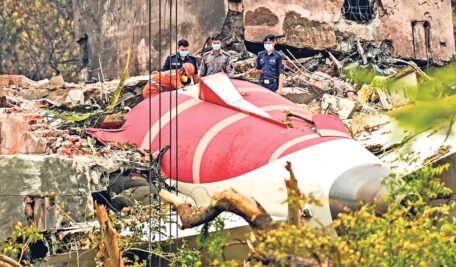
New Delhi: The Aircraft Accident Investigation Bureau (AAIB) has told the Supreme Court that draft final report of the probe into the June 2025 Air India flight AI-171 crash in Ahmedabad, which killed 260 people, is expected to be ready in October this year.
In a detailed affidavit filed before the top court, the AAIB submitted that a serious accident involving an international flight is not a matter purely of domestic inquiry, but one of international inquiry governed by the Chicago Convention and Annex 13 of the International Civil Aviation Organisation’s rules.
Annex 13 prescribes the standard operating procedure to conduct an aircraft accident investigation. “Article 26 obligates the State in which the accident occurs to institute an inquiry into the circumstances of the accident, while Annex 13 read with Aircraft (Investigation of Accidents and Incidents) Rules, 2025 expressly contemplates the participation of the State of Registry, State of Operator, State of Design, and State of Manufacture, each of whom possesses defined rights and responsibilities in the investigative process through accredited representatives and technical participation.
“Thus, the inquiry is not confined to an internal municipal exercise, but assumes the character of an internationally structured, treaty-governed investigation undertaken by the State of Occurrence in coordination with all concerned States having a legally recognised nexus to the aircraft, operator, design, or manufacture,” the AAIB said in the affidavit.
The affidavit stated that the objective of an aircraft accident investigation is solely to improve aviation safety and prevent future accidents, and not to apportion blame or determine civil or criminal liability.
“In view of the nature, scale and complexity of the present accident, the AAIB has carefully assessed the timeline for completion of the investigation.
“In all probability, the investigation activities as described…subject to the resolution of the pending external dependencies set out therein, are anticipated to be completed within approximately six weeks.
Thereafter, the draft final report, following completion of the analysis phase, is expected to be ready approximately in October 2026,” it said.
The AAIB further submitted that international and domestic legal provisions impose strict confidentiality over sensitive investigative material.
The affidavit said that these include witness statements, cockpit voice recorder recordings and transcripts, air traffic control communications, medical information and other protected records, disclosure of which could adversely affect the integrity of the ongoing investigation and future aviation safety inquiries.
The June 12 plane crash claimed 260 lives — 229 passengers, 12 crew members, and 19 people on the ground. The top court had earlier told the 91-year-old father of pilot Sumeet Sabharwal who died in the plane crash in Ahmedabad that his son is not to be blamed for the accident and he should not carry the burden on himself.
Pushkaraj Sabharwal and the Federation of Indian Pilots moved the Supreme Court for a court-monitored inquiry headed by a former apex court judge into the plane crash.
The nonagenarian has sought a “fair, transparent and technically robust” investigation into the tragic incident. “An incomplete and prejudiced inquiry, without identification of the exact cause of the accident, endangers the lives of future passengers and undermines aviation safety at large, causing a violation of Article 21 of the Constitution,” his plea said.
The ill-fated aircraft had taken off from Ahmedabad for London but crashed within minutes, impacting the BJ Medical College hostel located less than a nautical mile from the end of the runway.
The Emergency Locator Transmitter (ELT) failed to activate, and both the pilot-in-command Captain Sumeet Sabharwal and co-pilot Captain Clive Kunder lost their lives in the crash, the plea said.