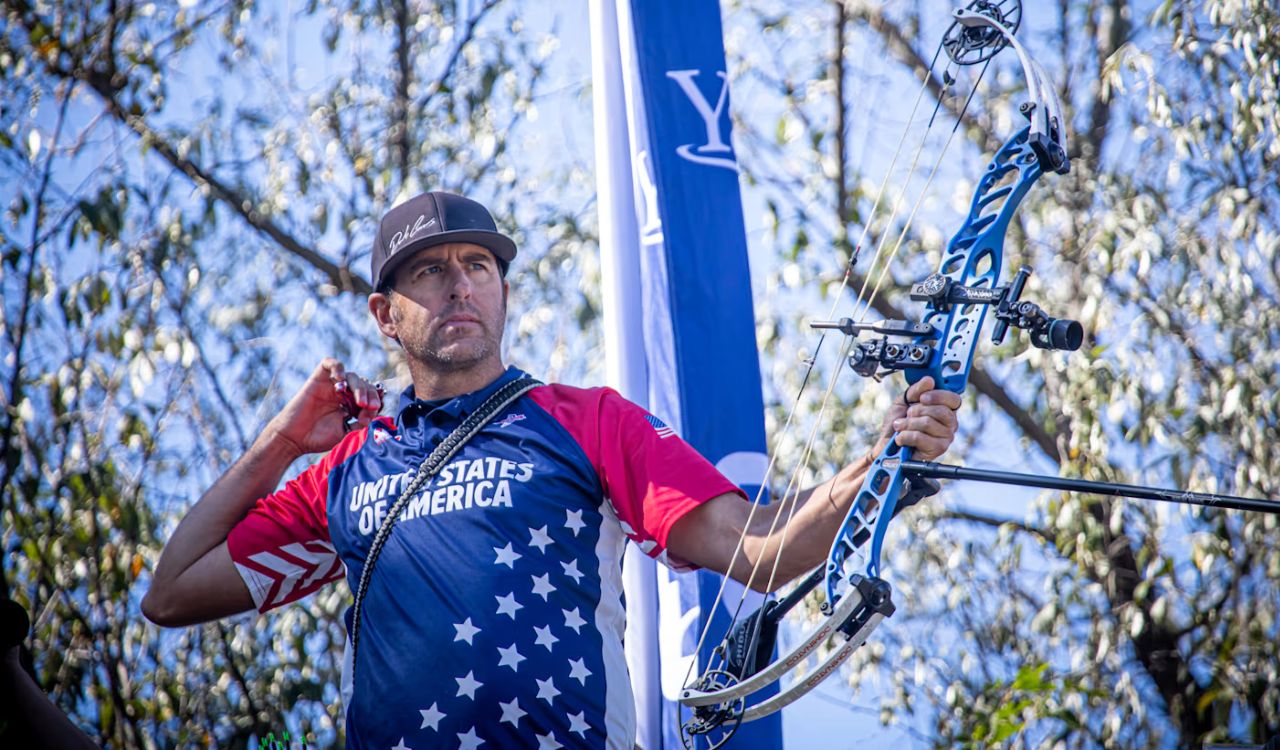
India’s archery teams head into the final World Cup stage in Madrid ahead of the Asian Games. The compound squad, under new coach Dave Cousins, aims to reverse a slump, while the recurve team seeks to build on recent progress
Published Date – 6 July 2026, 06:38 PM
Madrid: Indian compound archers, shepherded by new head coach Dave Cousins, will have to lift themselves from recent lows, while the recurve squad will be eager to build on its new-found momentum ahead of the Asian Games in the fourth and last World Cup stage beginning here on Tuesday.
The tournament assumes significance for Indian archers, as it is their last international outing before the Asian Games in Japan — September 19-October 4.
For Cousins, one of the most decorated compound archers in history, it will also mark his first international assignment with India since taking charge around three months before the continental showpiece.
The American inherits an inconsistent side, which once was the world’s most feared compound unit. The 49-year-old replaces Italian Sergio Pagni, under whom India enjoyed an unprecedented golden era, sweeping all five compound gold medals besides adding a silver and a bronze at Hangzhou.
Pagni’s contract ended after the Hangzhou Games and his departure has coincided with a sharp decline in India’s fortunes.
Numbers don’t lie
From three World Cup stages this season, India have managed just one gold and a bronze.
Their lowest point came at Antalya last month when the compound contingent returned empty-handed.
Contrastingly, in 2023, during the build-up to the Hangzhou Games, India amassed seven gold, one silver and four bronze medals across four World Cup stages.
Despite reduced focus on compound event because it was not a part of the Paris Games in 2024, India collected six gold and three silver medals from three World Cups.
The decline became more evident in 2025, when India settled for three gold, three silver and five bronze medals from four stages.
Now, the slide has hit the rock-bottom this year.
After opening the season with the women’s team gold in Puebla, India managed only one bronze medal — through Sahil Jadhav — in Shanghai before drawing a blank in Antalya. Alarmingly, none of the Asian Games-bound compound archers reached the podium.
The transition has also been accelerated by the absence of several leading lights.
Ojas Deotale, the reigning Asian Games champion and triple gold medalist at Hangzhou, world champion Aditi Swami and Hangzhou team gold medallist Parneet Kaur failed to make the Asian Games squad.
The Archery Association of India made repeated attempts to bring back Pagni before finally appointing Cousins, whose stellar CV includes world titles across outdoor, indoor, field, 3D and World Games disciplines.
Cousins challenge and Jyothi’s decline
While Cousins’ credentials as an archer are beyond question, his biggest challenge lies in translating that excellence into coaching.
His international coaching experience is limited, but India have entrusted him with a long-term vision, handing him a contract through the Los Angeles Games, where compound archery will make its Olympic debut in the mixed team event.
He has already overseen two national camps — first at the high-altitude centre in Silaru, Himachal Pradesh, and later in Sonipat — before arriving in Madrid.
His immediate task is to ensure a smooth transition after the exit of veteran Abhishek Verma and revive the fortunes of India’s women’s spearhead Jyothi Surekha Vennam.
Jyothi has endured a prolonged drop in form. She has not won an individual World Cup gold since Shanghai in 2024, while her last international individual title came at the Madrid World Cup in 2025.
As a seasoned pro, Jyoti will have to handle more responsibility in a youthful women’s quartet featuring Chikitha Taniparthi and Prithika Pradeep, alongside Parneet.
The men’s side faces bigger challenges.
With Indian stalwart Verma no longer in the squad, Sahil Jadhav, Kushal Dalal and Thirumuru Ganesh Mani Ratnam have shown flashes of promise but are yet to consistently challenge the elite.
Rishabh Yadav, included for Madrid but not part of the Asian Games squad, completes the four-member team.
India’s slide has also coincided with China’s rapid emergence as a compound powerhouse.
China stunned the field by winning the men’s team title in Antalya after claiming bronze in Shanghai, signalling a significant shift in the balance of power.
Recurve’s rise
Unlike compound, India’s recurve archers arrive in Madrid with growing confidence.
Leading their charge is Paris Olympian Dhiraj Bommadevara. The Army archer produced the performance of his career in Antalya, defeating Olympic bronze medallist Lee Woo-seok of Korea 7-3 to clinch his maiden individual World Cup gold.
Dhiraj returns after overcoming the personal tragedy of losing his cousin recently and will spearhead the men’s challenge alongside Neeraj Chauhan and Yashdeep Bhoge, with veteran Atanu Das featuring as the fourth member in individual section.
The women’s recurve team, led by Ankita Bhakat, appears to be steadily finding its feet.
India had won the Shanghai World Cup gold with Deepika Kumari in the team, but the trio of Ankita, Kumkum Mohod and Kirti Sharma struggled to replicate that success in Antalya.
They suffered a disappointing quarterfinal exit against Turkey, exposing the void left by Deepika’s experience.
With Deepika failing to enter the Asian Games team and is only competing individually as the fourth member here, greater responsibility now rests on Ankita to guide the relatively young unit.