India and the US reviewed progress on an interim bilateral trade agreement during two days of ministerial talks, discussing market access, digital trade and tariff-related issues. Both countries aim to conclude the pact before a temporary US tariff arrangement expires on July 24
Published Date – 24 June 2026, 06:11 PM
New Delhi: India and the US reviewed the progress of negotiations for an interim bilateral trade agreement during a two-day ministerial meeting and discussed core elements, including market access, digital trade and non-tariff barriers, as both countries aim to conclude the pact before Washington’s temporary 10 per cent tariff expires on July 24.
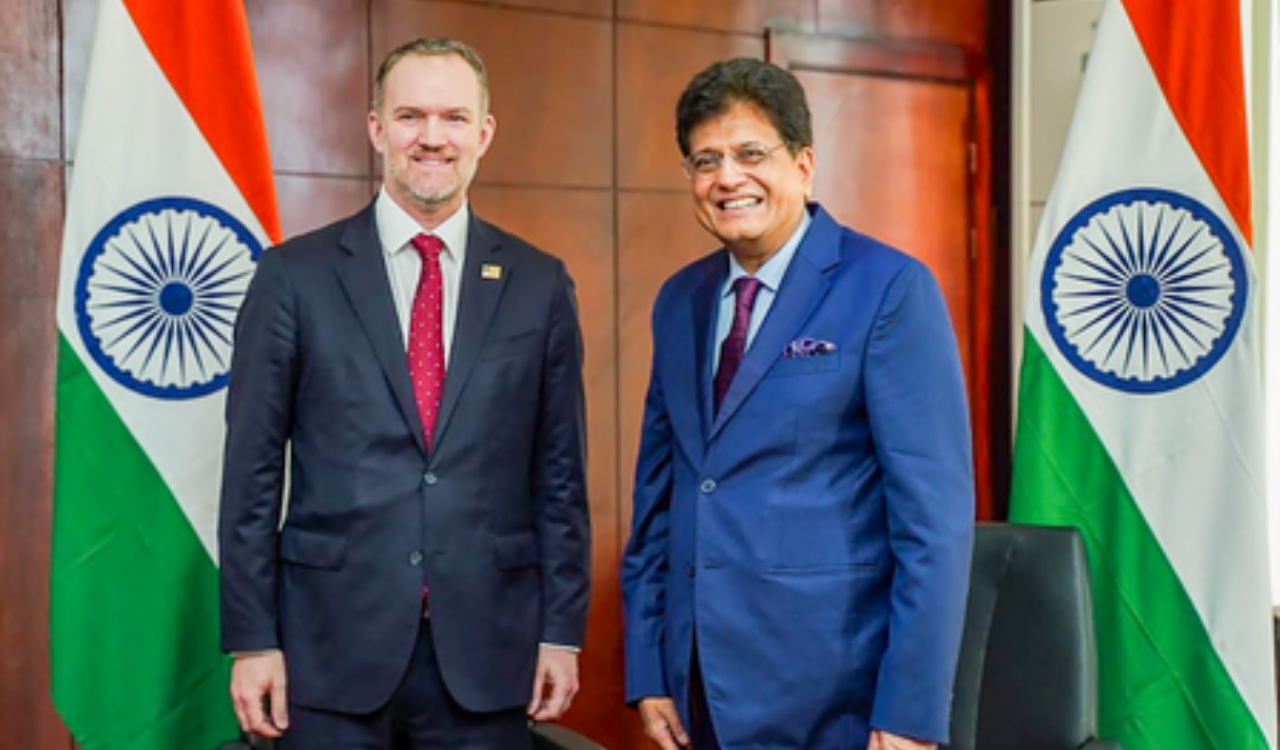
Leading an official delegation, United States Trade Representative (USTR) Jamieson Greer was here from June 22-24 for talks with Commerce and Industry Minister Piyush Goyal on the first phase of the bilateral trade agreement (BTA).
The visit marked a key step in the ongoing efforts to advance a balanced, mutually beneficial India-US BTA and finalise an interim deal in line with the joint statement of February 7, 2026, the commerce ministry said in a statement on Wednesday.
The two ministers held multiple rounds of discussions and “conducted a comprehensive review of core BTA elements, including enhanced market access, digital trade, supply chain resilience, reduction of non-tariff barriers, and expanded cooperation in strategic sectors,” it said.
It added that substantial progress had been made by the negotiating teams of the two sides on the pact in recent months.
“Discussions focused on pathways to conclude an interim agreement as an important milestone towards a comprehensive BTA,” it said, adding that the two ministers reaffirmed their commitment to a trade agreement that is balanced, commercially meaningful and delivers tangible benefits for businesses, farmers, workers and consumers in both countries.
“Recognising the growing significance of the India-US economic partnership amid evolving global trade dynamics, both sides reiterated their shared goal of expanding bilateral trade, fostering innovation and building resilient, trusted supply chains,” it added.
Earlier in the day, Goyal said in a social media post that the two sides reviewed the progress of the ongoing India-US trade discussions.
“I appreciate Ambassador Greer’s leadership and the sustained efforts of both teams in advancing our discussions in a constructive and forward-looking manner,” Goyal said.
The meeting was important as the two countries are aiming to salvage and recalibrate the proposed agreement after changes in US tariff policy upended a framework deal finalised earlier this year.
Greer’s visit comes days after Prime Minister Narendra Modi and US President Donald Trump held their first meeting in more than a year on the sidelines of the G7 summit in France on June 17, injecting fresh momentum into trade negotiations that both sides see as critical to strengthening economic ties.
The ministerial-level meeting follows chief negotiator-level discussions held in New Delhi earlier this month (June 2-4).
Securing preferential tariff treatment in the pact has become a central objective for New Delhi after changes in the US tariff landscape eroded an advantage India had expected to enjoy over regional competitors such as Vietnam and other ASEAN economies.
Under the February 7 framework, the US had agreed to reduce tariffs on Indian goods to 18 per cent from 25 per cent, lower than duties facing several competing exporting nations.
However, the subsequent US Supreme Court ruling striking down President Donald Trump’s sweeping tariffs and Washington’s move to impose a temporary 10 per cent tariff on imports from all countries prompted the two countries to revisit key elements of the proposed framework.
According to one of the clauses of that framework, “In the event of any changes to the agreed-upon tariffs of either country, the United States and India agree that the other country may modify its commitments.”
India and the US formally launched BTA negotiations on February 13, 2025.
Meanwhile, to retain bargaining leverage, the US Trade Representative launched two Section 301 investigations on March 11 and 12, covering about 60 economies.
One focused on alleged excess industrial capacity, while the other examined forced labour concerns in global supply chains. India was included in both investigations.
After the expiry of the temporary tariff, the US has only this mechanism (Section 301 probes) to impose tariffs of any magnitude on its trading partners, including India.
In February this year, the two sides announced the contours of the first phase. It was based on the 50 per cent tariffs imposed by the US on Indian goods.
However, on February 20, the US Supreme Court struck down these sweeping tariffs. This forced the Trump administration to impose 10 per cent tariffs under Section 122 of the Trade Act on all countries for 150 days from February 24. It will expire on July 24 this year.
Both sides are aiming to finalise the pact before that, as after July 24, most US imports will again face normal MFN tariff rates, restoring the pre-April 2025 tariff framework.
Under the agreed framework, India proposed eliminating or reducing tariffs on all US industrial goods and a wide range of food and agricultural products, including Dried Distillers’ Grains (DDGs), red sorghum for animal feed, tree nuts, fresh and processed fruit, soybean oil, wine and spirits, and additional products.
New Delhi has also expressed its intention to purchase USD 500 billion worth of US energy products, aircraft and aircraft parts, precious metals, technology products, and coking coal over the next five years.
The US was the second-largest trading partner of India in 2025-26.
India’s outbound shipments to the US grew marginally by 0.92 per cent to USD 87.3 billion during the last fiscal year despite high tariffs, while imports increased 15.95 per cent to USD 52.9 billion. The trade surplus declined to USD 34.4 billion in 2025-26 from USD 40.89 billion in 2024-25.