SCCL’s latest operational data has triggered fresh questions over alleged inflated coal stock records, a sharp decline in production and a simultaneous record in productivity. The Opposition has demanded an independent probe into the nearly 40 lakh tonnes of allegedly unaccounted coal.
Published Date – 24 June 2026, 05:55 PM
Hyderabad: Did the Singareni Collieries Company Limited (SCCL) somehow employ superheroes to achieve unprecedented productivity levels, or did it commit a serious error while adjusting its coal inventory? The company’s latest operational data has raised fresh questions.
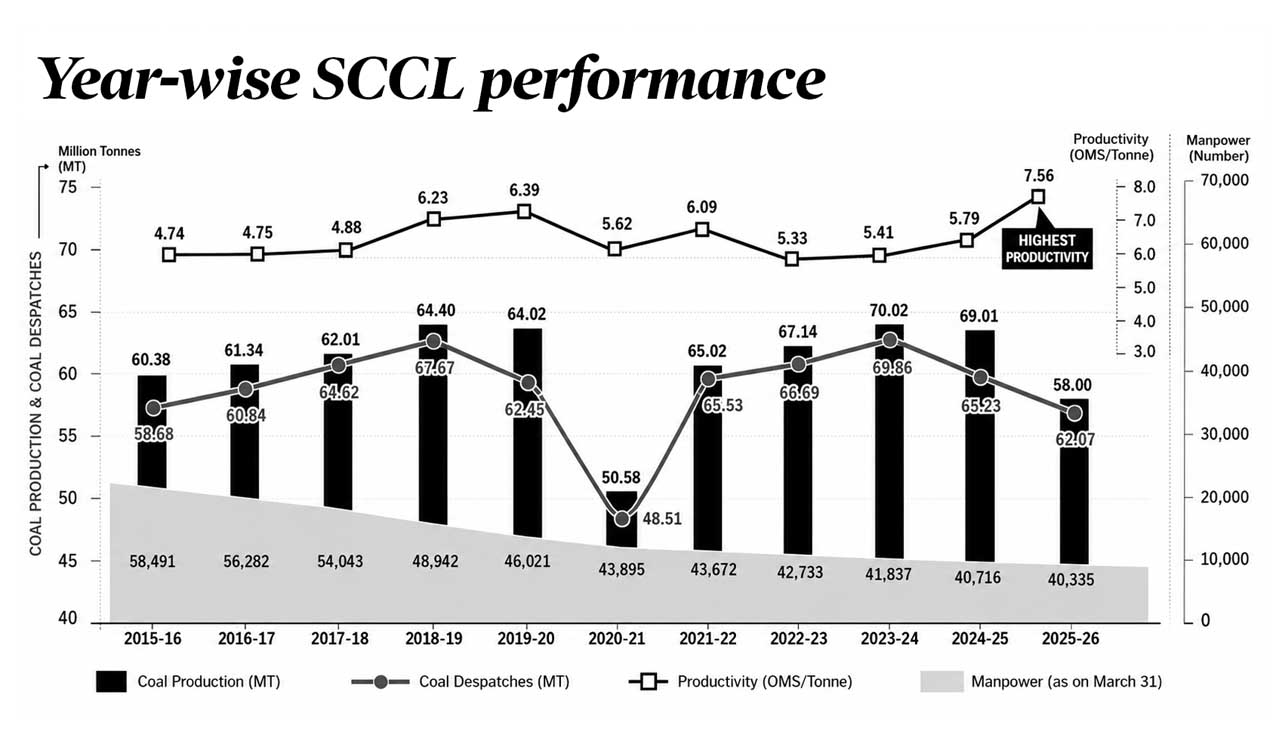
In an alleged bid to cover up inflated stock records from 2024-25, SCCL reported its lowest coal production in recent years during 2025-26, but inadvertently ended up recording an unprecedented overall output per man-shift (OMS) of 7.56 tonnes despite a shrinking workforce. This is significantly higher than the 5.79 overall OMS(T) recorded in 2024-25.
The numbers at the centre of the row are straightforward. In 2024-25, SCCL reported production of 69.01 million tonnes against despatches of 65.23 million tonnes, leaving a gap of 3.78 million tonnes, or nearly 37.8 lakh tonnes. The company’s balance sheet for that year reflected a closing stock of around 9.3 million tonnes, far above normal pithead levels of around 2-3 million tonnes. Allegations surfaced that a significant portion of this stock existed only on paper.
In 2025-26, production fell sharply to 58 million tonnes, while despatches rose to 62.07 million tonnes, exceeding production. The 3.78-million-tonne stock surplus from the previous year was effectively wiped out. It is suspected that this was not a genuine operational shift but an accounting adjustment to correct inflated figures from the previous year.
What makes the 2025-26 figures harder to explain is the productivity data. Overall output per man-shift jumped from 5.79 tonnes in 2024-25 to a record 7.56 tonnes in 2025-26, which is a 30 per cent increase. During the same period, manpower declined marginally from 40,716 to 40,335. Overburden (OB) removal fell by only 6 per cent.
In other words, SCCL is asking people to accept that production fell by nearly 16 per cent, or more than 11 million tonnes in a year, when workers were more productive than ever before, staffing levels were virtually unchanged and mining operations continued at a near-normal pace. Such a sharp fall in production despite record productivity and stable manpower requires a convincing explanation.
When the controversy erupted, SCCL issued a clarification stating that every tonne of coal is tracked through SAP, CoalNet, RFID, GPS, CCTV and electronic weighbridges. The company said production, stockpiling, transportation and sales are monitored at every stage and dismissed allegations of coal theft as baseless.
The clarification addresses coal movement after it is produced. But it does not address whether the stocks shown in the 2024-25 balance sheet were physically verified, how stock quantities were measured, or why production dropped by more than 11 million tonnes in a single year despite record productivity.
BRS Legislature Party deputy leader T Harish Rao was the first to raise the issue in May and question the missing coal. He alleged that physical checks at locations where large stocks were officially recorded revealed far lower quantities on the ground. He estimated the value of unaccounted coal at nearly Rs 1,600 crore and demanded an independent inquiry.
Upon learning about the issue, Union Coal Minister G Kishan Reddy subsequently wrote to Chief Minister A Revanth Reddy seeking an investigation. While the State government is yet to respond, SCCL has rejected all allegations.
However, the company failed to address the central issue raised by the Opposition and sections of the media on whether nearly 40 lakh tonnes of coal shown in company records actually existed on the ground.
If the coal existed, the authorities could settle the debate through an in-depth investigation into the allegations, along with a transparent disclosure of stock verification records, mine-wise production data and independent audits. If it did not, the issue goes far beyond transportation security systems.
The SCCL’s statement explains how coal is tracked once it leaves the mine. But it does not explain the gap between production and despatch figures, the unusual stock build-up, the sharp production fall of more than 11 million tonnes, or the simultaneous productivity record. It also does not address whether the figures were inflated and then adjusted at the direction of the company management and, if so, for what purpose.