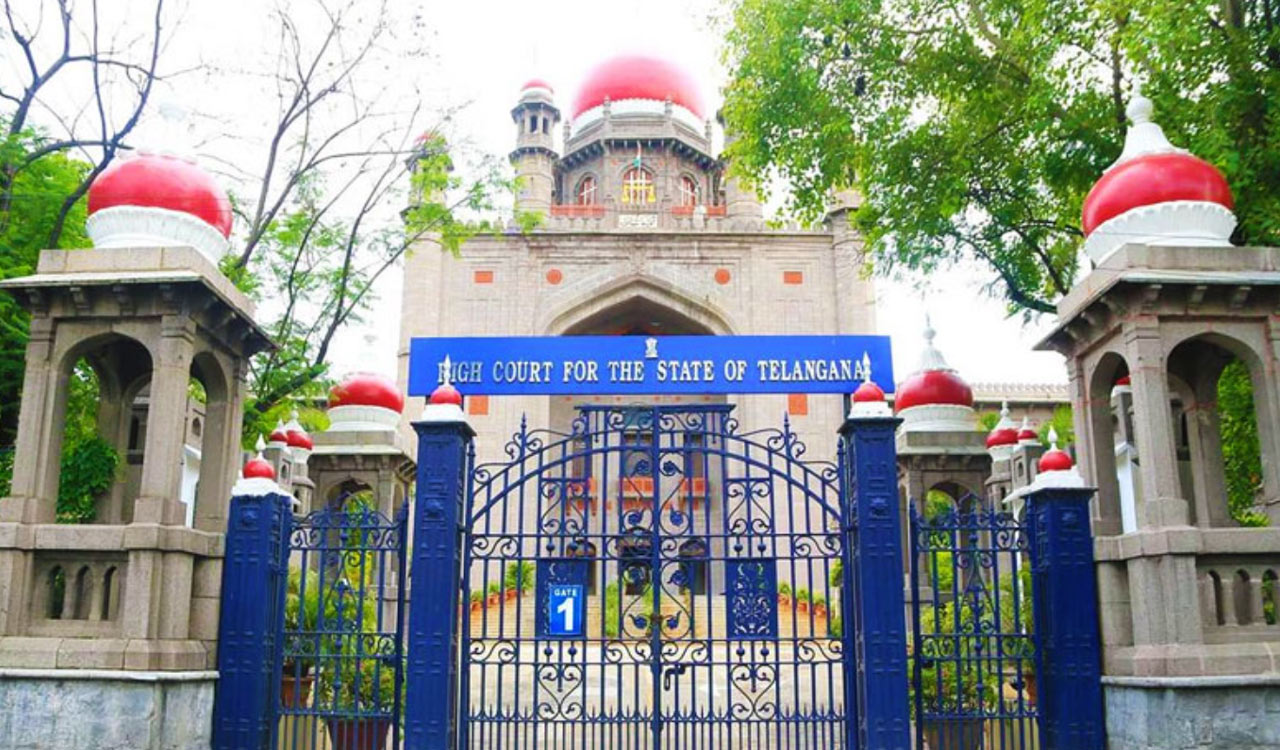
The Telangana High Court upheld the local candidature of an Assistant Executive Engineer aspirant, ruling that early schooling outside Telangana does not negate local status. In a separate case, the Court rejected an LRS plea for land earmarked as a road in a layout.
Published Date – 22 June 2026, 08:32 PM
By Our Legal Correspondent
Hyderabad: The Division Bench of the Telangana High Court, comprising Justices P Sam Koshy and Narsing Rao Nandikonda, held that a candidate cannot be denied local status for a technical post merely because he pursued his early schooling outside Telangana. Accordingly, the Bench dismissed a writ appeal filed by the Telangana State Public Service Commission (TGPSC) and upheld the candidature of an Assistant Executive Engineer (AEE) aspirant as a local candidate.
The writ appeal was filed by TGPSC challenging an order of a Single Judge in favour of Palla Nishanth, who had questioned the Commission’s decision to treat him as a non-local candidate for recruitment to the post of Assistant Executive Engineer pursuant to Notification No. 12 of 2022. TGPSC contended that local candidature had to be determined on the basis of schooling up to Class VII, as Nishanth had studied Classes I to VI in Andhra Pradesh. It argued that he could not be treated as a local candidate in Telangana for the purpose of recruitment. Rejecting the contention, the Division Bench held that TGPSC had adopted an unduly narrow interpretation of the Presidential Order.
The Court observed that for a technical post such as Assistant Executive Engineer, the relevant qualifying examination could not be mechanically pegged to Class VII and that the provisions governing local candidature must be interpreted in a manner consistent with the purpose of the Presidential Order. The Bench noted that the candidate had pursued education in Telangana for more than four consecutive academic years ending with the qualifying examination relevant to the post and therefore satisfied the requirements for being treated as a local candidate.
The Court further found fault with TGPSC for adopting inconsistent grounds while rejecting the candidature and observed that a constitutional recruiting body is expected to apply a uniform and legally sustainable standard. Holding that the Commission’s interpretation would lead to arbitrary and unreasonable results, the Division Bench upheld the order of the Single Judge and dismissed the writ appeal.
Plea for LRS rejected
Justice Laxmi Narayana Alishetty of the Telangana High Court has upheld the rejection of a Layout Regularisation Scheme (LRS) application in respect of a property at Guttalabegumpet, Serilingampally, holding that the land forms part of a road earmarked in a layout and cannot be regularised. The writ petition was filed by Kanneti Kamalamma challenging the orders of the GHMC and the appellate authority rejecting her application for regularisation of a 287-square-yard plot.
The petitioner contended that the draft layout relied upon by the authorities had been withdrawn in 1996. However, the Court held that the subject land was shown as a road in the layout and that the roads and open spaces had already vested in the municipality through a registered gift deed. The Court observed that the subsequent withdrawal of the layout would not alter the nature of the land and upheld the rejection of the LRS application.
Justice Alishetty further directed the District Collector to take steps to include the land in the prohibitory register under Section 22-A of the Registration Act, 1908, to prevent further transactions in respect of the property. In a connected writ petition, the Court set aside a cancellation deed executed in 2018 through which the petitioner’s registered sale deed was unilaterally cancelled by the Sub-Registrar at the request of GHMC authorities. The Court held that the unilateral cancellation of a registered conveyance after the amendments to the Registration Rules was impermissible and contrary to law. While setting aside the cancellation deed, the Court granted liberty to the authorities to initiate appropriate proceedings for cancellation of the sale deed in accordance with law.