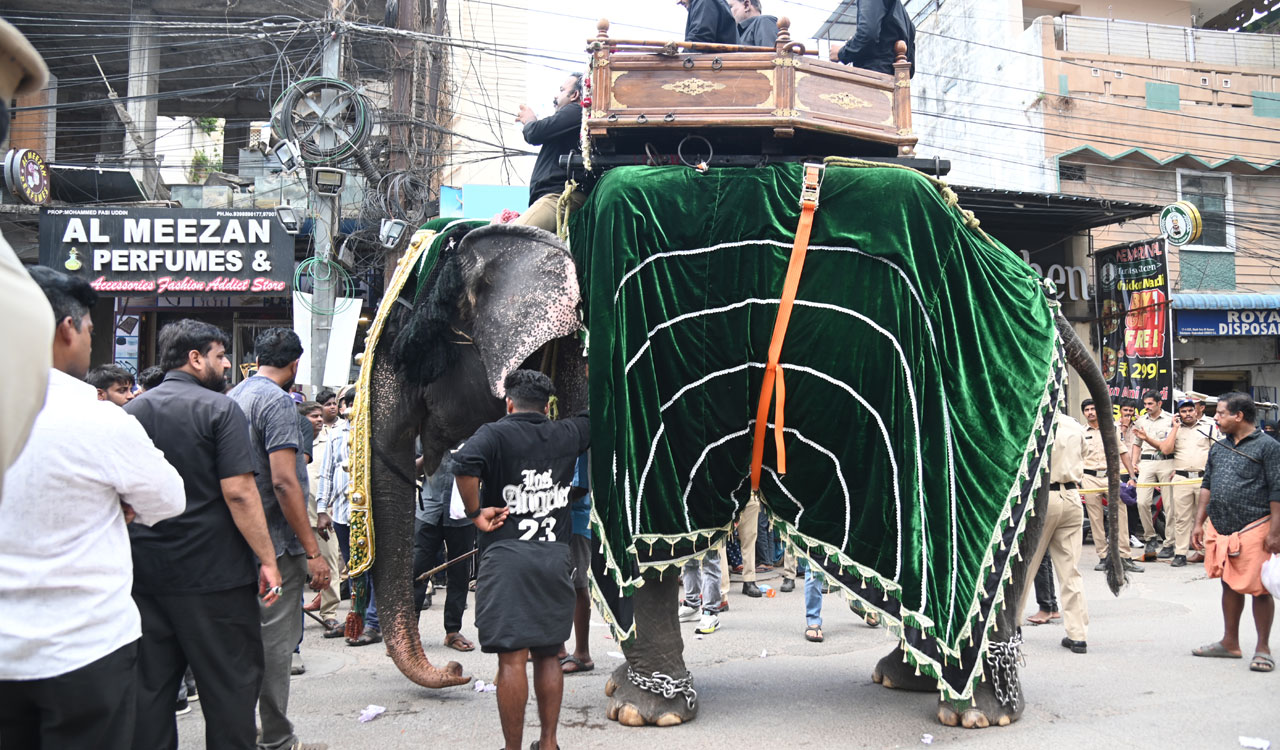
The six black velvet pouches adorning Hyderabad’s Bibi-ka-Alam have intrigued devotees for generations. Historians believe they contain priceless jewels gifted by the Nizams, while the alam itself houses a sacred relic linked to Hazrat Bibi Fatima and Islamic history.
Published Date – 20 June 2026, 05:16 PM
HYDERABAD: Every year during Muharram, the narrow lanes of Dabeerpura transform into a sea of mourners, devotees and curious onlookers who gather to witness one of Hyderabad’s most revered religious traditions — the Bibi-ka-Alam procession.
Amid the solemn rituals and centuries-old customs, one enduring mystery continues to captivate the imagination of thousands – the six black velvet pouches suspended on either side of the Alam-e-Mubarak. For generations, the pouches have remained one of the most interesting features of the Bibi-ka-Alam, distinguishing it from hundreds of other alams installed across Telangana during Muharram.
The mystery is reinforced by extraordinary security arrangements. From the moment the alam is installed at Bibi-ka-Alawa until it is returned to its vault after the 14th day of Muharram, the pouches remain under constant protection.
Historians believe the answer lies in Hyderabad’s royal past.
According to Prof Salma Ahmed Farooqui of the H K Sherwani Centre for Deccan Studies at Maulana Azad National Urdu University, historical records suggest the pouches contain priceless jewellery offered by the Asaf Jahi rulers. Among them are emerald and ruby drops fashioned into jhumkas, presented as nazr by the fourth Nizam of Hyderabad, Mir Farqunda Ali Khan, better known as Nasir-ud-Daulah, who ruled from 1829 to 1857.
Another account widely accepted among historians and the Shia community is the seventh Nizam, Mir Osman Ali Khan, also contributed valuable diamonds to the alam.
“The jewellery, often referred to as ‘heere jewaraat’, is not displayed publicly. It is brought out only during Muharram when the alam is installed and is subsequently returned to the vault. The ornaments remain sealed within the velvet pouches,” Prof Farooqui explains. For the rest of the year, these are secured inside a specially designed vault shaped like a sarcophagus, known as a zarih.
Azmath Jaffery, a prominent Shia youth leader, says elaborate procedures have been followed for decades to protect the sacred relic and the valuable offerings associated with it.
“After the Bibi-ka-Alam is taken out in a procession, the pouches are kept in a secure room that is sealed in the presence of local police officials, the Tahsildar and representatives of the Nizam’s Trust. During the procession, a tight security cordon surrounds the elephant carrying the alam,” he says.
Yet the significance of the Bibi-ka-Alam extends far beyond the jewels concealed within its velvet pouches. Its origins trace back to the Qutb Shahi era, when Hayat Bakshi Begum, the influential queen and wife of Sultan Muhammad Qutb Shah, installed an alam in memory of Hazrat Bibi Fatima at Golconda. During the Asaf Jahi period, the alam was shifted to Bibi-ka-Alawa in Dabeerpura, a structure specially constructed for its installation and veneration.
The Bibi-ka-Alam is revered because it houses a sacred relic believed to be a fragment of the wooden plank upon which Hazrat Bibi Fatima, the daughter of Prophet Muhammad, received her final ablution before burial. Historical accounts indicate the relic was brought from Karbala in present-day Iraq to Golconda during the reign of Abdullah Qutb Shah, says Hamed Hussain Jaffery, president of the Telangana Shia Youth Conference.