
Textbooks are educational resources, not propaganda documents, and students deserve facts, not filtered history
Published Date – 18 June 2026, 08:55 PM
By Chada Rekha Rao
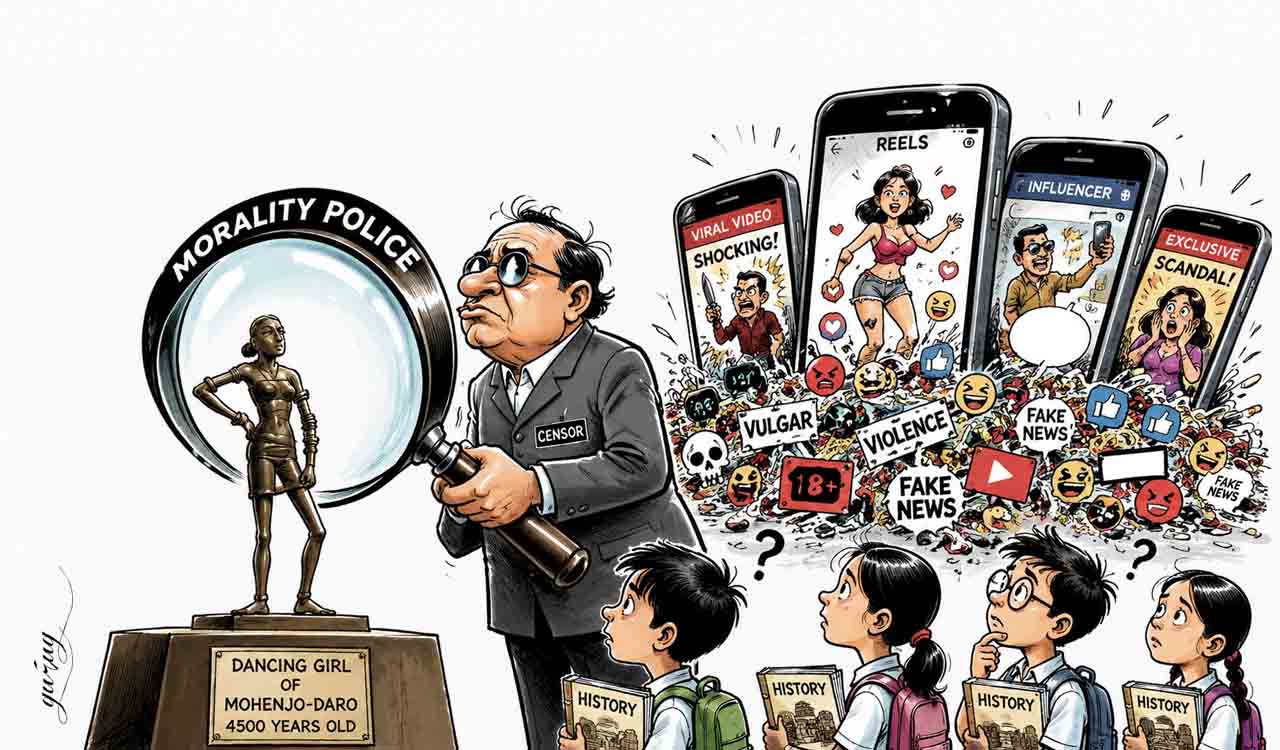
If anything needs censoring, it is not history, not a 10.5-cm-tall, 5-cm-wide, 2.5-cm-deep artistic marvel of ancient metallurgy. If anything has to change, it is not history. Our film censor board has to change. The content on mobile phones has to change. Reels on social media have to change. Choreography has to change. Lyrics have to change.
The vulgarity, violence and sensationalism that children consume every day must be examined first. History should not become the easiest victim of misplaced moral policing.
Dancing Girl
The recent controversy surrounding the alteration of the iconic Dancing Girl of Mohenjo-daro in a Class IX NCERT textbook has raised serious concerns about how India treats its historical heritage. The modified image, in which parts of the original artefact appeared to be covered or altered, triggered widespread criticism from historians, academics and cultural observers.
Following the backlash, NCERT itself decided to restore the original image, acknowledging the importance of authenticity in educational material. This is not merely a debate about a photograph. It is a debate about truth.
The Dancing Girl is not an ordinary image. It is one of the most celebrated artefacts of the Indus Valley Civilisation, discovered at Mohenjo-daro nearly a century ago. For generations, Indian students have studied this bronze figurine as evidence of the artistic sophistication, creativity and cultural richness of one of the world’s oldest urban civilisations.
When an archaeological artefact is altered to suit contemporary sensitivities, a dangerous precedent is created. History is no longer being presented as it existed; it is being presented as someone wishes it had existed. A civilisation that is confident of its past does not edit its history. It studies it. It preserves it. It debates it. But it does not distort it.
The Dancing Girl has survived over four millennia, enduring empires and upheavals. She deserves to be seen exactly as history left her
Wrong Focus
The irony is impossible to ignore. At a time when children are exposed to unlimited content through smartphones, social media platforms and streaming services, the focus appears to be on modifying a 4,500-year-old artefact.
Every day, millions of children watch reels filled with inappropriate language, suggestive dances, reckless stunts and glorification of instant fame. Songs with questionable lyrics trend across platforms. Movies routinely showcase violence and objectification. Yet the energy devoted to regulating these influences is often far less than the energy spent on policing history.
If policymakers genuinely believe that young minds require protection, then the first place to look is not Mohenjo-daro. It is the smartphone. A student today spends significantly more time on Instagram, YouTube Shorts and other social media platforms than on a history textbook. The values absorbed from these platforms often shape attitudes, aspirations and behaviour far more powerfully than classroom lessons.
Therefore, if moral concerns are truly the motivation, contemporary content deserves much greater scrutiny than historical artefacts.
Uncomfortable with Heritage?
The issue also raises a larger question: Are we becoming uncomfortable with our own heritage? India’s historical legacy is vast and diverse. Ancient temples contain sculptures depicting every aspect of human life.
Classical literature discusses themes of love, desire, philosophy, spirituality and social relationships with remarkable openness. Historical artefacts reflect the realities of their times. Their purpose is not to conform to modern notions of comfort but to help us understand the societies that created them.
Once we begin modifying artefacts because they appear unsuitable by present-day standards, where do we stop? Will paintings be altered? Will sculptures be redesigned? Will historical photographs be edited? Will uncomfortable chapters of history be removed because they challenge contemporary narratives?
History cannot survive selective presentation. Textbooks are not propaganda documents. They are educational resources. Their primary responsibility is accuracy. Students deserve facts, not filtered versions of facts. The purpose of education is not to shield young minds from reality but to help them understand reality through informed discussion and critical thinking.
Academic Integrity
The decision by NCERT to restore the original image is, therefore, welcome. It demonstrates that public institutions can still respond to scholarly criticism and uphold academic integrity. Experts had argued that the altered image misrepresented the original artefact, and the restoration reaffirms the principle that historical evidence must be presented in its authentic form.
However, the larger lesson should not be forgotten. History must remain beyond ideological editing. Governments change. Political priorities change. Social attitudes change. But historical evidence must remain constant. Every generation has the right to examine the past as it was, not as others have reconstructed it to suit contemporary preferences.
For Telangana, a land deeply connected with history, heritage and cultural pride, this debate carries special significance. From the architectural grandeur of the Kakatiyas to the rich legacy of the Deccan, our historical identity has been preserved because generations respected authenticity. We do not honour history by altering it; we honour it by protecting it.
The real challenge before India is not the preservation of ancient sculptures. It is the preservation of intellectual honesty. History should never be rewritten to satisfy temporary sensibilities. The Dancing Girl has survived for over four millennia. She has endured the passage of empires, invasions, political transitions and social transformations. She deserves to be seen exactly as history left her.
If anything requires correction today, it is not a 4,500-year-old artefact. It is the culture of superficial outrage, selective morality and the growing tendency to tamper with historical truth. Let history remain history.
Change the vulgarity in entertainment if necessary. Reform social media excesses if necessary. Strengthen content regulation for children if necessary. But do not rewrite the past. A nation that edits its history eventually loses its memory. And a nation that loses its memory risks losing its identity.
(The author is an academician)