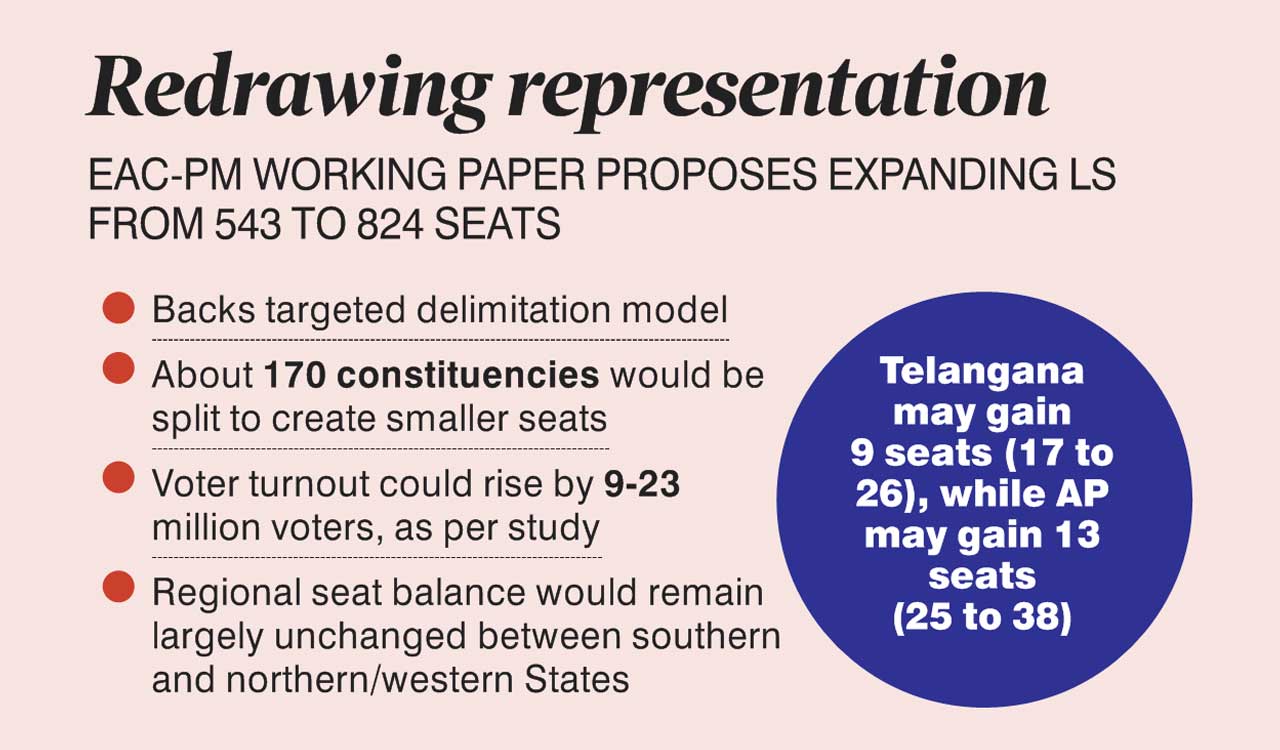
An EAC-PM working paper has proposed expanding the Lok Sabha from 543 to 824 seats by splitting 170 constituencies under a targeted delimitation model. The study says smaller constituencies could improve representation, boost voter turnout and increase Telangana’s seats from 17 to 26
Published Date – 11 June 2026, 11:46 PM
New Delhi: A working paper from the Economic Advisory Council to the Prime Minister (EAC-PM) has proposed a “targeted delimitation” model, splitting 170 existing Lok Sabha constituencies into smaller units to increase the Lower House’s strength to 824 from the current 543 to address oversized constituencies and improve electoral participation.
The paper, titled ‘Constituency Size, Composition and the Case for Delimitation in India’s Lok Sabha (2009-2024)’, argues that a future delimitation exercise should not rely only on uniform seat division but identify constituencies where restructuring would have the greatest impact on representation and voter access.
“A targeted plan that splits 170 of the 543 constituencies into 824 in total (59 two-way splits and 111 three-way splits) is predicted to raise national voter turnout by between 0.3 and 2.3 percentage points at the next general election, corresponding to 9 to 23 million additional voters,” says the paper authored by EAC-PM member Dr Shamika Ravi and Mudit Kapoor of the Economics and Planning Unit at the Indian Statistical Institute (Delhi Centre).
It has been uploaded on the EAC-PM website at a time when the government has indicated that it plans to reintroduce three bills in Parliament to carry out nationwide delimitation, increase the Lok Sabha’s sanctioned seat strength from 550 to 850, and reserve one-third seats for women in the Lok Sabha and state legislatures.
The Bills, including one that proposed a constitutional amendment, were defeated in the Lok Sabha during a special sitting of Parliament in April after the government failed to secure the required two-thirds majority due to resistance from a united opposition.
The EAC-PM paper recommends splitting 59 constituencies into two parts and 111 constituencies into three parts, creating 824 constituencies. Under the proposed model, Kerala and Tamil Nadu alone account for 22 of the 59 proposed two-way splits.
In cases of three-way splits, the lion’s share is in Uttar Pradesh (17), Maharashtra (12), Bihar (10), and West Bengal (10). Implementing the formula will keep the share of seats of the southern states and more populous northern and western states in the Lok Sabha broadly unchanged: 23.6% versus 23.7%, and 45.2% versus 45.6%, respectively.
According to a table in the paper illustrating the formula’s impact, the number of seats will rise as follows: Telangana from 17 to 26, Andhra Pradesh from 25 to 38, Karnataka from 28 to 42, Tamil Nadu from 39 to 59 and Kerala from 20 to 30. Among the more northern and western states, seats will rise from 48 to 72 in Maharashtra, 25 to 38 in Rajasthan, 80 to 120 in Uttar Pradesh, 29 to 44 in Madhya Pradesh, 26 to 39 in Gujarat and 40 to 60 in Bihar.
The paper identifies constituency size as a growing challenge, noting that the median Lok Sabha constituency had 18.2 lakh registered electors in 2024, while the largest constituencies had more than 32 lakh voters.
“Across India’s parliamentary constituencies, larger ones tend to vote at lower rates. The question is why,” the paper notes, laying out the possible factors: share of SC and ST voters, whether a seat is urban or rural, and whether people speak one dominant language or many.
It found that ST-dominated constituencies now have among the highest voting rates, while highly urban constituencies have seen turnout fall. Linguistically mixed constituencies tend to vote more, while SC-heavy constituencies, which earlier had higher turnouts, no longer show that advantage.
Importantly, it underlines that women’s voting behaviour is much more affected by where they live than men’s. Urbanisation is the biggest factor behind lower female turnout, with a woman living in a large city constituency being much less likely to vote compared with a woman in a rural, ST-heavy constituency, the paper states.
“In plain terms, where a woman lives, how urban it is, how linguistically mixed, how dominated by one tongue, shapes whether she shows up to vote far more than the same features shape whether a man does…The least-participating subgroup in the Indian electoral system today is the woman in a large, fully-urban metropolitan parliamentary constituency; the most-participating subgroup is the woman in a high-Scheduled-Tribe, rural parliamentary constituency,” it adds.
According to the paper, delimitation must accompany measures such as women-only polling booths in metropolitan constituencies, extending polling hours into the evening “that accommodate the time constraints of urban working women”, improving transport access from urban fringes to polling stations, and using local networks such as anganwadi centres, women’s self-help groups and ASHA workers for voter-roll updates.
The paper says these interventions should be viewed together, arguing that constituency restructuring alone may not deliver the expected improvement in turnout unless supported by changes in polling access and voter facilitation.
“We recommend that the Delimitation Commission, when it is constituted after the 2027 Census, treat the joint demographic and linguistic profile of a candidate constituency, and not its size alone, as the criterion for splitting,” states the paper.