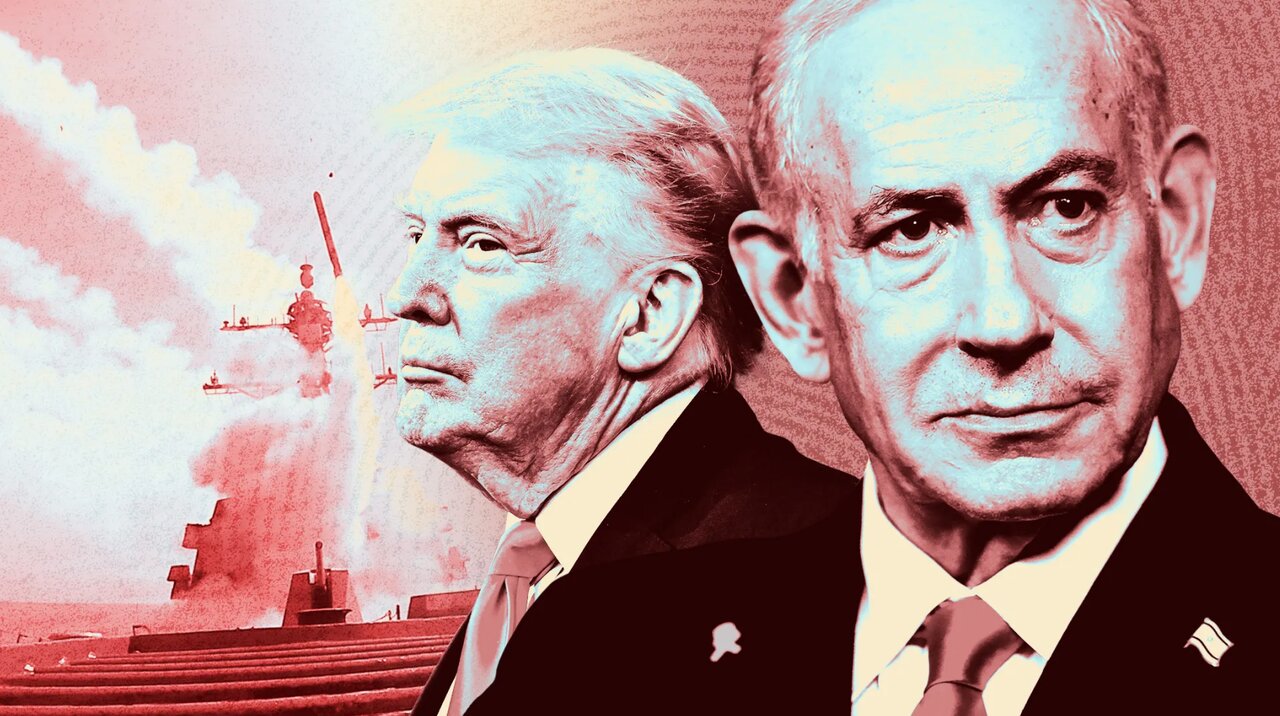
The recent developments in West Asia have once again shown that the rift between Donald Trump and Benjamin Netanyahu is not rooted in strategic disagreements or differing views on Iran, but rather stems from the different requirements of their political survival. Both share one thing in common: both are politicians who have tied their political fate to regional crises. But the difference is this: Netanyahu needs the continuation of war to sustain his political life, while Trump needs the end of war to preserve his political position.
The recent Axios report on the intensive contacts between the US president and the Israeli prime minister presents an unprecedented picture of this rift. According to the report, following the reciprocal missile strikes between Iran and Israel, Trump was deeply concerned that the region was moving toward an all-out war, a war that would ultimately force the US into direct involvement. For this reason, in multiple contacts with Netanyahu, he tried to contain the scope of the conflict and prevent the implementation of Israel’s most extensive military plans against Iran.
At first glance, this behavior might be interpreted as a sign of strategic disagreement between Washington and Tel Aviv, but the reality is more complex than that. Trump and Netanyahu have little disagreement over their overarching goals. Both seek to contain Iran’s regional power, both support the policy of pressure against the Axis of Resistance, and both have repeatedly spoken in recent years of close security and military cooperation. What has created distance between them today is not a difference in goals but a difference in political priorities.
Trump entered the White House after his return with the slogan of ending America’s endless wars. He has repeatedly emphasized that his administration does not intend to commit American forces to new wars in the Middle East. A significant part of Trump’s social base supports this approach. Many Republican voters believe that decades of US military intervention in the region have not only brought no benefit to Washington but have also drained the country’s economic and military resources.
Contrary to these slogans, however, Trump did go to war with Iran and suffered a major defeat. But beyond that, US entry into a broader war with Iran could deal a serious blow to Trump’s most important political promise. He knows well that any new conflict with Iran could lead to rising energy prices, the spread of regional insecurity, reciprocal attacks on US forces, and ultimately Washington becoming trapped in a prolonged crisis. Such a scenario would not only bring no benefit to Trump but could severely erode his political capital.
In contrast, Netanyahu’s situation is completely different. The Israeli prime minister has faced a series of domestic and political crises in recent years. Widespread domestic protests, deep social rifts, legal cases, and security failures have shaken his position more than ever. In such circumstances, war has become a tool for maintaining political cohesion and preventing public attention from focusing on domestic problems.
Netanyahu knows well that the end of security crises could once again turn attention toward domestic challenges. For this reason, many analysts believe that the continuation of a war atmosphere is a political necessity for him. War allows Netanyahu to present himself as a “security leader” and marginalize domestic opponents. Hence, any lasting ceasefire or de-escalation could carry high political costs for him.
This same reality gives meaning to the quote by a US official in the Axios report: that Netanyahu needs the continuation of war for his political survival, and Trump needs its end for his political survival. This statement may be the most precise description of the current state of relations between the two sides.
The important point is that the disagreement between Trump and Netanyahu should not be interpreted as a fundamental rift between the US and Israel. The experience of past decades has shown that the strategic relationship between Washington and Tel Aviv is far too deep to collapse over a disagreement between two individuals. What is being observed today is a tactical disagreement over the timing, level, and manner of crisis management.
In fact, Trump believes that pressure on Iran should be pursued within a controlled framework, one that does not drag the US into further war. But Netanyahu thinks that escalating military pressure could shift conditions in Israel’s favor. This difference in perspective has resulted in both sides ostensibly being on the same front, yet experiencing tension with each other over how to proceed along this path. Meanwhile, Iran’s reciprocal responses have also played a significant role in shaping this disagreement. Iran’s missile strikes showed that Tehran is prepared to respond directly to Israeli actions, and any escalation could quickly assume regional dimensions. This has complicated Trump’s calculations. The US president now faces the reality that unconditional support for Israeli actions could inadvertently lead Washington toward a broad war.
On the other hand, Netanyahu also faces new constraints. Whereas in the past he could count on full and automatic US support, he is now facing a president whose primary priority is preventing the continuation of war due to domestic deadlock. This very issue has caused the Israeli prime minister to encounter more obstacles in advancing his goals.
Ultimately, what is unfolding between Trump and Netanyahu today is not a struggle between war and peace, but a competition between two different projects for survival. Trump sees his survival in preventing the US from entering a new war, and Netanyahu seeks his survival in the continuation of an atmosphere where crisis and insecurity are the main agenda.
This conflict of interest will continue as long as the domestic political conditions of the two sides do not change. For this reason, even if a ceasefire or de-escalation is achieved in the short term, the roots of the disagreement will remain. The reality is that today, the most important rift between Washington and Tel Aviv is not over Iran, not over regional security, and not even over the future of the war; it is over the political future of two politicians, each of whom needs a different path to stay in power.
MNA