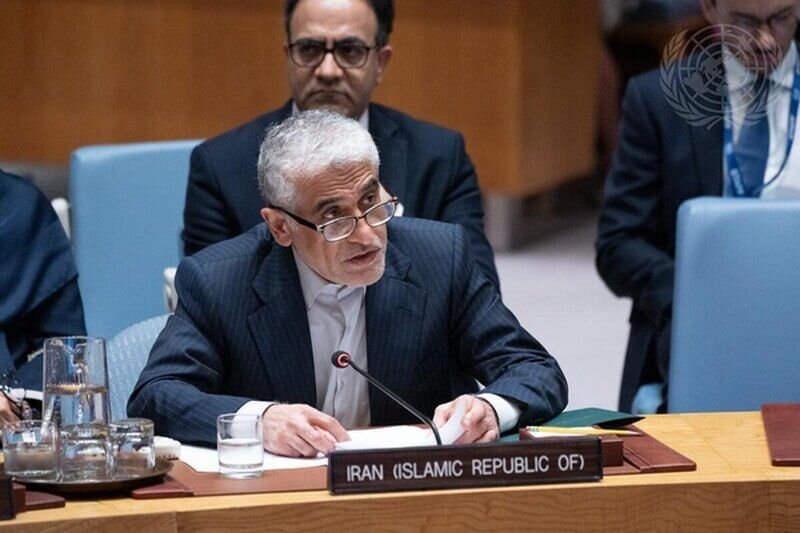
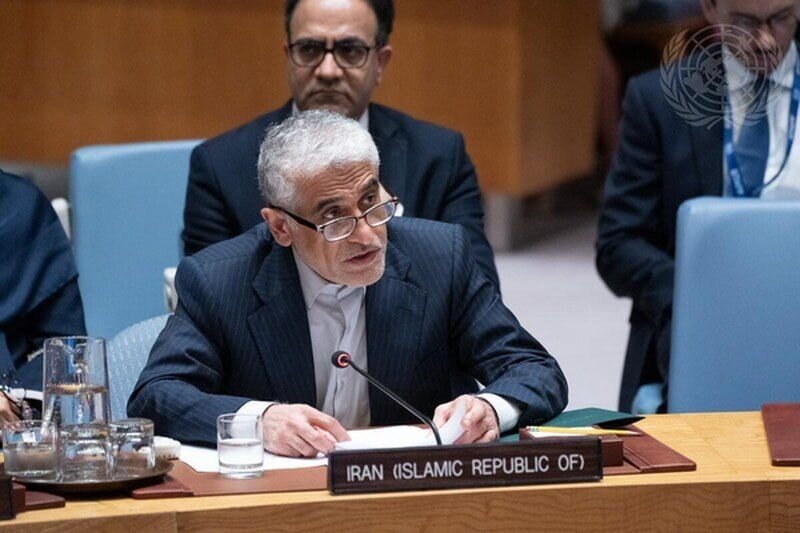
Addressing a United Nations Security Council briefing on the situation in Afghanistan, held in New York on June 8, Saeed Iravani outlined Tehran’s position on key humanitarian, security, and regional challenges facing Afghanistan and stressed the need for coordinated international and regional efforts to support peace, economic recovery, and long-term stability in the country.
What follows is the full text of his speech:
In the Name of God, the Most Compassionate, the Most Merciful
Madam President, thank you for convening this meeting.
At the outset, we congratulate Colombia on assuming the Presidency of the Security Council for this month. We also commend China for its effective leadership and successful Presidency of the Council during the month of May.
We thank Ms. Georgette Gagnon, Deputy Special Representative, and Ms. Edem Wosornu, Director, Crisis Response Division, (OCHA) for their insightful briefing.
We listened to the statement delivered by Ms. Metra Mehran.
We take note of the Secretary General’s latest report (S/2026/431). The report indicates that Afghanistan continues to face complex challenges, including a deteriorating humanitarian and economic situation, restrictions affecting women and girls, and the persistent threat posed by terrorist groups. At the same time, the report also notes certain areas of economic stabilization and efforts by the de facto authorities to maintain governance and advance economic activity, which deserve acknowledgment.
In this context, I wish to underline the following points:
First, we remain concerned by the worsening humanitarian and economic conditions in Afghanistan. According to report, an estimated 21.9 million people—approximately 45 per cent of the population—require humanitarian assistance in 2026. As of 30 April, the 2026 Afghanistan Humanitarian Needs Response Plan remained significantly underfunded at 14 per cent ($240.9 million of $1.7 billion required).
We reiterate our call on the international community and donors to provide increased, predictable, and flexible funding to sustain life-saving humanitarian operations. Efforts aimed at economic recovery should be supported, assets frozen should be released unconditionally and obstacles that hinder economic stabilization should be removed. Humanitarian assistance must remain impartial and free from politicization.
Second, continued international engagement with the de facto authorities remains indispensable for advancing stability and addressing Afghanistan’s challenges. The Secretary General’s report reaffirms the importance of the comprehensive approach of principled and pragmatic engagement. Constructive dialogue remains essential to address humanitarian, economic, counter-narcotics, and governance-related issues. In this regard, the Doha Process continues to provide an important platform for practical cooperation. Iran has actively participated in the Working Groups on Counter-Narcotics and the Private Sector under this Process and supports efforts aimed at enhancing regional and international cooperation.
We welcome the significant reduction in opium poppy cultivation in Afghanistan, which represents an important achievement with positive global implications. However, as highlighted in the report, the economic consequences for rural communities remain severe. Without sustained investment in alternative livelihoods, rural development, and access to markets, the improvements achieved may not be sustainable. We also note growing concerns regarding the expansion of synthetic drug production and trafficking, which require enhanced international cooperation.
Third, the continued deprivation of women and girls of their fundamental rights remains a matter of concern. Restrictions on education, employment, freedom of movement, and participation in public life not only undermine human dignity but also hinder Afghanistan’s long-term development and economic recovery. Such measures are incompatible with the true teachings of Islam. We call on the de facto authorities to remove these restrictions and to ensure that women and girls can enjoy their rights, including access to education and employment. Similarly, Afghanistan is an integral part of the region and Persian rich and ancient civilization, and it is essential that the rights, identity, and cultural heritage of all ethnic and national communities in Afghanistan be fully respected and protected.
We believe that international constructive engagement remains the most effective means to encourage and promote the protection of human rights, including the rights of women and ethnic and religious communities.
Fourth, the security situation in Afghanistan remains a source of serious concern. The threat posed by terrorist groups, including ISIL-K, continues to endanger Afghanistan and the wider region. Afghanistan must never become a safe haven for terrorism, nor should its territory be used to threaten or undermine the security of other States, particularly neighboring countries. We also express concern over the recent tensions between our two brotherly neighbors, Afghanistan and Pakistan, and welcome ongoing regional efforts aimed at promoting dialogue, confidence-building, and lasting stability between them. We echo the Secretary General’s call for restraint, de-escalation, and the peaceful resolution of differences through dialogue and diplomacy. We welcome regional mediation efforts and encourage parties to pursue sustainable arrangements that promote stability and good-neighborly relations.
Fifth, neighboring countries continue to bear a disproportionate share of the consequences arising from the situation in Afghanistan. Regional cooperation mechanisms and initiatives, like neighboring mechanism, Moscow Format and SCO Afghanistan Contact Group therefore remain indispensable for promoting sustainable peace, security, and development in Afghanistan. The Islamic Republic of Iran, sharing a long border with Afghanistan, has for more than four decades hosted millions of Afghan nationals and provided them with access to education, healthcare, and other essential services. This longstanding commitment reflects Iran’s continued dedication to supporting the Afghan people and contributing to stability and security in Afghanistan and the broader region. The international community must provide greater support to countries hosting Afghan refugees and migrants.
Finally, UNAMA continues to play a vital and indispensable role in supporting the Afghan people, facilitating dialogue, coordinating international assistance, and advancing a coherent international approach toward Afghanistan. In this context, the Special Representative plays a vital role in fostering constructive engagement with the de facto authorities. Iran supports the expeditious appointment of a qualified and suitable candidate, while taking into account the views and considerations of the Afghan authorities, so as to facilitate effective dialogue and cooperation.
We also reaffirm our support for the extension of UNAMA’s mandate and for its effective, impartial, and balanced implementation. In this regard, we appreciate the efforts of China, as penholder, in preparing and submitting the draft resolution to extend UNAMA’s mandate for an additional year, as well as its continued constructive engagement with other members of the Security Council throughout the negotiation process. Iran remains committed to close cooperation with the United Nations, neighboring countries, regional organizations, and all relevant stakeholders in pursuit of a stable, peaceful, and prosperous Afghanistan that is fully reintegrated into the international community.
I thank you.
MNA