If the juggernaut of SIR rolls on unchecked through Phase 3, it risks transforming the Indian electorate from a representation of the sovereign people into a curated list designed exclusively by and for those in power
Published Date – 8 June 2026, 10:36 PM
By Geetartha Pathak
The core promise of a democratic republic rests on a deceptively simple mathematical equation: one citizen, one vote. Yet, as the Election Commission of India (ECI) rolls out Phase 3 of its massive Special Intensive Revision (SIR) across 16 States and 3 Union Territories—targeting an electorate of 36.73 crore—that foundational equation is being radically disrupted.
What is presented by authorities as a clinical, software-driven “clean-up” of ghost voters and structural duplicates has mutated into a sweeping crisis of mass disenfranchisement. The numbers emerging from the first two phases are staggering.
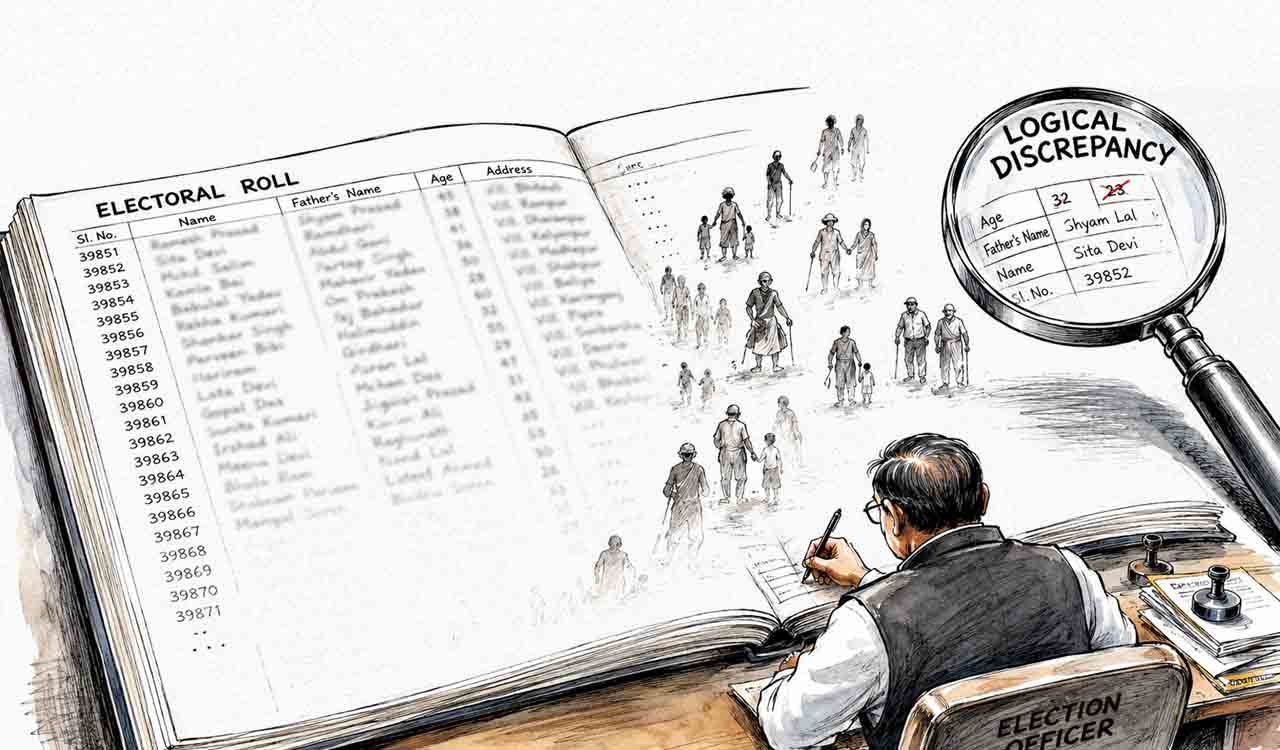
Rather than fine-tuning the rolls, the SIR has executed a blunt, staggering net trim of 10.2% of the electorate across covered States, reducing the voter base from 50.99 crore to 45.81 crore. In Uttar Pradesh, over 2.04 crore names were struck off; in West Bengal, the number stands at a massive 91 lakh voters deleted, leaving over 27 lakh citizens trapped in bureaucratic limbo under the label of “logical discrepancies.”
Defining Citizenship
This unprecedented scale of deletion raises existential questions about the definition of citizenship, the integrity of elections, and the weaponisation of administrative machinery.
The central paradox of the SIR lies in its sudden, unannounced premise: that Indian voter lists are suddenly bloated with millions of “non-citizens,” deceased entities, or fraudulent entries. For generations, families in States like Bihar, West Bengal, and Assam have lived, worked, paid taxes, and exercised their franchise using state-issued identity documents.
To suddenly cast doubt on their legitimacy is to flip constitutional jurisprudence on its head. Legally, the foundation of a democracy assumes a resident’s inclusion on the electoral roll is an acknowledgement of their civil standing. The SIR, however, asks an impossible question: Is citizenship the basis for inclusion in the electoral roll, or is inclusion in the roll the basis of citizenship?
By utilising automated algorithms that flag “logical discrepancies”—such as families with more than five siblings or parents whose recorded ages fall below a technical threshold (common anomalies in older, handwritten legacy records)—the ECI’s software has treated historical data-entry errors as proof of fraud. Consequently, genuine citizens have had their names struck off not because they lack citizenship, but because they cannot navigate a complex, centrally managed bureaucratic maze.
SIR asks an impossible question: Is citizenship the basis for inclusion in the electoral roll, or is inclusion in the roll the basis of citizenship?
Reversal of Onus
Section 21(3) of the Representation of the People Act, 1950, grants the ECI discretionary powers to revise rolls. However, the current iteration of the SIR fundamentally shifts the burden of proof. Instead of state officials verifying and proving an individual’s ineligibility, the onus has been placed entirely on the individual elector to prove they exist and deserve to remain on the roll.
In an ideal framework of state sovereignty, if a government genuinely suspects massive influxes of undocumented foreign nationals, the legal and constitutional recourse is clear:
- Verify identities through judicial or quasi-judicial Tribunals.
- Enforce the Foreigners Act.
- Initiate formal legal procedures for detection, followed by diplomatic channels for deportation.
Instead, contemporary administrative practices show a complete inversion of this logic. Rather than conducting rigorous, transparent judicial reviews, the state has initiated a “voter list purge” from the opposite side. In States like Assam, political rhetoric often bypasses the rule of law entirely, relying on aggressive, unilateral actions—such as pushing suspected individuals across borders under the cover of night—rather than institutional verification.
By avoiding formal tribunals and relying on the SIR to quietly drop names from the voter list, the state achieves political neutralisation without the legal accountability of proving a lack of citizenship. This has catastrophic real-world consequences.
In West Bengal and Bihar, newly elected or incumbent administrations have already begun linking social welfare eligibility directly to the updated electoral rolls. Those deleted during the SIR are being systematically barred from receiving basic rations and state welfare benefits, effectively reducing genuine but disenfranchised citizens to a status of civic non-existence.
The alignment of the SIR with upcoming elections strongly suggests an exercise in bureaucratic gerrymandering—the strategic alteration of the voter demographic to guarantee a specific outcome for the ruling classes. While traditional gerrymandering involves redrawing physical constituency boundaries, “voter-list gerrymandering” achieves the same result by surgically removing specific voting blocks.
Data from Phase 2 indicates that these deletions are far from random. In West Bengal and Bihar, constituency-level data reveal that deletions are heavily concentrated in minority-dominated and marginalised migrant regions. In specific border districts of West Bengal, such as Murshidabad and Malda, a disproportionate majority of the unresolved “logical discrepancy” cases belong to marginalised communities.
This strategy is not unique to India; it finds clear parallels in global electoral manipulation:
- The United States (Voter Purges): In States like Georgia and Ohio, aggressive “voter maintenance” laws have been used to purge millions of voters from the rolls for minor clerical mismatches or for not voting in consecutive elections. Studies have demonstrated that these automated purges disproportionately target Black, Hispanic, and low-income voters, effectively altering the outcome of close State elections.
- Malaysia (Malapportionment and Roll Manipulation): Prior to the 2018 electoral shift, the ruling coalition frequently faced allegations of moving thousands of voters across constituency lines without their explicit consent or deleting voters in opposition strongholds to dilute their voting power.
When an independent electoral body relies on centralised software managed from New Delhi rather than empowering local Electoral Registration Officers (EROs) on the ground, the democratic fabric is severely compromised. Conducting booth rationalisation in parallel with enumeration—rather than after it—effectively hides the true scale of these deletions, leaving civil society and political parties blind until the final drafts are published.
The democratic slide cannot be arrested by managerial supervision alone. While the Supreme Court of India has directed the acceptance of alternative identity documents, it has bypassed the core constitutional crisis: the unilateral shifting of the burden of proof onto the citizen.
To prevent Phase 3 of the SIR from turning into a permanent instrument of state-sponsored voter suppression, a fundamental recalibration is required:
- Prioritise universal adult franchise: The ECI must return to its primary mandate: ensuring every adult citizen of voting age is included on the list. The presence of clerical errors or legacy data gaps should trigger an official-led assistance drive, not an automated deletion notice.
- Decentralise and humanise verification: Reliance on flawed algorithms must be replaced with field-level, transparent verification by empowered local authorities. Deletion notices must carry explicit, written explanations, providing a mandatory 60-day window for physical appeals before any name is struck.
- Sequence revision correctly: If the state wishes to audit citizenship, it must do so through transparent, uniform legal processes applicable to all residents equally. Purging the voter list as a shortcut to alter political demographics strikes at the very heart of democratic legitimacy.
If the juggernaut of the SIR rolls on unchecked through Phase 3, it risks transforming the Indian electorate from a representation of the sovereign people into a curated list designed exclusively by and for those in power.
(The author is a senior journalist from Assam)