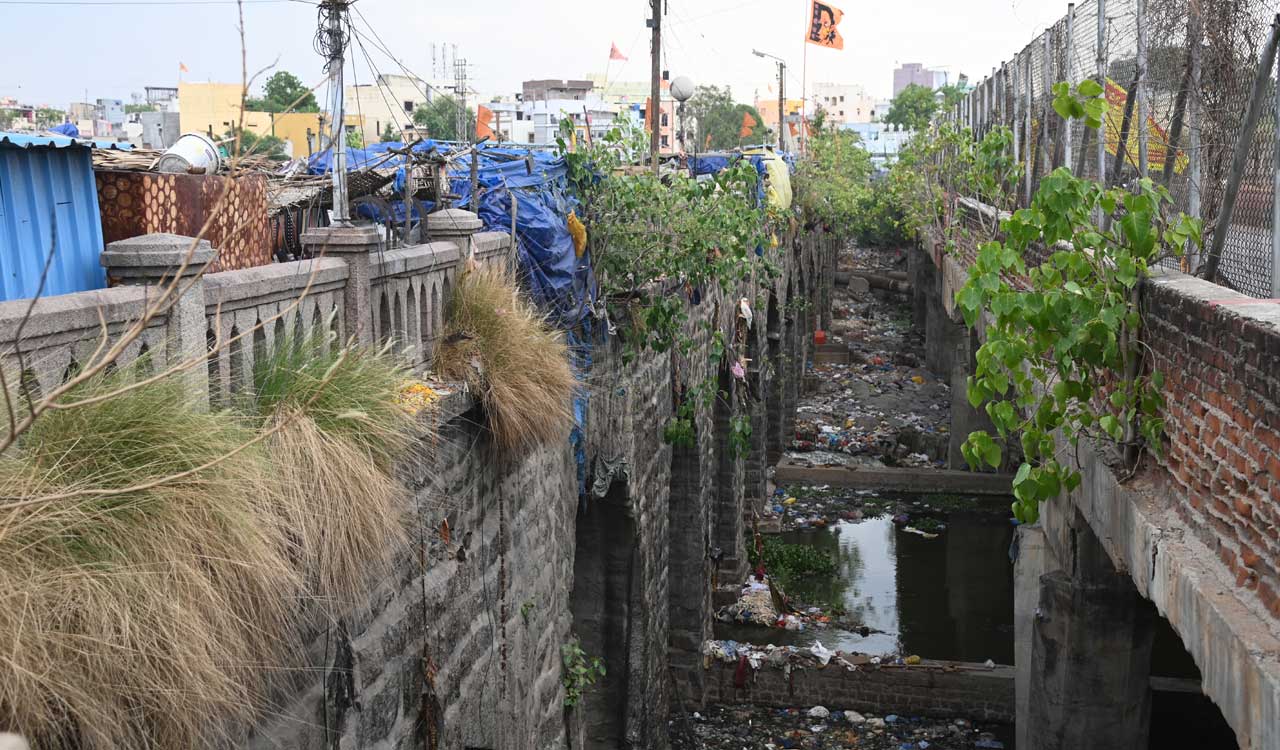
Hyderabad’s historic Puranapul Bridge, built in 1578, is showing signs of deterioration with broken railings, vegetation growth and structural damage. Residents and historians say the bridge has suffered decades of neglect and requires urgent restoration to preserve its heritage value
Published Date – 5 June 2026, 05:12 PM
Hyderabad: Tree branches protruding from the structure, broken railings and holes in the pillars – the Ibrahim Bridge, popularly known as the Puranapul Bridge in the Old City, cries out for attention.
The first bridge of the city, the Puranapul, built in 1578 over the Musi River, awaits a full-fledged restoration. It was built during the Qutb Shahi era over the Musi and is 600 feet long and 54 feet above the river bed, with 22 arches. It is the only bridge in Hyderabad to have escaped destruction in the 1908 floods.
Neglected by the authorities for decades, the bridge presents a sordid state of affairs and has become a market, with scores of vendors selling fruits and vegetables from dawn till dusk. It remains closed to traffic after engineers considered it unsafe for vehicular movement.

Mohd Habeebuddin, a local social worker, pointed out that the bridge is getting damaged day by day due to neglect, and added, “The wild vegetative growth on the bridge has not been cleared for a long time. It is uprooting the railing and the granite on the centuries-old bridge. If left unattended, it could collapse soon.”
The last time the authorities cleared encroachments from the bridge was in 2002. Considering its historic significance, the authorities planned to transform it into a tourist spot and, when N Chandrababu Naidu was the Chief Minister of unified Andhra Pradesh, the bridge was renamed ‘Pyarana Pul’ and spruced up. A photo session was arranged and a few couples were made to walk on the bridge.
The officials planned to renovate the bridge, clear encroachments, re-carpet the road and make seating arrangements alongside an exclusive hawker zone and walking track.
“Engineering experts inspected the bridge on different occasions and made plans for its renovation. Nothing much happened except the cleaning of vegetation,” said Mohd Safiullah, a historian.
There are many legends surrounding the events that led to the construction of the bridge. A few historians claim that the Puranapul was built by Ibrahim Quli Qutb Shah (1518-1580) after his son Muhammad Quli Qutb Shah (1565-1612) crossed the Musi River in turbulent conditions to meet his lady love Bhagmati. However, there have also been historians who ruled out the very existence of Bhagmati.
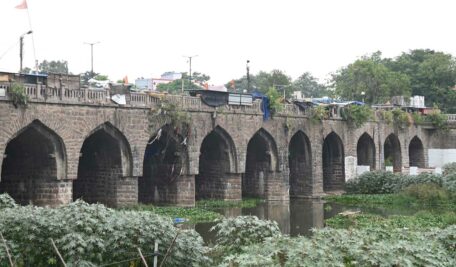
Prof. Benjamin B Cohen, Department of History, University of Utah, in his works wrote about Puranapul of Hyderabad: “In the late sixteenth century, the Sultan of Golconda (India) faced a problem. Within the Golconda fort complex, the population boomed as the air and water quality plummeted. Perched atop a rocky outcropping, Golconda lay on the north bank of the Musi River while across it and a few kilometres to the east was an open, flat space. To facilitate transport and mobility across the river between the fort and the south bank, and in preparation for establishing a new capital city (Hyderabad) at the open space, Ibrahim Quli Qutb Shah constructed the first bridge across the Musi River.”