Decisions on highly hazardous pesticides must be guided by science, public health and the precautionary principle, not commercial interests
Published Date – 2 June 2026, 07:53 PM
By Dr Kattamreddy Ananth Rupesh
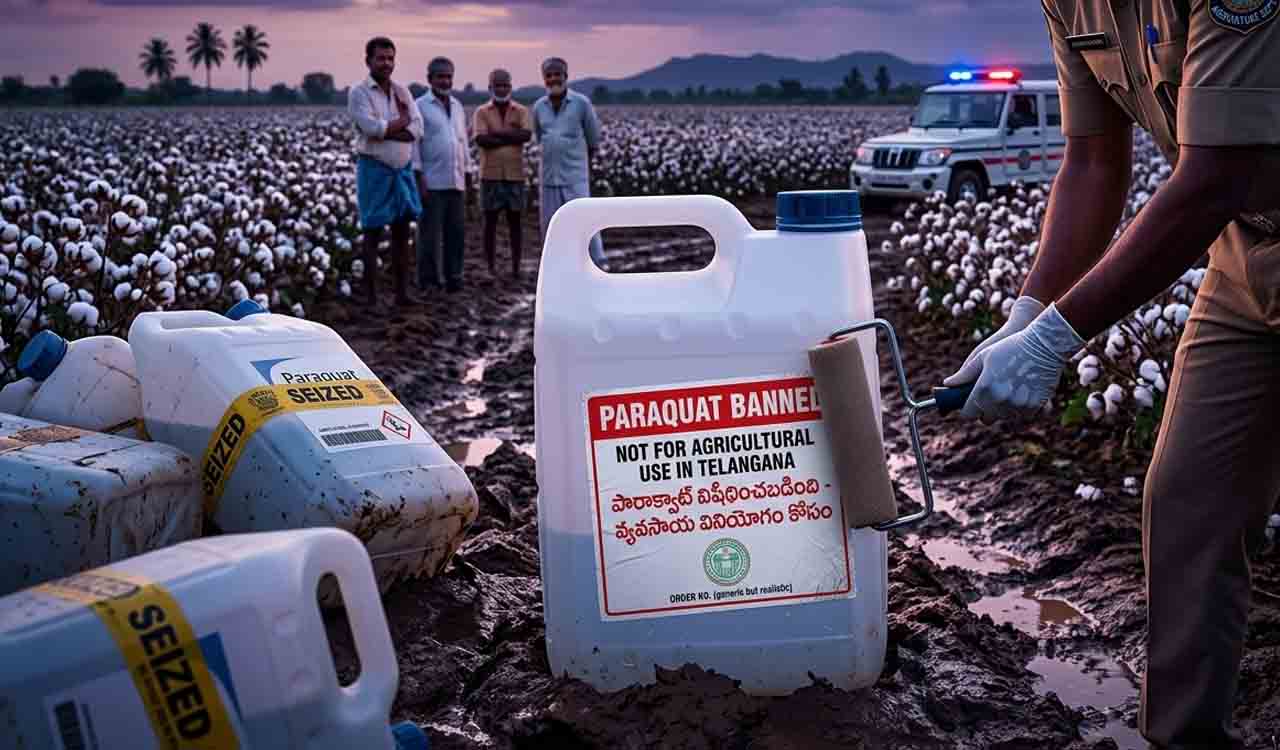
As the 60-day prohibition on lethal herbicide ‘Paraquat Dichloride 24% SL’ imposed by the Government of Telangana approaches its expiry, the State faces an important public health decision. Rather than allowing the restriction to lapse, the government should extend it under Section 27 of the Insecticides Act for an additional 30 days and continue the prohibition pending a comprehensive and independent risk assessment.
Telangana’s action on paraquat was the culmination of an extraordinary public campaign that united farmers, doctors, public health experts, civil society organisations, media and political leaders across party lines.
In a rare display of political consensus, the Telangana Legislative Assembly unanimously adopted a resolution urging the Union government to impose a nationwide ban on paraquat. Few pesticide-related issues in recent years have mobilised such a broad coalition of stakeholders or generated such widespread agreement on the need for decisive regulatory action.
Toxic herbicide
The concern is straightforward. Paraquat is among the most acutely toxic herbicides still in use. Even small quantities can be fatal, and there is no specific antidote. Hospitals in several parts of the country have reported multiple cases of severe poisoning, often with fatal outcomes. Its ready availability has also made it a frequent agent in self-harm cases. Beyond acute poisoning, a growing body of scientific evidence has linked occupational exposure to an increased risk of Parkinson’s disease, prompting many countries to prohibit or severely restrict its use.
Telangana’s initiative has already had a positive impact on Andhra Pradesh, which has issued a similar prohibition order. Together, the Telugu-speaking States have demonstrated leadership in addressing the risks posed by highly hazardous pesticides. Their actions should encourage a broader national conversation on the continued use of chemicals that carry unacceptable human costs.
Coincidentally, the Union government has constituted an expert committee to review the regulatory status of paraquat and carbosulfan, but its report is still awaited. It is, therefore, premature for industry groups to focus on projected economic losses or agronomic challenges before the scientific assessment has been completed. The committee’s findings should be allowed to guide policy, with public health and safety taking precedence over commercial considerations.
Effective implementation
While extending the ban remains the immediate priority, the government must also ensure its effective implementation. Particular attention should be paid to border districts, where paraquat could continue to enter Telangana and Andhra Pradesh from neighbouring States that have not imposed similar restrictions. Preventing such leakages will require close inter-state coordination, regular surveillance and strict monitoring of supply chains.
A key weakness in the current prohibition framework is that enforcement and surveillance rest largely with the Department of Agriculture and its field machinery. Given the grave public health risks associated with paraquat, the government should explicitly empower the police to take cognisance of violations and act in coordination with agricultural authorities against those selling, stocking or distributing the prohibited product. Without such support, enforcement may remain uneven, particularly in border districts and informal markets where regulatory oversight is often limited.
Generating evidence
The prohibition period also offers a valuable opportunity to generate evidence. The government should systematically analyse poisoning cases, hospital admissions and mortality data before and during the ban to assess its public health impact. Simultaneously, an expert committee comprising toxicologists, neurologists, intensivists, epidemiologists and agricultural scientists should conduct a transparent review of paraquat’s risks and available alternatives.
The government must also remain vigilant against efforts by the agrochemical lobby to dilute or reverse the prohibition. Regulatory decisions on highly hazardous pesticides should be based on independent scientific evidence, public health considerations and the precautionary principle, not on commercial interests seeking to preserve market access for a product under serious safety scrutiny.
Telangana has already taken a courageous first step. It must not retreat now. The temporary prohibition should be extended, the scientific inquiry strengthened, and the path towards a permanent ban pursued with determination. The Centre, in turn, should heed Telangana’s example and initiate a nationwide review leading to the phase-out of paraquat and other highly hazardous pesticides.
Human lives are worth more than a weed killer.

(The author is Associate Professor of Forensic Medicine and Toxicology, Siddhartha Medical College Vijayawada)