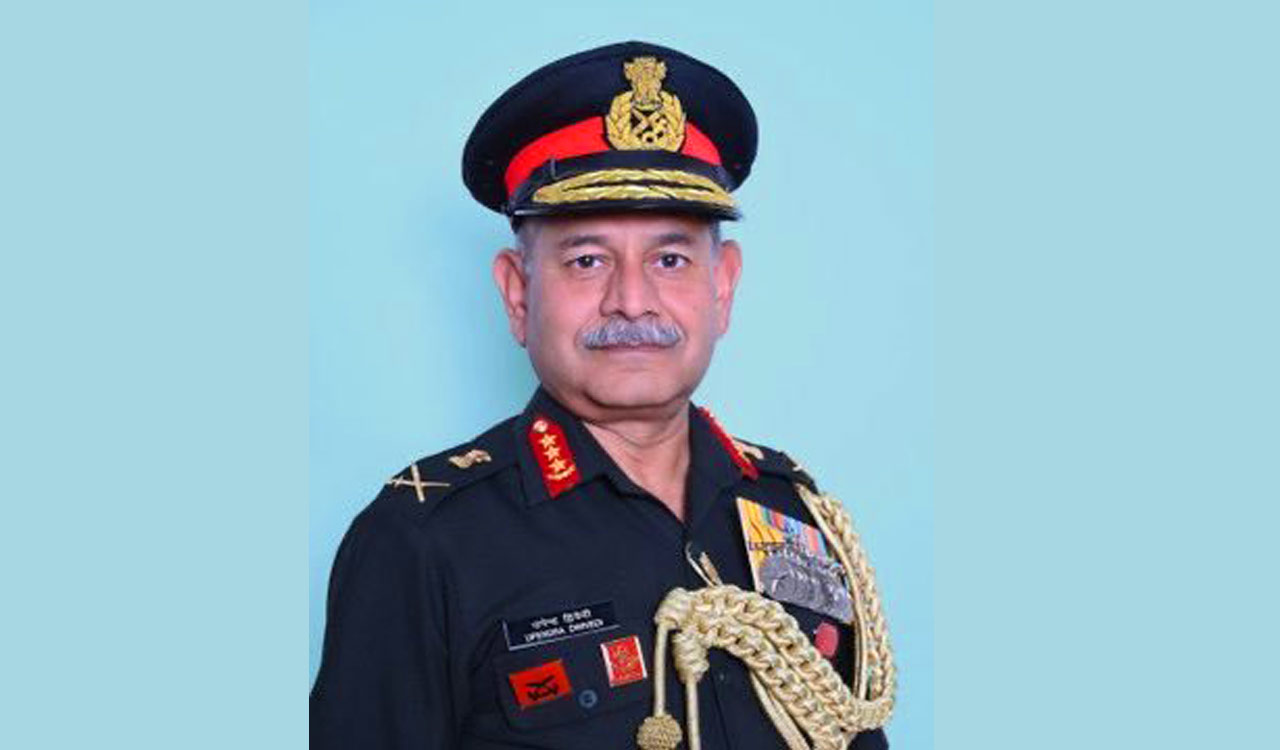
Army Chief General Upendra Dwivedi said the armed forces are fully prepared for Operation Sindoor 2.0 if required. He highlighted lessons from modern warfare, stressed the importance of military theatreisation, and underlined the growing role of technology, drones and information warfare
Published Date – 30 May 2026, 08:54 PM
Pune: The armed forces are fully prepared for ‘Operation Sindoor 2.0′ if the need arises, Chief of Army Staff General Upendra Dwivedi said on Saturday, asserting that all three services are enhancing synergy for modern multi-domain warfare that extends beyond land, air and sea.
Speaking at a press conference on the sidelines of the passing-out parade of the 150th course of the National Defence Academy (NDA) here, General Dwivedi noted that while a temporary cessation of hostilities currently exists, all three services are preparing intensely for the next phase should it arise.
India launched Operation Sindoor, a military operation to destroy terror infrastructure in Pakistan in May 2025, in response to the Pahalgam terror attack, which claimed 26 lives in April.
“As far as Operation Sindoor is concerned, firstly, it is still continuing. There is a temporary cessation of hostilities. So the Indian Army and all three services are preparing well for Operation Sindoor 2.0 if it takes place,” he said.
He noted that future warfare will not be limited to land, maritime and air domains alone, but would be increasingly influenced by emerging domains such as space, cyber and cognitive warfare.
Modern battlefields have become highly transparent, General Dwivedi said, adding that military planners must remain cautious about deployments and force protection measures.
“What we have seen over a period of time is 24/7 transparency. The battlefield is so transparent that every movement is known to the other side. Therefore, we have to be very cautious in terms of our deployment, in terms of our employment, and the protection required for our troops as well as civilians in the border areas,” he said.
Referring to information warfare lessons from Operation Sindoor, General Dwivedi said public trust and national cohesion would remain decisive factors in future conflicts.
“Victory is always in the mind. It’s not on the ground. Therefore, information warfare is only successful if the whole nation comes together and trusts the people who are giving the information,” he said.
“If that happens, I can assure you that a nation whose people trust one another and all stakeholders will always win the war,” the Army Chief added.
He said that Operation Sindoor demonstrated India’s resolve and the armed forces’ ability to deliver a calibrated, precise and purposeful response.
“This operation underlined the importance of integrated planning, real-time intelligence, precision targeting, strong air defence, secure communications and synergy across domains,” the Army chief said.
He said the Indian Army is fully conscious of the need for modernisation and transformation.
“We are transforming ourselves into a future-ready force under the ‘Decade of Transformation’, wherein the role of the younger generation will be pivotal,” he added.
He noted that the raising of industry drone battalions, Divyastra batteries, Shaktiman regiments, Bhairav battalions and other technology-enabled structures from within existing resources is part of this transformation.
The general said the next major step is networking and data-centricity, where data becomes a strategic resource and decision-making becomes faster, smarter and more resilient.
Talking about the use of drones and other indigenous weapons, General Dwivedi said that since taking over, he has been advocating the concept of an “Eagle on the Arm”.
“This means every soldier should have an ‘eagle’ in their hand. Every soldier should have the capability to fly a drone. You have seen that in our academies and other places, training for this is ongoing and simulators are available,” he said.
He further said that the long-awaited military theatreisation process is on the “right track”, with deliberations within the Chiefs of Staff Committee completed and a report submitted to Defence Minister Rajnath Singh for review.
All major concerns and interests of the three services have been accommodated in the proposed structure, he said.
General Dwivedi said service chiefs would continue to be responsible for “raise, train and sustain”, while theatre commanders would be tasked with the operational orchestration of forces.
“We are hopeful that the next setup which is coming under the new CDS will be able to take the journey forward and in the next two to three years, we should be able to see it happening on the ground,” he said.
Earlier in the day, General Dwivedi reviewed the passing-out parade of the 150th course at NDA, Khadakwasla, where he said that Operation Sindoor had set a benchmark for when national will was expressed with precision and resolve, defining India’s response to provocation.
“From contested grey zones to high-velocity hybrid warfare, today’s security environment demands that those who serve must think sharply as they act,” he said.
“Operation Sindoor demonstrated that and set the benchmark when national will was expressed with precision and resolve, defining how Bharat responds to provocation. That standard now belongs to you to uphold,” the Army Chief said.
Calling the occasion “a poignant and particularly personal moment”, General Dwivedi recalled passing out from the same quarterdeck over 42 years ago.
“Today, as I stand before you at the far end of a life in uniform, preparing to doff mine as you prepare to don yours, I can tell you with certainty: what you begin here endures forever,” he said.