As courts become sites of political contestation, and citizens begin viewing judgments through partisan lenses, every order becomes suspect, and public trust erodes
Published Date – 26 May 2026, 09:57 PM
By Shashank Shekhar and Snigdha Kuriyal
In every courtroom hangs an invisible promise: justice will not only be done, it will also appear to be done. The phrase is old, almost clichéd in legal circles, but democracies survive on such clichés. The public may not understand every procedural nuance, but they instinctively understand fairness. And once fairness begins to look selective, institutions begin to look political.
That is why the recent controversy surrounding the recusal plea against Justice Swarana Kanta Sharma in the Delhi excise policy case deserves a larger public conversation, not about personalities, but about power, perception, and the uneasy architecture of judicial accountability.
The Allegation
Former Delhi Chief Minister Arvind Kejriwal’s plea seeking Justice Sharma’s recusal was not based on allegations of corruption or personal dishonesty. It rested on the doctrine of “reasonable apprehension of bias.” The argument was that certain surrounding circumstances — prior observations, perceived institutional proximity, and the professional association of the judge’s children with the Union government’s legal machinery — could create a perception that impartiality may reasonably be questioned.
This distinction is important because bias in law is not always about proven prejudice. Courts across common law systems have long recognised that bias can be institutional, structural, subconscious, or even perceptual. A judge need not actually be unfair; the question is whether a reasonable person could reasonably fear unfairness.
Two Legal Tests of Bias
Indian jurisprudence has historically oscillated between two standards. The first is the “real likelihood” test, which asks whether bias is likely to exist in reality. The second is the “reasonable apprehension” test, which asks whether an informed observer could reasonably suspect bias. Over time, Indian courts have leaned more toward the second standard because justice in a constitutional democracy is not merely about legal correctness. It is equally about public confidence. Courts derive legitimacy not from force, but from trust.
Strange Paradox of Recusal
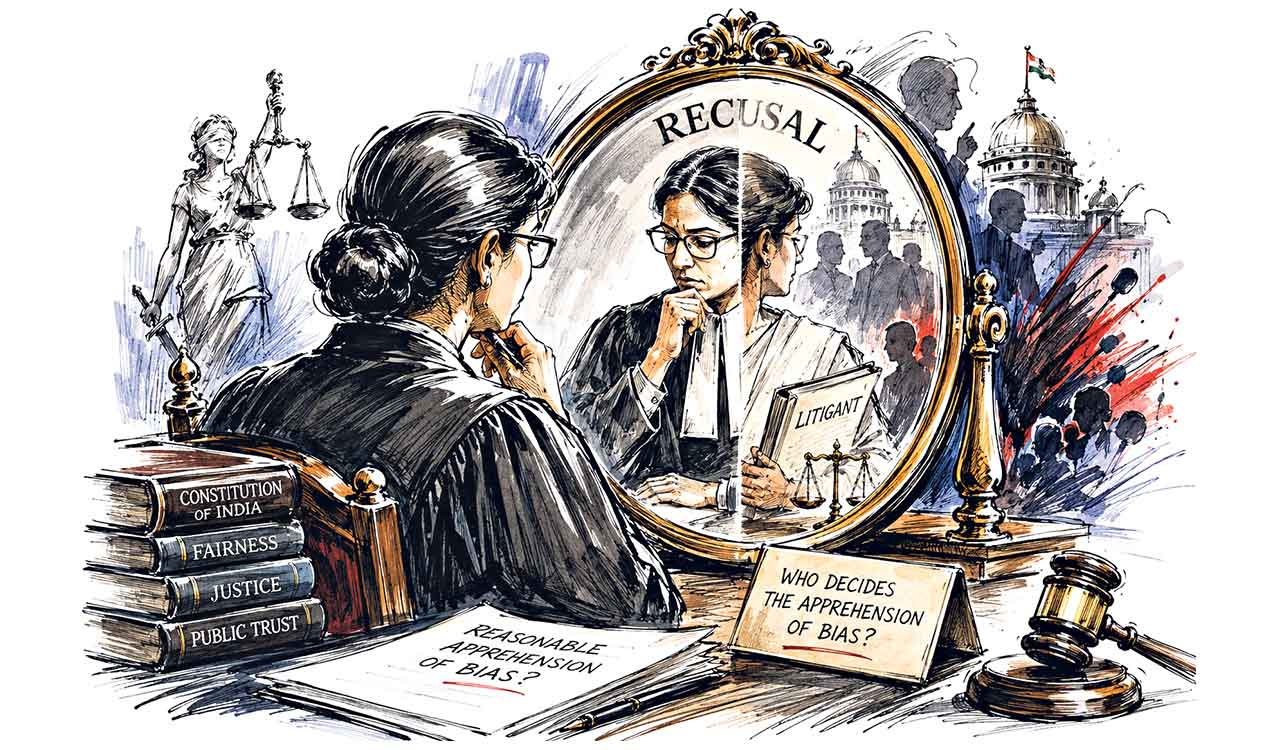
But here lies the constitutional paradox. Who decides whether the apprehension of bias is reasonable? The judge herself.
In most legal situations, nobody is permitted to become a judge in their own cause. Yet in recusal matters, the very person against whom apprehension is expressed determines whether that apprehension deserves acceptance. Legally, this arrangement is defended as necessary. If litigants could force recusals merely by alleging bias, judges would become vulnerable to “bench hunting.” Powerful parties could strategically avoid judges they consider inconvenient.
This concern is real. But the opposite danger is equally serious: when judges alone become the final arbiters of allegations concerning themselves, the institution can begin to appear insulated rather than accountable.
Can Justice Also Appear Fair?
Justice Sharma reportedly observed while rejecting the plea that courts cannot yield to “imaginary apprehensions”, and that recusal cannot become an “easy path.” Institutionally, that reasoning carries weight. Courts cannot appear weak before political pressure campaigns. Yet constitutional morality demands another question: what if the issue is not actual bias, but institutional confidence?
The problem with India’s recusal jurisprudence is the absence of transparent standards. There is no codified mechanism, no independent review, no neutral committee, and no clearly articulated threshold. Everything ultimately depends on individual judicial discretion. This creates inconsistency.
In some cases, judges recuse themselves merely because they know a party socially. In others, judges continue despite repeated allegations of institutional proximity. Sometimes recusals happen without explanation. Sometimes, lengthy orders are written defending why recusal is unnecessary. Both extremes create suspicion.
Public Perception Matters
And suspicion is dangerous for courts. The judiciary possesses neither the sword nor the purse. Its authority rests entirely on legitimacy. Once citizens begin to believe that outcomes are shaped by ideological alignment, institutional trust erodes slowly but deeply.
This becomes even more sensitive in politically charged prosecutions where the state itself is the prosecuting party. In such matters, neutrality must not merely exist; it must be visible from a distance.
This is precisely why the Kejriwal matter acquired wider resonance. Supporters viewed the refusal to recuse as institutional rigidity. Critics viewed the recusal plea itself as political theatre aimed at intimidating the judiciary. Social media amplified both extremes, transforming a constitutional question into partisan warfare.
The Timing Question
Then came the most dramatic development. Nearly 25 days after rejecting the recusal plea, contempt proceedings were initiated over allegedly “vilifying” social media content concerning the judge and the proceedings. Soon after, Justice Sharma recused herself from hearing the substantive excise matter.
This sequence naturally raises uncomfortable questions. If recusal was unnecessary on April 20, what changed by mid-May? Was the recusal prompted by the contempt controversy itself? If so, does that indirectly acknowledge that the atmosphere surrounding the proceedings had become institutionally untenable? And if the atmosphere had indeed become so charged, should recusal have occurred earlier to preserve confidence?
These are not allegations. They are constitutional questions. Timing matters in law because timing shapes perception.
Contempt, Constitutional Anxiety
Equally troubling is the broader concern surrounding contempt powers. Indian courts possess sweeping contempt jurisdiction designed to protect the dignity of the judiciary. But dignity cannot become indistinguishable from insulation against criticism. Democracies require a careful balance between protecting judicial authority and preserving public scrutiny.
If every sharp allegation against a judge risks contempt consequences, litigants may begin to fear openly expressing apprehensions regarding fairness. Yet if reckless allegations are normalised, judicial independence itself suffers. The line is extraordinarily thin.
Is India Ready for Reform?
And perhaps that is precisely why recusal matters should not depend solely upon personal judicial determination. India may now need a more structured framework — perhaps an independent in-house recusal review mechanism for constitutionally sensitive matters, especially where allegations concern institutional conflict rather than personal misconduct.
Such a reform would protect judges as much as litigants. Because recusal is not necessarily an admission of guilt. Often, it is an act of institutional wisdom.
The finest judges across democracies have occasionally stepped aside not because they accepted allegations against themselves, but because they understood that public confidence is fragile. Sometimes institutions preserve strength not by asserting authority, but by demonstrating restraint.
Larger Constitutional Danger
The real danger today is not whether one judge heard or did not hear one particular case. The danger is the growing public perception that courts themselves are becoming sites of political contestation. Once citizens begin viewing judgments through partisan lenses, every order becomes suspect, every refusal appears ideological, and every conviction or acquittal becomes tribal ammunition.
Courts cannot afford that future. The judiciary remains the last institution where even the weakest citizen can still hope to stand equal before power. But equality before law survives only when courts appear visibly detached from political currents. That is why the debate triggered by the Kejriwal recusal controversy should not be dismissed as mere courtroom drama. It goes to the very heart of constitutional democracy: Who watches power when power itself wears robes?

(The authors are Assistant Professors of Law, Lloyd Law College, Greater Noida)